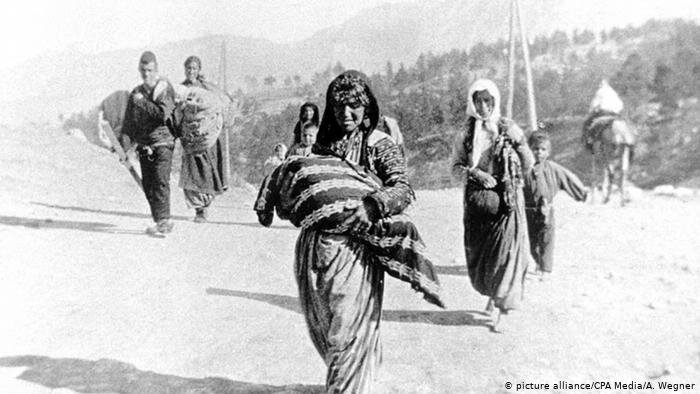

Israel’s government on Sunday voted unanimously to officially recognize the Armenian Genocide for the first time, approving a resolution that formally acknowledges the mass killings of 1.5 million Armenians during the final years of the Ottoman Empire and condemns all attempts to deny, minimize or distort the historical truth. The measure now heads to the Knesset for a vote.
The resolution was brought by Foreign Minister Gideon Sa’ar, who first announced the move days earlier. “It’s never too late to do the right thing,” Sa’ar said after the vote, adding that Israel joins the countries that have fulfilled a moral duty by recognizing the historical truth and rejecting attempts to deny it. In a Hebrew-language video statement, he called the recognition a Jewish moral imperative: “This horrifying genocide, which took place over 100 years ago, and whose facts are not really up for debate, included the murder of 1.5 million people and the destruction of an ancient and historic cultural heritage. In my view, it’s our moral imperative as Jews, and certainly as the state of the Jewish nation, to make the decision that we made today.”
Prime Minister Benjamin Netanyahu, who in August 2025 became the first Israeli premier to personally state that he recognized the genocide, fully backed the resolution. Asked whether he had any concern about Turkey’s reaction, Netanyahu said he had never made any effort to block this or past proposals and stated simply, “I certainly support it.”
The explanatory text accompanying the resolution states that despite extensive and unequivocal historical documentation, the Armenian Genocide remains the target of an organized campaign of denial and minimization, including the manipulative rewriting of history books, primarily by Turkey. The notes recount that the genocide began in April 1915 with the arrest, deportation and killing of hundreds of Armenian intellectuals, leaders and educated figures in Constantinople, today’s Istanbul. Spearheaded by the Ottoman Empire’s Committee of Union and Progress, the government then turned to the systematic extermination of the Armenian population. The resolution observes that 32 countries, including the United States, Canada, Russia and Germany, along with the Holy See and the European Parliament, have recognized the Armenian Genocide in various forms.
The recognition marked a sharp break with Israel’s long-standing position. For decades Jerusalem refrained from recognizing the World War I atrocities as genocide over fears it would damage relations with Ankara. That calculus shifted as ties deteriorated under Turkish President Recep Tayyip Erdogan, who has repeatedly accused Israel of genocide in Gaza and compared its conduct to Nazi Germany. Turkey, the Ottoman Empire’s successor state, continues to reject the charge that the massacres, imprisonment and forced deportation of Armenians amounted to genocide, and as of this report had issued no immediate reaction to the vote. The move also came days after US President Donald Trump praised Erdogan as his friend for staying “out of the war with Iran” and said there would be no confrontation between Israel and Turkey.
Even as Israel positioned itself as a recognizer of historical genocide, it faces accusations of committing one now. The United Nations, rights organizations, genocide scholars, and South Africa’s case before the International Court of Justice have charged Israel with genocide in Gaza, where the Hamas-run Health Ministry reports more than 73,000 people killed, roughly half of them women and children. Erdogan, the very leader whose denial campaign the resolution sets out to condemn, has leveled the same accusation. Israel fiercely denies the charge.
While the issue had surfaced in Israel before, it had never been adopted as an official government position until now. On August 1, 2016, the Knesset’s Education, Culture and Sports Committee recognized the genocide and called on the government to follow suit, but committee statements carried no binding force. In May 2018, amid worsening Israel-Turkey ties, the Knesset plenum approved a discussion and vote on similar recognition, yet no resolution was ever passed.
In August 2025, Netanyahu said on the PBD Podcast with Patrick Bet-David, who is ethnically Armenian and Assyrian, that he personally recognizes the Armenian Genocide, telling the host “I just did” when pressed. That comment, made in an interview rather than through any legislative or government act, did not constitute formal Israeli recognition, and Netanyahu inaccurately claimed during the same exchange that the Knesset had already passed a resolution to that effect. Sunday’s unanimous cabinet vote marked the first time the matter became the official position of the Israeli government.