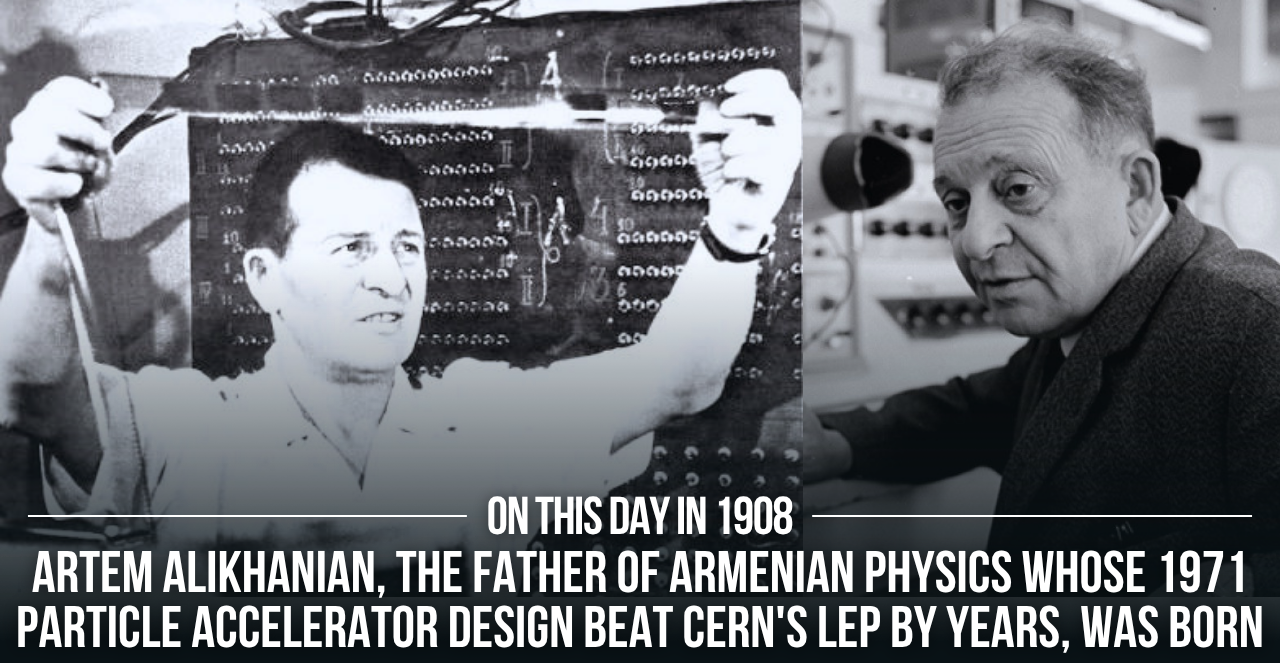

118 years ago today, on June 24, 1908, Artem Alikhanian, the Gandzak-born Armenian physicist, the co-founder of experimental nuclear physics in the USSR, a pioneer of Soviet experimental nuclear physics and one of the founding figures of Soviet nuclear physics, the founder of the Yerevan Physics Institute and of the high-altitude Aragats and Nor-Amberd cosmic ray stations, and the architect of a particle accelerator design that anticipated CERN’s LEP by years, was born.
He was also the discoverer of the first artificial radioactive element to emit ordinary electrons, the protector of Soviet dissidents, and the man whose intellect, friendships, and quiet defiance built modern Armenian science from a mountain.
From Gandzak To Leningrad
Alikhanian was born in Gandzak, then called Elizavetpol under the Russian Empire and now occupied by Azerbaijan as Ganja, the historic Armenian city that gave the modern world two of its most consequential nuclear physicists. His father was a railway engineer on the Transcaucasus Railway. His mother was a homemaker. He was the younger of two brothers. The elder, Abraham, would become Abram Alikhanov, director of the Institute for Theoretical and Experimental Physics in Moscow and the man who built the first Soviet nuclear reactor in 1949.
In 1912 the family moved to Aleksandropol. They later lived in Tiflis. Artem graduated from Leningrad State University in 1931. He had already begun working at the Leningrad Physical-Technical Institute in 1927, at the age of 19, alongside his brother.
The Silicon Discovery
In January 1934, Irène and Frédéric Joliot-Curie announced the discovery of artificial radioactivity in Paris. They had bombarded aluminum with alpha particles and produced phosphorus-30, an artificial radioactive isotope that emitted positrons. The discovery would win them the Nobel Prize the following year.
Immediately afterward, in the same year, Artem Alikhanian and his colleagues at the Leningrad Physical-Technical Institute discovered the first artificial radioactive element that emitted ordinary negative electrons. The element was silicon. The discovery proved that artificial radioactivity could produce both types of beta decay, positron and electron emission, and helped establish the foundational understanding of what determines the sign of charge in beta-decay particles. Academician Lev Artsimovich would later assess that this discovery was essential to clarifying the physics of beta decay itself.
The same year, working alongside his brother Abraham and physicist Maxim Kozodaev, Alikhanian also discovered the formation of an electron-positron pair through the internal conversion of energy from an excited atomic nucleus. He was 26 years old.
In 1941, the Soviet government awarded him the Stalin Prize Second Class for his radioactivity research.
The Mountain
In 1942, with Nazi armies pushing into the Caucasus and the survival of the Soviet Union itself in question, Artem Alikhanian and his brother Abraham led the first expedition to Mount Aragats in Armenia to establish a high-altitude cosmic ray research station.
The Central Committee of the Armenian Communist Party authorized the expedition and armed its members. Alikhanian himself was given direct instructions: in the event that German forces broke through the Caucasus, he was to merge his expedition with one of the partisan units and fight.
The station was built at an altitude of 3,250 meters. It was the first major scientific facility of its kind in the Soviet Union. More than eight decades later, the Aragats Cosmic Ray Station remains Armenia’s primary national cosmic ray research center, continuously operating since the war.
In 1943, the two brothers participated in the founding of the Armenian Academy of Sciences, and within its framework, established the Yerevan Physics Institute. Artem Alikhanian became its director and held that position for the next 30 years.
In 1948, the Alikhanian brothers were jointly awarded the Stalin Prize First Class for their cosmic ray research, which had documented the existence of particles with masses between the muon and the proton, the so-called narrow showers, and intense streams of fast protons in the upper atmosphere.
The Father Of Armenian Physics
From the directorship of the Yerevan Physics Institute, Alikhanian built modern Armenian science.
From 1946 to 1960, he simultaneously led the Chair of Nuclear Physics at the Moscow Engineering Physical Institute and the Laboratory of Elementary Particles at the Lebedev Physics Institute in Moscow. He trained an entire school of Soviet physicists who would lead the field for the next half-century.
In 1956, together with his brother and the Armenian astrophysicist Viktor Hambartsumian, he initiated the construction of the Yerevan Electron Synchrotron at 6 GeV. The machine, known as ARUS, came online in 1967 and was at the time one of the largest electron ring accelerators in the world. Alikhanian led the design and construction.
In 1961, he founded the Nor-Amberd International School of Theoretical and Experimental Physics, and organized its annual sessions until 1975, drawing Nobel laureates and senior physicists from around the world to a mountain village in Soviet Armenia. The Nor-Amberd schools became one of the most important meeting points of East-West scientific exchange during the Cold War.
He pioneered the use of X-ray transition radiation as a tool for particle detection and identification. He developed a new type of spark chamber, the wide-gap track chamber, for which he was awarded the Lenin Prize in 1970. He became the first European to hold the Loeb Professorship at Harvard University. He received the title of Honored Scientist of the Armenian SSR in 1967, two Orders of the Red Banner of Labor, and the USSR Council of Ministers Prize in 1973.
He was, by every measure, the Father of Armenian Physics.
The Particle Accelerator That Foreshadowed CERN
In 1971, alongside the dissident physicist Yuri Orlov and theorist Boris Ioffe, Alikhanian presented a design for a 50 to 200 GeV high-current collider-synchrotron in Yerevan. The machine was to feature multiple colliding beam configurations across the energy spectrum. It was a concept far ahead of its time.
The European Organization for Nuclear Research had not yet conceived its Large Electron-Positron Collider. CERN’s LEP would not begin operation until 1989, eighteen years after Alikhanian’s Yerevan proposal. The Yerevan machine was never built. The Soviet system did not fund it. But the design itself, in scope, ambition, and physics philosophy, anticipated the architecture of LEP by nearly two decades.
The Circle
Alikhanian was non-party, a status that in the Soviet Union signaled both intellectual independence and political risk. In 1955, he signed the Letter of Three Hundred, the famous letter by senior Soviet scientists against the pseudoscientific orthodoxy of Lysenkoism. He maintained close friendships with the academicians Isaak Pomeranchuk, Arkady Migdal, Lev Artsimovich, and Lev Landau.
He was a friend of the composer Dmitri Shostakovich. He was a friend of the writers Mikhail Zoshchenko and Marietta Shaginyan. He was a friend of the painters Martiros Saryan, Haroutiun Galentz, and Minas Avetisyan, and the sculptor Arto Tchakmaktchian. He hosted the poet Joseph Brodsky at his home in Yerevan. He organized the visits of Andrei Sakharov, Yelena Bonner, and the comedian Arkady Raikin to Armenia. He protected the dissident physicist Yuri Orlov, hiring him at the Yerevan Physics Institute after Orlov was fired from his Moscow position for a pro-democracy speech.
Yuri Orlov would later write that there were rumors Alikhanian maintained his own network of informants who helped protect him and his colleagues from the KGB. Whether that network existed or not, the artists, dissidents, and free thinkers who passed through his Yerevan home in those years constituted an unofficial republic of intellectual freedom inside the Soviet Union.
His own most famous line captured the principle of that republic: “Intellect is ignited by intellect.”
The Fall
In 1973, after a series of conflicts with senior Soviet officials, Artem Alikhanian was forced to resign from the directorship of the Yerevan Physics Institute. He left Yerevan and moved to Moscow.
He had founded the institute. He had built it for thirty years. He had trained the physicists who staffed it. He had designed the particle accelerator that ran in its halls. Soviet politics took it from him in a single decision.
A Legacy In Stone, In Steel, In Cosmic Light
Artem Alikhanian died on February 25, 1978, in Moscow, at the age of 69. He was buried in the Tokhmakh Cemetery in Yerevan.
The Yerevan Physics Institute now bears his name. A street in Yerevan bears the Alikhanian brothers’ name. A memorial plaque hangs on the wall of his former residence at 18 Marshal Baghramyan Avenue. The Aragats Cosmic Ray Station, now operated by the Cosmic Ray Division of the institute he founded, still records the secondary particles from cosmic rays striking the Earth’s atmosphere, more than eighty years after the wartime expedition that built it.
Gandzak, the Armenian city where he was born, remains under Azerbaijani occupation. The institutions he built in Yerevan still stand. The intellect he ignited is still burning.