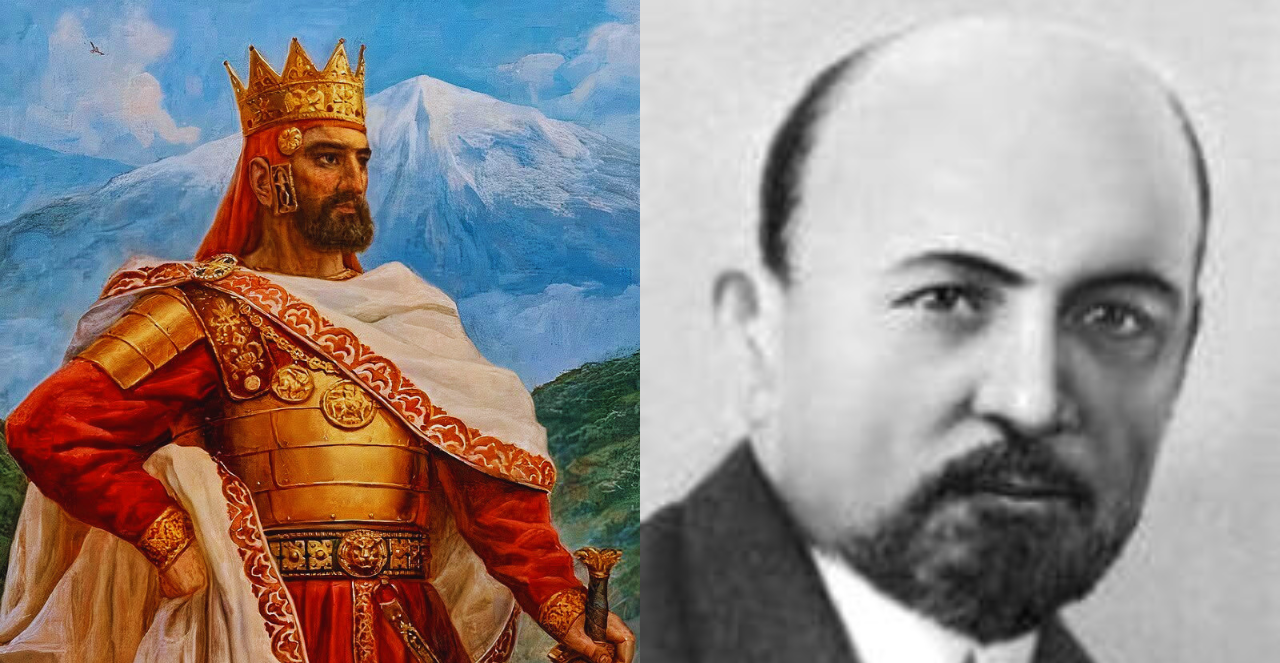

Yerevan’s Amiryan Street in the Kentron administrative district has been renamed King Pap Street in honor of the 4th-century king of Armenia, ending the name of a Soviet-era Bolshevik commissar over the objections of opposition factions who were shut out of any public debate. The decision was approved during today’s session of the Yerevan City Council.
The street, which runs from Republic Square to Saryan Street, had carried the name of Arsen Amiryan, an Armenian Bolshevik figure, journalist, and one of the 26 Baku Commissars, the group of Soviet officials executed in 1918 and long celebrated in Soviet historiography. The renaming is the latest in a steady reworking of Armenian public space away from its Soviet inheritance.
The issue was included on the council’s agenda among non-reporting items, meaning it was not subject to a public presentation or debate. It was one of 45 unreported items presented as a single package by Mayor Tigran Avinyan, a bundle that also covered the installation of commemorative plaques and a series of other street-renaming decisions to be forwarded to the national cadastre authority. The opposition “Public Voice” and “Mother Armenia” factions proposed making the renaming a reporting item, arguing that they opposed the draft decision and wanted a discussion. The proposal, however, was rejected by the other council factions.
Avinyan defended placing the renaming among the non-debated items, saying it was done to avoid prolonged discussion. He added that few residents were aware of who Arsen Amiryan was, while also questioning whether Amiryan was an appropriate figure to have a street named after him in central Yerevan.
“I want us to remember who Arsen Amiryan actually was. Of course, it is difficult to recall here because 90% of those sitting in this hall did not understand who this person was, and yet we have a street in central Yerevan named after him. With all due respect to all generations and descendants of the Amiryan family, I am not sure that this person has the merits to have a street next to Republic Square named after him,” Avinyan said.
The head of the “Mother Armenia” faction, Manuk Sukiasyan, criticized the process, saying the initiative lacked public legitimacy. He argued that the proposal should have been discussed openly to address concerns and allow arguments from both sides.
“This has no consensus within the council, and there has been no public signal either, for example from residents of Amiryan Street. Bringing this forward as a non-reporting item means there is no opportunity to understand the arguments behind the renaming. It gives the impression that King Pap is being used as a reason to remove Amiryan’s name,” Sukiasyan said.
The initiative to rename the street was authored by Hayk Grigoryan, a member of the “National Progress” faction. This was the second time the proposal had appeared on the council’s agenda. During the previous session, the issue was presented as a reporting item but failed to receive enough support from council members.
In the justification for the proposal, Grigoryan described King Pap as one of the youngest rulers in Armenian history and highlighted his reforms.
“Pap, one of the youngest kings in Armenian history, managed to achieve so much during his short reign that today his name is already among the most prominent figures in Armenian history. He was an innovator, and as often happens with innovators, many did not accept or support him,” the statement read.
Pap reigned as king of Armenia from roughly 370 to 374 and is remembered for strengthening royal power and the army, though his reign was also marked by sharp conflict with the Armenian Church, including accusations, which Armenian sources dispute, that he was behind the death of Catholicos Nerses I. He was assassinated by the Romans in 374.
The choice of Pap carries contemporary resonance. Prime Minister Nikol Pashinyan, whose Civil Contract party controls the council, has frequently invoked King Pap, one of his favorite historical figures, as a symbol of Armenian statehood. In recent years, and particularly amid his confrontation with the Armenian Apostolic Church, Pashinyan has drawn parallels between his own dispute with the Church and King Pap’s policies. Pap sought to curb the Church’s political and economic influence, seen by critics as undermining its independence. The most recent reference came during the parliamentary election campaign, when Pashinyan declared that “King Pap is a symbol of Armenian sovereign statehood.”
Earlier, Grigoryan had proposed renaming Amiryan Street after Artsakh liberation war participant, Artsakh Hero, and recipient of the First Degree Medal of Combat Cross Ashot Ghulyan, known as “Bekor Ashot.” The proposal was not approved.
The street has changed names several times throughout its history. Before the Soviet period, it was known as Nazarovskaya Street. Between 1918 and 1921, it carried the name of Kristapor Mikayelyan, one of the founders of the Armenian Revolutionary Federation. After Armenia regained independence, it was renamed Vramshapuh Street in the 1990s for several years before becoming Amiryan Street once again.