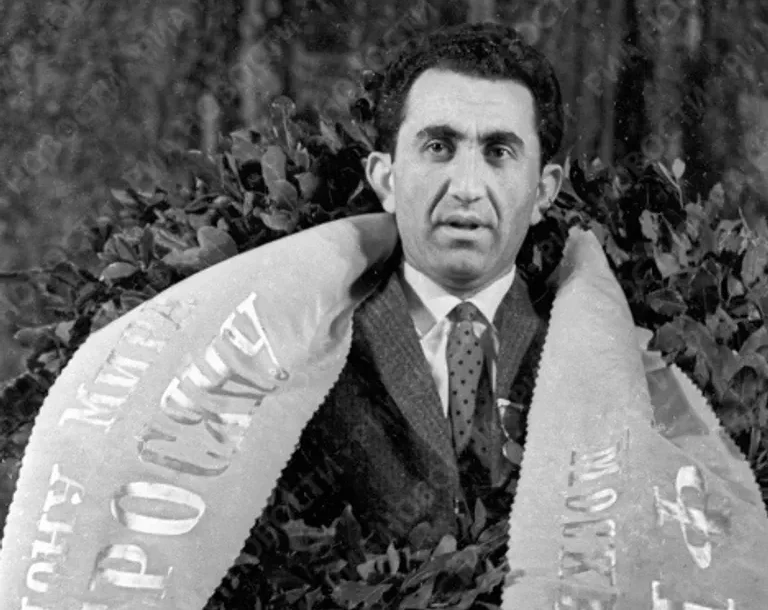

97 years ago today, on June 17, 1929, one of the greatest chess minds in the history of the game was born in Tiflis, the city now known as Tbilisi. Tigran Vartani Petrosian would go on to become the 9th World Chess Champion, the only Armenian ever to hold the title, an Honored Master of Sports of the USSR, and the player a landmark 2004 study identified as the most difficult opponent to defeat in the entire history of the game.
From Orphan to Master
Petrosian was born into a working-class Armenian family in Tiflis. His father Vartan worked as a janitor at the Tbilisi Officers’ House, in the building where the future World Champion would spend his childhood. The Second World War took both of his parents while he was still a teenager, and Petrosian was raised by his older sister Vartush. To survive, he swept the streets of Tbilisi.
He learned chess at the age of 8 and began formal training at the Tiflis Palace of Pioneers under the master Archil Ebralidze. The young Petrosian fell under the influence of Aron Nimzowitsch’s “My System,” the book that would shape his style for the rest of his life. At 16, he was already the champion of Georgia. In 1946, he moved to Yerevan, where he won the Armenian Chess Championship and the USSR Junior Championship in the same year. In 1949, he settled in Moscow. He earned the title of International Master in 1951 and Grandmaster in 1952.
Iron Tigran
Petrosian’s chess was unlike anything the world had seen. He elevated prophylaxis, the art of anticipating and neutralizing an opponent’s threats before they could form, into a complete worldview at the board. He valued safety above all else, dismantled attacks before they began, and forced his opponents into positions where there was simply nothing to do. They called him “Iron Tigran,” and they meant it. A 2004 study that examined the records of every World Champion in chess history identified him as the most difficult player ever to beat.
The World Championship Years
In 1963, at 33 years old, Petrosian defeated the legendary Mikhail Botvinnik to become the 9th World Chess Champion. He defended the title in 1966 against Boris Spassky, becoming the first Soviet champion in decades to successfully defend his crown. He held the title for 6 years, finally losing it to Spassky in 1969 in one of the most studied matches in chess history.
He won the Soviet Chess Championship 4 times, in 1959, 1961, 1969, and 1975, and represented the USSR in 10 Chess Olympiads. His individual Olympiad record stands as one of the most extraordinary in the history of team chess: 79 wins, 1 loss, and 50 draws. In 6 of the Soviet Championships he played, he did not lose a single game.
In 1968, Petrosian defended his candidate’s dissertation in philosophy under the title “Some Problems of the Logic of Chess Thought,” and from 1968 to 1977 he served as editor-in-chief of the magazine Chess Moscow. He later founded and published the weekly 64, one of the most respected chess publications in the Soviet world.
Havana, 1966
While visiting Cuba in 1966, Petrosian played a simultaneous exhibition that included Fidel Castro himself. Their game ended in a draw, and the Comandante gifted Petrosian the marble table on which they had played, a souvenir he kept for the rest of his life.
The Pride of Armenia
Petrosian’s reign as World Champion turned a nation of survivors into a nation of chess players. In Soviet Armenia and across the diaspora, his championship galvanized a sense of national pride that ran deeper than sport. He was proof that an Armenian mind, sharpened in adversity, could conquer the world stage of the most intellectual game on earth.
His 1963 victory over Botvinnik triggered a chess boom across Soviet Armenia, and in households throughout the republic, boys began to be named Tigran in his honor. The Tigran Petrosian Chess House opened in Yerevan in 1970, its foundation stone laid by the Grandmaster himself, and it remains the spiritual home of Armenian chess.
Today, Armenia is one of the strongest chess nations per capita in the world, a 3-time Chess Olympiad gold medalist (2006, 2008, 2012), and the only country on earth to have made chess a mandatory subject in its public schools. Every Armenian Grandmaster who has followed, from Levon Aronian to the modern Tigran L. Petrosian who was named in his honor, plays in his shadow.
A Legacy Engraved In The Game
Tigran Petrosian passed away on August 13, 1984, in Moscow, at the age of 55. He is buried at Vagankovo Cemetery. His games are still studied in chess academies from Yerevan to New York, his openings still played, his ideas still cited.
His portrait appears on the 2,000 dram banknote of the Republic of Armenia. A street in Yerevan bears his name. So does the Chess House he helped raise from the ground.
97 years after his birth, the man from Tiflis who learned chess as an orphan and conquered the world remains the patron saint of Armenian chess and one of the most original minds the game has ever produced.