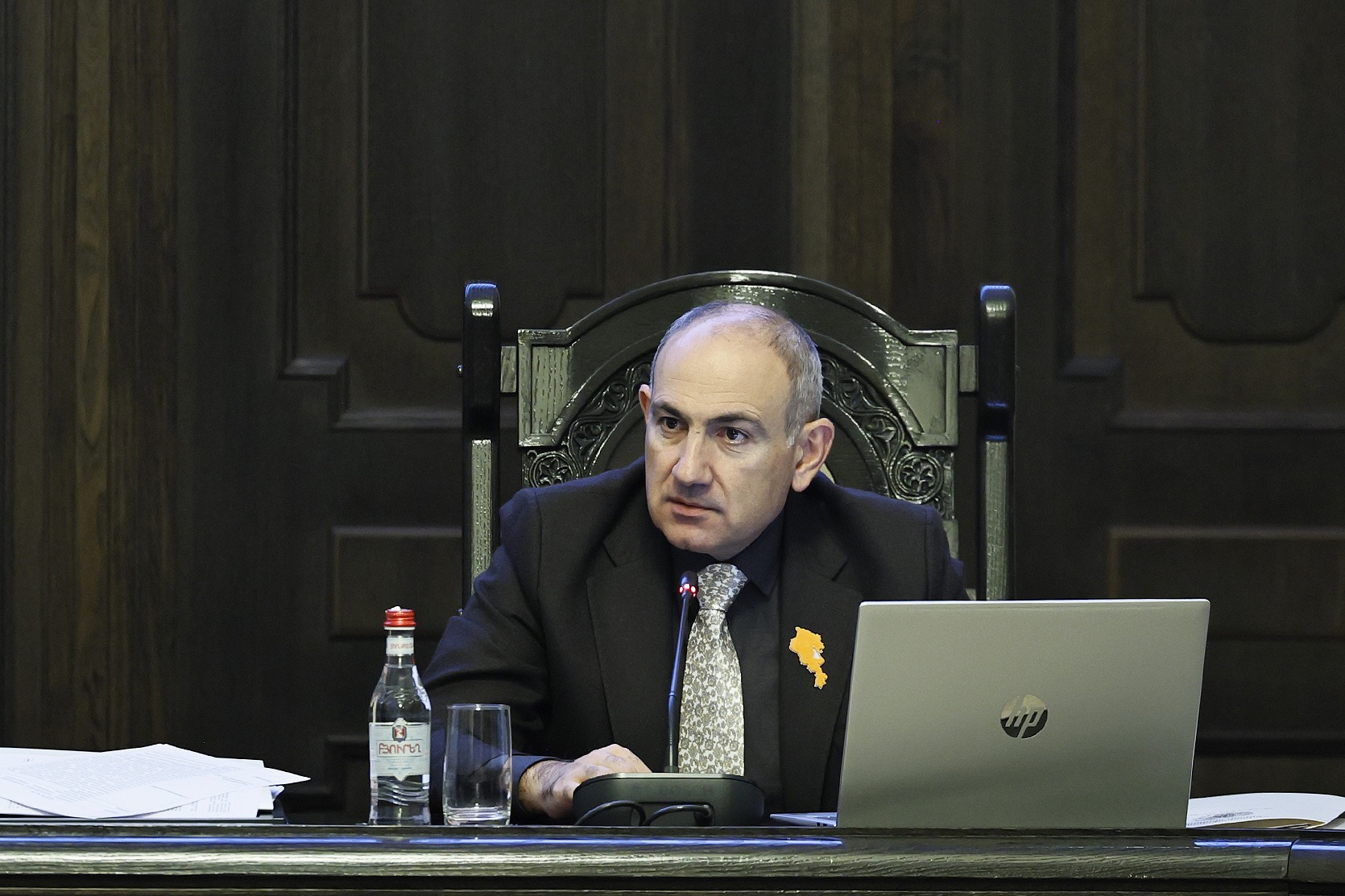

Armenian Prime Minister Nikol Pashinyan said he will resign immediately if Armenians vote down his government’s new constitution in a referendum, and that if they approve it he will stay in office until the next parliamentary elections in 2031 and then not run for prime minister again.
Neither outcome is available to him yet. Pashinyan cannot call the referendum without opposition votes in parliament, and both opposition factions rejected the offer within hours of hearing it.
Speaking on Thursday, November 19, a day after first presenting the offer in parliament, Pashinyan framed the choice as one he loses either way. “If our people say no [to the new constitution], I will step down. But if they say yes, I will see through the peace agenda, and in the following election, I will not run for prime minister again,” he said.
“I am giving them an unbeatable option, and regardless of the outcome of the referendum, I would be leaving,” he said. “In one case, having left the peace agenda unfinished, because it turns out that this agenda does not receive the people’s support, at least as presented by me; in the second option, having implemented it in this capacity until the next elections, I will not be a candidate for prime minister in the next elections.”
He added that the referendum is not the only route out of office for him. “The people can come out and achieve my resignation, regardless of the referendum,” he said.
Pashinyan said the draft constitution will be published next week and opened to public discussion. He said it will introduce additional checks and balances, including guaranteed representation for opposition forces in key state institutions such as the board of the Central Bank and the Central Electoral Commission.
He had teased the proposal since October as an offer the opposition could not refuse. He paired it on Thursday with a threat, saying refusal would mean “political death” for the two opposition factions.
“If they reject this option to remove me, we will remove them,” Pashinyan said, repeating a warning from the previous day that the government would move toward snap parliamentary elections in which, he claimed, neither opposition faction would return to the National Assembly.
The prime minister confirmed that the draft will not keep the current constitution’s reference to Armenia’s 1990 Declaration of Independence, and that it will be built around his government’s “Real Armenia” concept, which limits the state’s horizon to its internationally recognized borders.
“Of course, the draft of the new constitution must be finalized, but it must be in the context of the ‘Real Armenia’ ideology,” Pashinyan said. “We will not bring it with [the reference to] the Declaration of Independence in it.”
Pressed on why the reference has to go, Pashinyan named what the Declaration contains. “Why should we not have anything to do with the provisions included in the Declaration of Independence on the reunification of Western Armenia and NKAO and Armenia?” he said. “Because they were placing Armenia in a conflict logic, but we need to take Armenia out of that logic.”
The Declaration of Independence, adopted on August 23, 1990, is the document the current constitution’s preamble rests on. Its 11th article states that “Armenia stands in support of the task of achieving international recognition of the 1915 Genocide in Ottoman Turkey and Western Armenia.” Removing the reference would strip that commitment, and the 1989 act on the reunification of Armenia and Artsakh, of their constitutional anchoring.
Pashinyan also attacked the Armenian Revolutionary Federation’s ideological influence on independent Armenia, saying that “Soviet Armenia was transformed into ‘Dashnaktsutyun Armenia.'”
He then demanded that the Hayastan (Armenia) bloc, the Strong Armenia alliance and the extra-parliamentary groups campaigning against the referendum state whether they still pursue the idea of a “united Armenia” that includes Artsakh (Nagorno-Karabakh), and whether they demand the return of Armenians to Artsakh and the return of Armenian refugees from Azerbaijan.
The right he asked them to disavow is one the European Parliament has already affirmed. Its October 5, 2023 resolution condemned the ethnic cleansing of Nagorno-Karabakh and stressed the right of Armenians to return under international guarantees, while urging Azerbaijan to release every Artsakh resident it had arrested, including captives taken before the offensive.
Both factions refused. Anna Grigorian, who heads the Hayastan bloc, dismissed the resignation pledge as a maneuver. “Mr. Pashinyan, you have no credibility with at least 50 percent of our people,” she said in parliament. “‘Aliyev’s Constitution’ won’t pass in Armenia… Our answer is no, nyet, nein.”
Narek Karapetyan, the parliamentary leader of Strong Armenia, said Pashinyan was acting on instructions from Azerbaijani President Ilham Aliyev. “Armenians will not [change the constitution] at Aliyev’s behest. It is the foundation of our sovereignty,” he said. Hayastan lawmaker Kristine Vardanian said the opposition would remove Pashinyan “without striking a deal,” and the two blocs were recently joined by 10 extra-parliamentary parties that argue stripping the Declaration would weaken the legal foundations of Armenian statehood.
The offer exists because of arithmetic. Civil Contract holds 64 of the 105 seats in the National Assembly after the June 7 elections, 6 votes short of the two-thirds majority required to put a draft constitution to a referendum.
Azerbaijan has made the constitutional change a precondition for signing a peace treaty, objecting to the preamble’s reference to the Declaration of Independence, which cites the 1989 act on the reunification of Armenia and the then Nagorno-Karabakh Autonomous Oblast. Armenia and Azerbaijan initialed a peace agreement at United States-brokered talks in Washington in 2025, and Baku says it cannot be signed until the reference is gone.
Azerbaijan is under no equivalent obligation. In August 2022 it renamed its Azerbaijan Refugee Society the “Western Azerbaijan Community,” a term Baku uses for the territory of the Republic of Armenia, and the group has since adopted a “Concept of Return” for Azerbaijanis it says were expelled from present-day Armenia. The document contains no similar provision for Armenians displaced from Azerbaijan, and is widely seen as containing irredentist claims on Armenian territory.
Pashinyan has insisted the constitution is an internal Armenian matter, arguing that Civil Contract first proposed major constitutional changes shortly after coming to power in 2018, years before Azerbaijan raised the demand.
Azerbaijan seized Artsakh in a 24-hour offensive launched on September 19, 2023, ending more than 3 decades of Armenian self-governance and emptying the region of its entire Armenian population of 120,000 people in a week. The European Parliament resolution of October 5, 2023 said the situation “amounts to ethnic cleansing” and passed by 491 votes to 9, with 36 abstentions.
Azerbaijan still unlawfully holds 19 Armenians, and 8 of them led Artsakh. They are former State Minister Ruben Vardanyan, former Presidents Arayik Harutyunyan, Bako Sahakyan and Arkadi Ghukasyan, former Defense Army commander Levon Mnatsakanyan, former first deputy commander Davit Manukyan, former Foreign Minister Davit Babayan and former parliament speaker Davit Ishkhanyan.
A Baku court sentenced Harutyunyan, Mnatsakanyan, Manukyan, Ishkhanyan and Babayan to life imprisonment on February 5, 2026, and gave Ghukasyan and Sahakyan 20 years each. Vardanyan, whose case was severed from the others, was sentenced to 20 years. The Baku Court of Appeal rejected every appeal in August 2026 and left the sentences unchanged.
The other 11 captives were tried in the same proceedings. Among them, Madat Babayan and Melikset Pashayan received 19 years each, Garik Martirosyan 18 years, Davit Allahverdyan and Levon Balayan 16 years each, and Vasiliy Beglaryan, Gurgen Stepanyan and Erik Ghazaryan 15 years each. The 19 remained after Azerbaijan released 4 Armenians on January 14, 2026 in exchange for 2 convicted Syrian mercenaries.
Artsakh remains under Azerbaijani occupation and not one Armenian has been allowed to return. Caucasus Heritage Watch, the Cornell and Purdue satellite monitoring initiative, has documented 17 cases of destruction, including 4 churches, 4 historic cemeteries and a memorial to the 1915 Armenian Genocide, among the nearly 500 Armenian heritage sites it tracks. Azerbaijan razed the Holy Mother of God Cathedral, the principal Armenian cathedral in Artsakh, between March 3 and April 2, 2026, and destroyed a Shushi cemetery holding 5 medieval khachkars in May 2026 to make way for a wastewater treatment plant.
Azerbaijan has done this before. Caucasus Heritage Watch found that between 1997 and 2011, 98 percent of Armenian cultural heritage in Nakhichevan was completely destroyed, 108 medieval and early modern monasteries, churches and cemeteries, including the Djulfa cemetery and its khachkars.