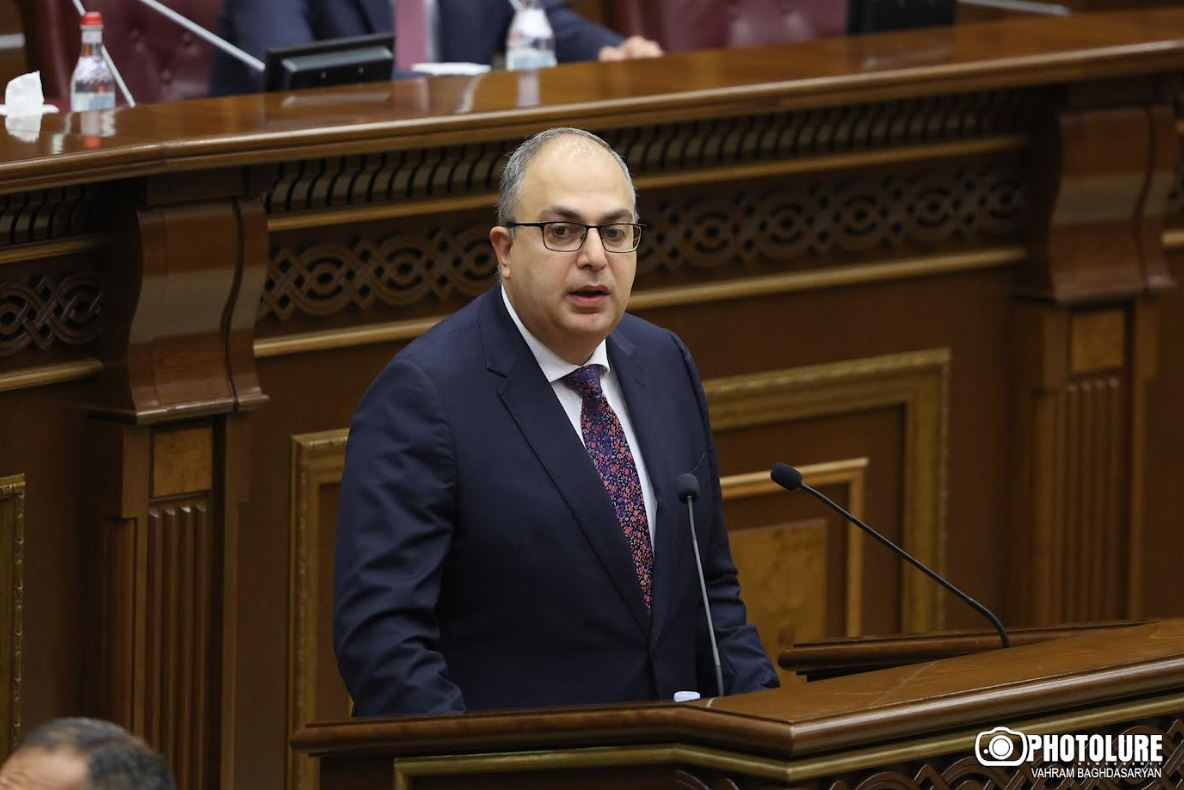

Vladimir Vardanyan, a member of parliament for Armenia’s ruling Civil Contract party until March, was elected president of Armenia’s Constitutional Court on Friday, November 6. The court he now leads must rule on the peace agreement with Azerbaijan before parliament can ratify it.
Neither Vardanyan nor Vice President Edgar Shatiryan won the 6 of the court’s 9 votes required in the first round of the secret ballot. Judge Seda Safaryan said Vardanyan then received 5 votes in the second round. The president serves a single 6-year term with no right to re-election.
The court failed to elect a president on October 14, 2 days after Arman Dilanyan’s term ended, when the same 2 candidates fell short in both rounds. Vardanyan nominated himself in that vote, while Judge Davit Khachaturyan nominated Shatiryan. Dilanyan remains on the court as a judge.
Vardanyan, 47, joined the court only in March. President Vahagn Khachaturyan nominated him on March 13, the same day Vardanyan ended his Civil Contract membership. Parliament confirmed him on March 25, with all 67 participating MPs voting in favor.
Vardanyan had served as an MP since 2019 and chaired parliament’s Standing Committee on State and Legal Affairs. Before entering parliament, he worked at the Constitutional Court for years and headed its staff from April 2018 to January 2019. On the court, he replaced Hrayr Tovmasyan, whose mandate was terminated after a court found him guilty of exceeding his authority as justice minister.
Civil society organizations urged parliament in March not to confirm him, saying his years of political activity cast doubt on his ability to serve impartially. At his confirmation hearing, Vardanyan said he saw risks of political bias in moving from a political post to the court. “Regardless of your political orientation or personal preferences, you are obliged to act in accordance with your oath,” he said.
At the same hearing, opposition MP Armenuhi Kyureghyan asked whether he still considered Azerbaijan’s actions against Artsakh (Nagorno-Karabakh) and its Armenians a crime against humanity, as he had once said. “I never renounce any statement I have made, I cannot renounce it,” Vardanyan said, adding that a candidate for the court could not be asked about Armenia’s foreign policy.
As an MP, Vardanyan called Azerbaijan’s blockade of the Lachin corridor, Artsakh’s only road to Armenia, “a carefully planned attempted policy of ethnic cleansing” in December 2022, days after it began. He cited the Genocide Convention’s definition of deliberately inflicting conditions of life calculated to destroy a group, saying, “We are facing this.” The blockade lasted 9 months, until Azerbaijan’s military assault on Artsakh in September 2023.
In October 2022, after Azerbaijan’s September assault on Armenia’s sovereign territory, he wrote that all political groups at the Parliamentary Assembly of the Council of Europe had unanimously condemned Azerbaijani aggression and war crimes against Armenia. A year later, after the ethnic cleansing of Artsakh forcibly displaced 120,000 Armenians, he asked Azerbaijani delegate Samad Seyidov at the Assembly what he would tell his children and grandchildren when they asked “what happened with the Armenians living in Nagorno-Karabakh.”
Under Armenian law, the government must submit the signed peace treaty to the Constitutional Court to verify that it complies with the Constitution. The agreement was initialed in Washington in August 2025 and remains unsigned, with Baku conditioning its signature on a new Armenian constitution. Prime Minister Nikol Pashinyan has said that if the court found the treaty unconstitutional, Armenia would most likely initiate constitutional changes.