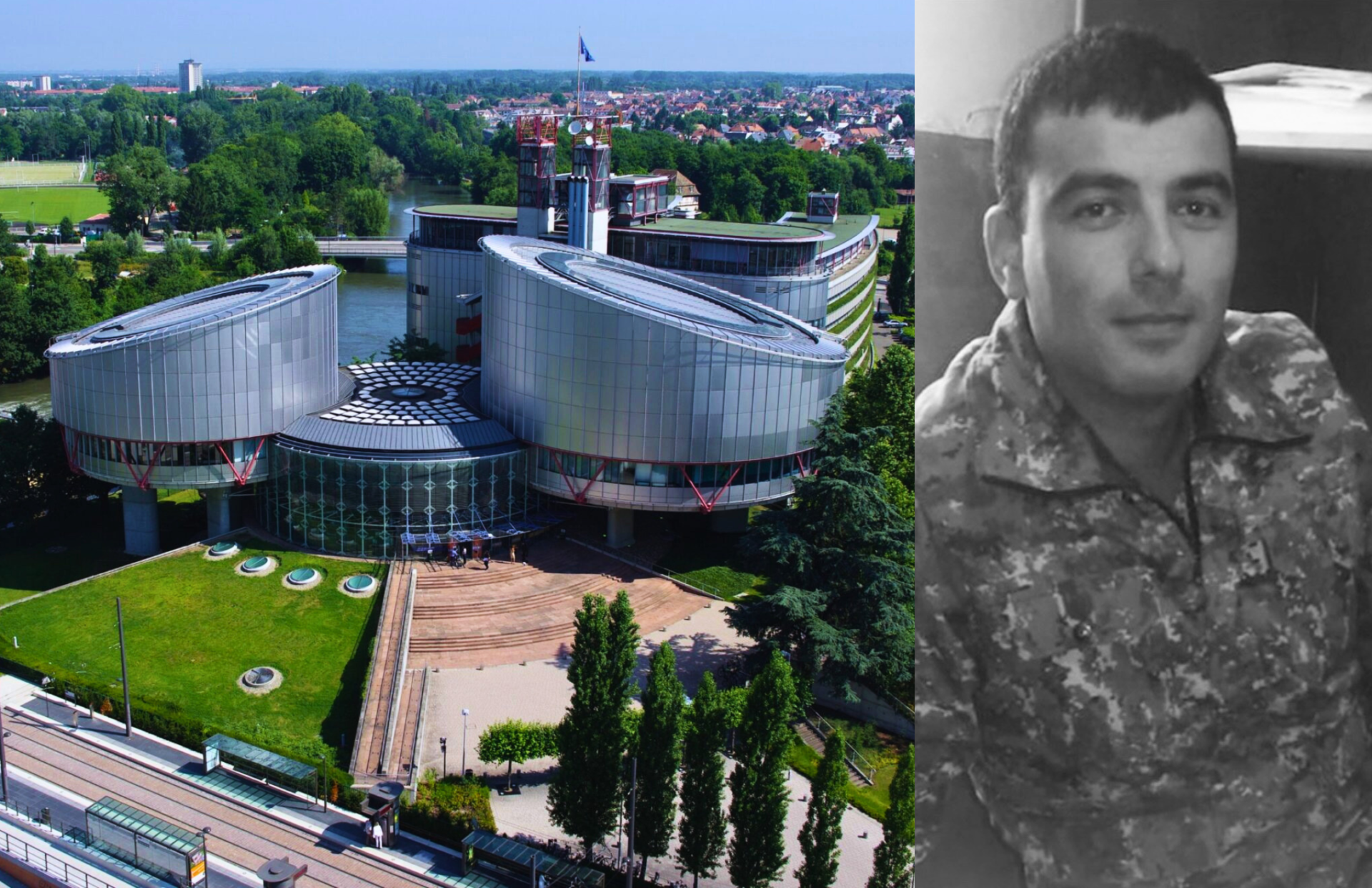

The European Court of Human Rights has made final its ruling that Azerbaijan tortured and beheaded 30-year-old Armenian officer Major Hayk Toroyan during the April 2016 Four-Day War in and around Artsakh (Nagorno-Karabakh), after a five-judge panel of the Court’s Grand Chamber rejected Azerbaijan’s request to reopen the case on Monday, November 2, reports Zartonk Media.
The rejection means the judgment can no longer be appealed. The Court delivered it on June 18 in the case of V.T. and Others v. Azerbaijan, application no. 20075/16, finding violations of Article 2, the right to life, and Article 3, the prohibition of torture and inhuman or degrading treatment, as Zartonk Media reported at the time. It was the first ruling the Court issued among the cases of that war, and the Chamber found each violation by six votes to one.
Liparit Drmeyan, former head of Armenia’s Office of the Representative on International Legal Matters, wrote on Facebook on Tuesday that the judgment “has thus entered into force, and it will be a cornerstone for the examination of similar ongoing and future complaints.”
He pointed to a contradiction in Baku’s position. Azerbaijan declares at the highest level that it does not accept the Court’s jurisdiction and has stopped cooperating with the Council of Europe’s Committee of Ministers, Drmeyan wrote, yet when it suits, Baku “remembers the importance of legal processes and files complaints.”
Hasmik Harutyunyan, a member of the team that submitted the application, said the judgment was “not only an important step toward restoring justice for the victims concerned but also a clear message that gross human rights violations cannot go unpunished.” Establishing such violations through international justice, she said, “can be crucial both for protecting individual rights and preventing future abuses.”
Major Hayk Toroyan was born in Yerevan in 1985 and served in the armed forces of the then Artsakh Republic as head of the rocket and artillery armament service of his unit in Mataghis, having made major at 28. On March 31, 2016, an order came through transferring him to a post at Armenia’s Ministry of Defense. He was killed two days later.
The Court anonymized the proceedings, referring to him by his initials and withholding the names of the applicants, his parents and sister, who filed the application on April 13, 2016, 11 days after he was killed.
Toroyan and Hrant Gharibyan, a soldier in the same army serving as his driver, left their unit on April 2, 2016 to deliver ammunition to a command post about two kilometers north of the village of Talish. Their truck was ambushed and came under heavy fire about a kilometer from the village. A crime scene report drawn up three days later recorded that every tire had been punctured, that the left door carried gunshot traces, and that there was blood in the cabin.
At 11:25 that morning, Toroyan sent a text message to a fellow soldier that read, “They shot me.” The soldier’s phone battery had died and he did not receive it until two days later.
Gharibyan’s body was found at around 4 p.m. that afternoon, about 15 meters from the vehicle, decapitated and with his head missing. A forensic examination concluded that he had been martyred by gunshot wounds and that his head was severed after he was already dead.
Toroyan was taken out of the truck alive. The forensic report found that the gunshot wounds had incapacitated him and left him unable to walk, that he stayed alive for between half an hour and two hours afterward, and that during that time he “could make conscious movements, but was not able to walk independently.”
It found that his hands were cut off seconds before his death, the right one first and then the left, and that those injuries had no causal relationship with the immediate cause of death, which was decapitation. His head had been “traumatically severed while he was still alive, seconds before his death, and leading to his death.”
His body was found by Armenian troops the next morning, about 30 meters from the truck near a ravine. He was buried on April 7, 2016 at the Yerablur military pantheon, without the severed body parts, which are still missing. His father had to identify the mutilated body during the forensic examination.
The Court found that Azerbaijan had jurisdiction over the killing through its soldiers’ “State agent authority and control” over the victim, rejecting Azerbaijan’s argument that it bore no responsibility because the events took place on territory outside its control. It held that Toroyan was killed after he had been wounded and could no longer defend himself or move on his own, and that this conduct was not compatible with international humanitarian law.
On the torture finding, the Court said the injuries “involved a high degree of brutality” and that their particular nature “undoubtedly involved the deliberate intention of the perpetrators to cause very serious and cruel suffering.” It found a separate violation of Article 3 for the family, whose moral suffering, caused by the mutilation and by their inability to recover his remains and bury him whole, “must have caused them profound and continuous distress.” The Court also recorded that Azerbaijani authorities have taken no action to investigate the crimes against him.
On the merits, Azerbaijan’s only answer was that its forces had not entered Talish and so could not have been present. The Court answered it with Azerbaijan’s own material. Azerbaijan’s Ministry of Defense announced on April 2, 2016 that the military positions and surrounding heights of Talish had been “fully cleared of enemy forces.”
A Facebook user posted a photograph of a mutilated head and a wrist to the Azerbaijani Special Forces Facebook page with a caption in Azerbaijani reading “I have got one.” The Armenian National Bureau of Forensic Reports compared it with photographs of Toroyan taken when he was alive and concluded they showed the same person.
In April 2019, an Azerbaijani media YouTube channel published footage filmed at the scene by members of the special forces who took part in the war, in which they described how they had eliminated an Armenian military truck and killed the soldiers inside. The truck in the footage was the same vehicle photographed at the crime scene.
Azerbaijan offered no explanation for any of it. The Court wrote that because the respondent state failed to rebut evidence “which itself originates from its own authorities,” strong adverse inferences could be drawn.
A ceasefire ended the fighting on April 5, 2016, four days after it began. Official sources put the dead at a hundred or more on each side. As the bodies were returned, some were found mutilated and missing heads, hands or earlobes. The Artsakh Ombudsman’s second interim report on the war, submitted to the Court by Armenia, documented the deaths and alleged mutilation of 24 people and 5 cases of alleged torture, among them 3 decapitations and 7 alleged executions by gunfire.
The Court ordered Azerbaijan to pay €60,000 jointly to Toroyan’s parents and €30,000 to his sister in non-pecuniary damages, along with €14,210 in costs and expenses to be paid directly into the account of the Yerevan-based NGO Rule of Law, which represented the family. Payment is due within three months of the judgment becoming final, which it did on November 2. After that, interest runs at the European Central Bank’s marginal lending rate plus three percentage points.
The family was represented before the Court by a team of Yerevan-based lawyers that included Ara Ghazaryan, Araks Melkonyan, Artak Zeynalyan and Siranush Sahakyan. Armenia did not bring an interstate case over the April 2016 atrocities. It intervened in this one as a third party in support of the family.
Chingiz Asgarov, who represented Azerbaijan before the Court as its Agent in this case, said in June that Baku “rejects the conclusions” of the judgment, claiming the Court lacked sufficient evidence and favored materials submitted by Armenia. The Court’s own record states that Azerbaijan supplied no viable counter-argument and never accounted for the images its own soldiers published.
Azerbaijan’s relationship with the Council of Europe has deteriorated sharply. The Parliamentary Assembly refused to ratify the credentials of Azerbaijan’s delegation in January 2024. President Ilham Aliyev said in April 2025 that none of the Court’s decisions were valid for Azerbaijan, and in July 2026 that Baku was considering leaving the Council of Europe altogether. As of August, Azerbaijan had implemented none of the Court’s judgments in favor of Armenian applicants.
The Court communicated 22 April 2016 applications to Azerbaijan in November 2016. Twenty-one remain pending, and they now rest on a judgment Baku can no longer contest.