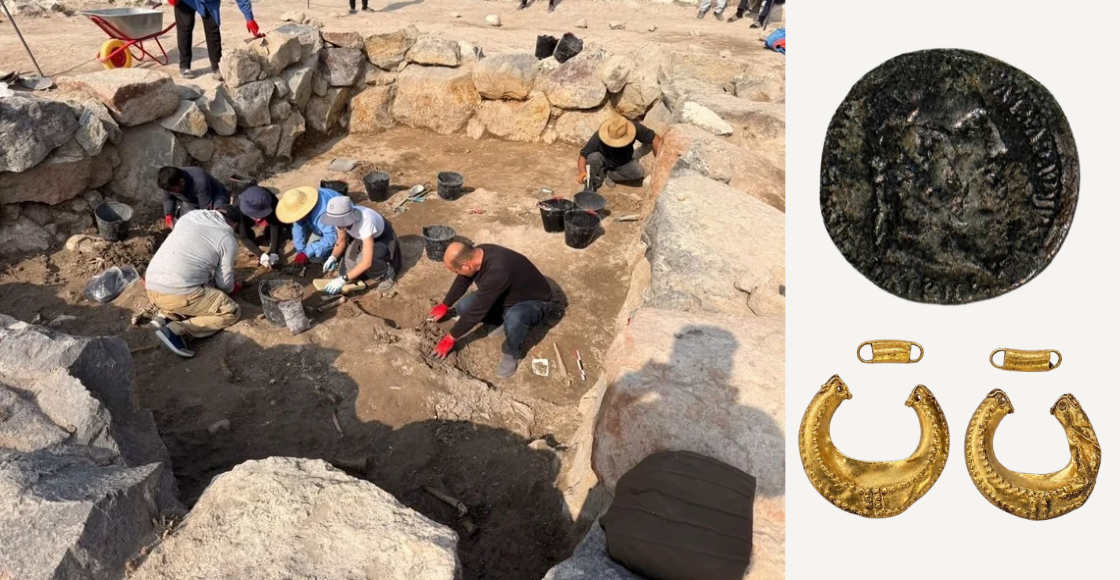

Archaeologists have uncovered gold jewelry, a silver coin of the first Roman emperor, a gold button, and a bronze dagger during excavations at the Metsamor archaeological site in Armenia’s Armavir Province. The finds were reported by the Service for the Protection of Historical Environment and Cultural Museum-Reservations and shared by Armenia’s Minister of Education, Science, Culture and Sport, Zhanna Andreasyan.
The coin carries the image of Octavian Augustus, who ruled Rome from 27 BC to 14 AD and became its first emperor. It came from a 1st-century AD burial in the upper layer of the tomb, uncovered in earlier seasons of the dig, alongside the gold jewelry.
The dig began two years ago and continued in 2026 on a privately owned plot next to the Metsamor Museum-Reserve. At its center is a stone burial chamber ringed by a cromlech, a circle of standing stones, about 20 meters across, built of tuff and basalt, with a stone-cist tomb roughly 6 by 4 meters inside. The mix of eras in its layers shows the tomb was used and reused over centuries.
The main burial, near the floor of the chamber, dates to the Late Bronze Age, the 14th to 13th centuries BC. It held a Lchashen-type dagger along with large quantities of pottery, horse bones, belt fragments, bronze objects, and bell-shaped pendants. A separate Iron Age layer held a single individual with grave goods and a large quantity of pottery.
Metsamor sits on the Ararat plain near the village of Taronik, about 35 kilometers west of Yerevan. The settlement was founded around the turn of the 4th millennium BC and was occupied, with interruptions, into the medieval period. A priest, Ghevork Alishyan, identified the site in the 1890s, and regular excavations have run there since 1965.
The site holds Armenia’s largest collection of archaeological gold, along with exceptional earlier finds from the 16th and 15th centuries BC, among them a Babylonian agate frog-shaped weight and a sardonyx seal carved with Egyptian hieroglyphs. Its ancient metal foundry and observation platform are among its best-known features. At its height in the Late Bronze and Early Iron Ages, the city spread across close to 100 hectares, while the fortified citadel on the Mets Blur mound stood behind cyclopean walls, with the necropolis to its east. In the early 8th century BC, the Urartian king Argishti I, who founded Erebuni in 782 BC, campaigned into the Ararat plain, and Metsamor was reduced from its former scale around this period.
The coin’s date fits an era when Armenia and Rome were closely bound. In 20 BC, Augustus established a Roman protectorate over the Armenian kingdom and installed Tigranes III on its throne, and Armenia remained a Roman client kingdom under a succession of Rome-backed rulers into the following century. A silver coin from Augustus’s reign, in a 1st-century AD burial, reflects that contact and Metsamor’s long position on east-west trade routes.
Excavations at the site are continuing.