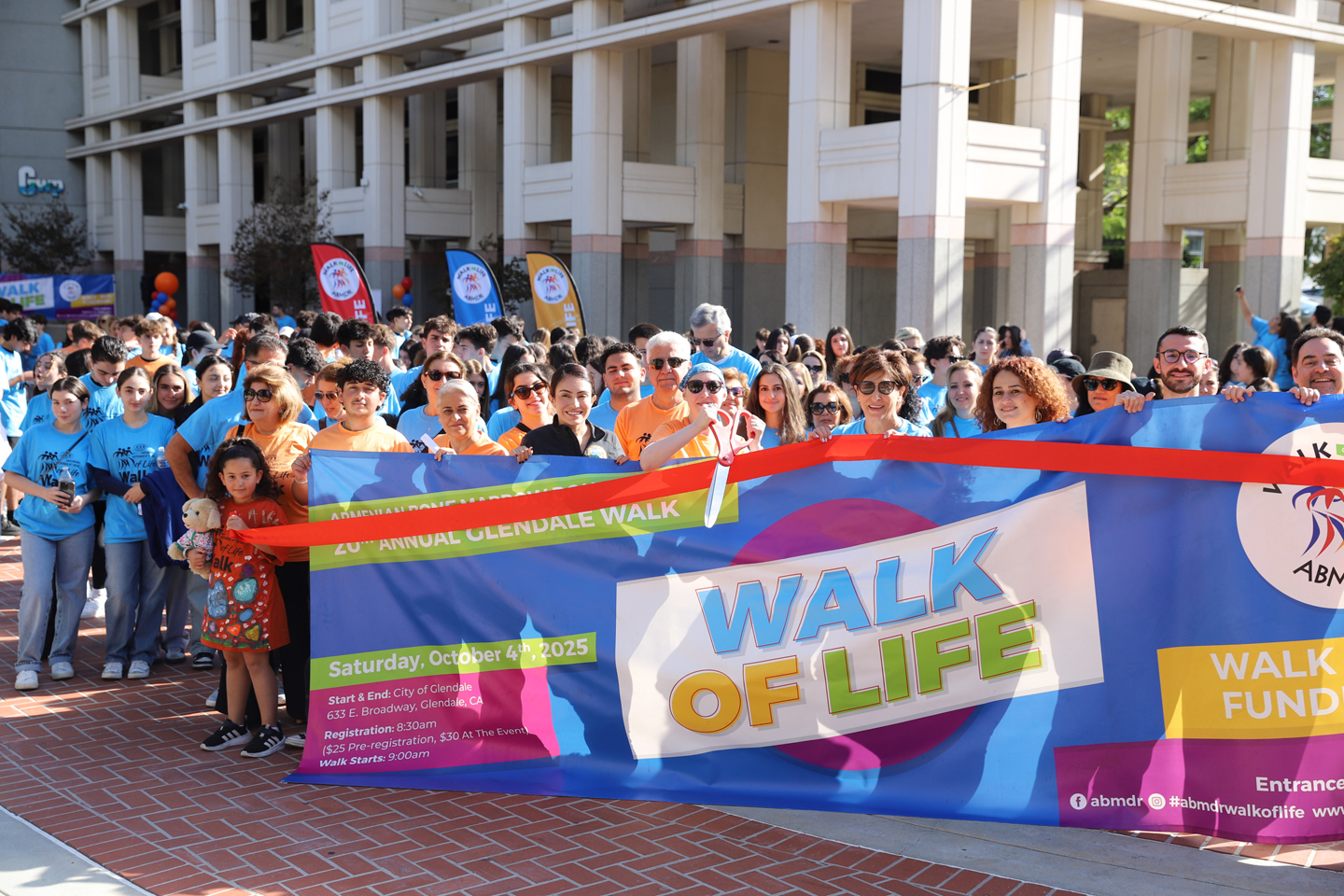

The Armenian Bone Marrow Donor Registry holds its 21st annual Walk of Life this Saturday, October 3, at the plaza of the Glendale City building, where volunteers will swab and register new stem cell donors through the morning.
Registration opens at 8:30 a.m. at 633 E. Broadway Ave. The 5K walk-run begins at 9:00 and loops through central Glendale before returning to the plaza.
Adult registration is $25 in advance and $30 on the day. Students and kids pay $10, and students receive 8 hours of community service for walking. Participants can sign up individually, form a team, or join an existing one at abmdr.am.
Last year’s walk drew close to 400 supporters, with teams from the USC Armenian Students’ Association, Glendale Community College, AGBU Manoogian-Demirdjian School, Ferrahian High School, Providence High School, and Rose and Alex Pilibos Armenian School. The Walkathon Committee is co-chaired by Medik Aghbalian and Khachig Boghossian.
Anyone between 18 and 50 in good general health can register on site. The process takes a short form and a few cheek swabs, and a donor stays in the database until age 55.
Transplants succeed or fail on human leukocyte antigen type, known as HLA, a group of proteins inherited as one set from each parent and carrying an enormous number of possible variants. Blood type plays no role.
Armenians carry a distinct HLA profile, separated over centuries by geography, language, and religion from the European, Mediterranean, and Asian populations that fill the global databases. An Armenian patient is most likely to match another Armenian, and searches of the large international registries frequently come back empty.
Only 25 percent of leukemia patients find a matching donor among their own relatives. The other 75 percent depend on a matched unrelated donor.
ABMDR was founded in 1999 by Dr. Frieda Jordan and Dr. Sevak Avagyan, and has since recruited more than 33,500 donors across 35 countries on 4 continents, processed over 9,000 patient referrals, and facilitated 45 bone marrow transplants.
The registry runs its own laboratory and Stem Cell Harvesting Center in Yerevan, an operational office in Los Angeles, recruitment centers on both American coasts, and representatives in Artsakh, Iran, Lebanon, Germany, and Russia.
The Yerevan laboratory is accredited by the European Federation for Immunogenetics, and ABMDR holds membership in the World Marrow Donor Association, Bone Marrow Donors Worldwide, and the American Society for Histocompatibility and Immunogenetics, along with cooperative membership in the National Marrow Donor Program. Those memberships allow a transplant center in Europe to search an Armenian donor file.
The same facility has banked over 200 cord blood units, performed kidney transplant compatibility testing, trained scientists and students, and carried out the Soldiers’ DNA identification project.
A matched donor receives injections of Filgrastim over 4 days to move stem cells from the marrow into the bloodstream, then gives cells through apheresis. The procedure takes a few hours and requires no anesthesia or surgery.
NextGen, the registry’s youth arm, expanded recruitment onto campuses including UCLA and UCSD over the past year. Executive director Jeffrey Balian said a drive at UCLA’s Coachellian collected over 25 new swab samples in one night.
Walk-up registration opens at 8:30 a.m. Saturday, and advance registration is open now at abmdr.am.