
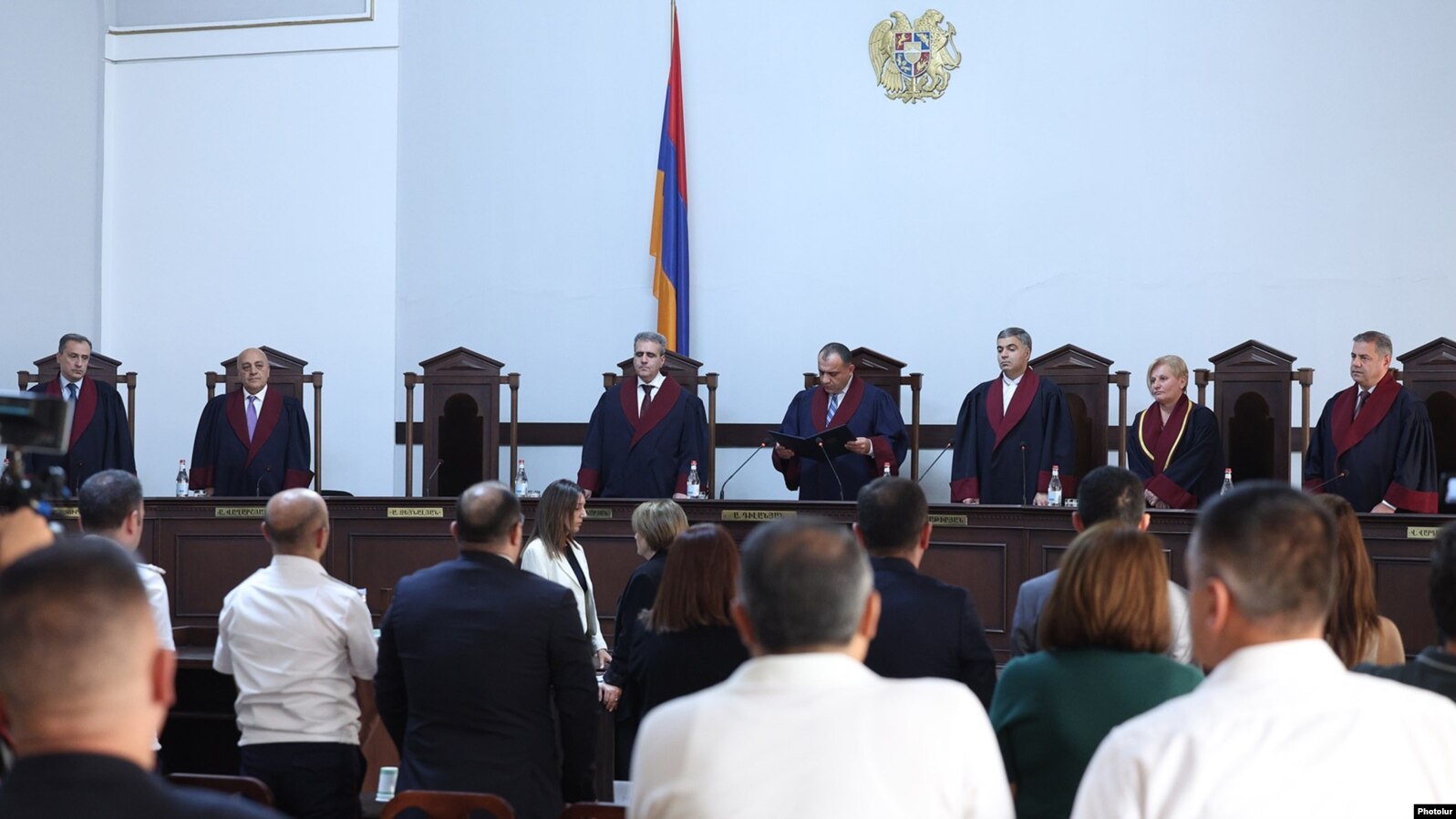

Armenia’s Constitutional Court ruled on Wednesday that the obligations in the Framework Agreement on Strategic Cooperation between Armenia and the United States concerning the Trump Route for International Peace and Prosperity comply with the Constitution, the court’s External Relations Department said.
The court reached that conclusion within hours of opening the case on Tuesday morning. The full text of the decision will be published within 3 days, after which the agreement goes to the National Assembly for ratification.
Foreign Minister Ararat Mirzoyan presented the ratification bill to the cabinet on July 16, and the government applied to the court on July 17. The court had until October 17 to rule.
Judge Edgar Shatiryan served as rapporteur and the case was heard in writing. Asked by Factor TV whether the court might switch to oral proceedings given the level of public interest, Shatiryan said the case could be examined effectively in writing, and that all Constitutional Court decisions are posted on the court’s website and become available to the public.
Mirzoyan and Secretary of State Marco Rubio initialed the framework agreement in Yerevan on May 26. It was signed on June 1 in Washington and on June 4 in Yerevan. Deputy Foreign Minister Vahan Kostanyan represented the government before the court.
The agreement creates a joint venture called the TRIPP Development Company, with the United States holding a 74 percent controlling stake and Armenia 26 percent. Armenia grants the company exclusive land use rights, development rights and related permissions for an initial term of 49 years, covering a railway, a road, energy and digital infrastructure along the corridor. The company may form special purpose vehicles and bring in other partners for individual projects.
The shareholders may extend those rights by mutual consent for a further 50 years when the initial term expires. If they do, Armenia’s stake rises to 49 percent, and the agreement specifies that the extension is the sole consideration Armenia provides in exchange.
Armenia is obliged to ensure the land along the implementation areas is or becomes Armenian property and is free of encumbrances or third-party rights, and to bear all financial costs of doing so. Armenia also remains the sole grantor of any concession.
The route would run through Syunik Province along Armenia’s border with Iran, connecting Azerbaijan to its Nakhichevan exclave and onward to Turkey. It covers ground that Azerbaijan and Turkey have long called the Zangezur Corridor, and emerged from the August 8, 2025 summit in Washington between Trump, Pashinyan and Aliyev.
The framework states that Armenia’s sovereignty and jurisdiction over its borders and customs operations are absolute. It also commits Armenia to a front office and back office model, under which private operators hired by the TDC provide customer-facing services at the crossings with Azerbaijan while Armenian officials take a back office role.
Armenia’s Justice Ministry told the cabinet in July that those arrangements run counter to Armenian law making border control the exclusive prerogative of state bodies, and questioned the legality of the tax exemptions planned for the TDC and its subsidiaries. It recommended approval anyway, citing political reasons.
Aliyev said last year that Azerbaijanis traveling to and from Nakhichevan should not see the faces of Armenian border guards. Pashinyan has said modern technology will be used to exclude physical contact between Armenian officials and Azerbaijani travelers, which his critics cite as evidence that TRIPP amounts to the extraterritorial corridor Baku has sought.
Iran opposes the project, concerned that it could bring a US security presence to the Armenian-Iranian border and weaken Armenian control of it. Iran’s ambassador to Armenia said on July 8 that Yerevan had not addressed Tehran’s concerns.
Pashinyan has said the government wants work on site to begin this fall. Armenia’s ambassador to the United States and Azerbaijan’s foreign minister have both since indicated construction is more likely to start early next year.
Armenia and Azerbaijan have not signed a final peace agreement. Baku has said it will not do so until Armenia removes territorial references from its constitution, a change requiring a referendum scheduled for 2027.


