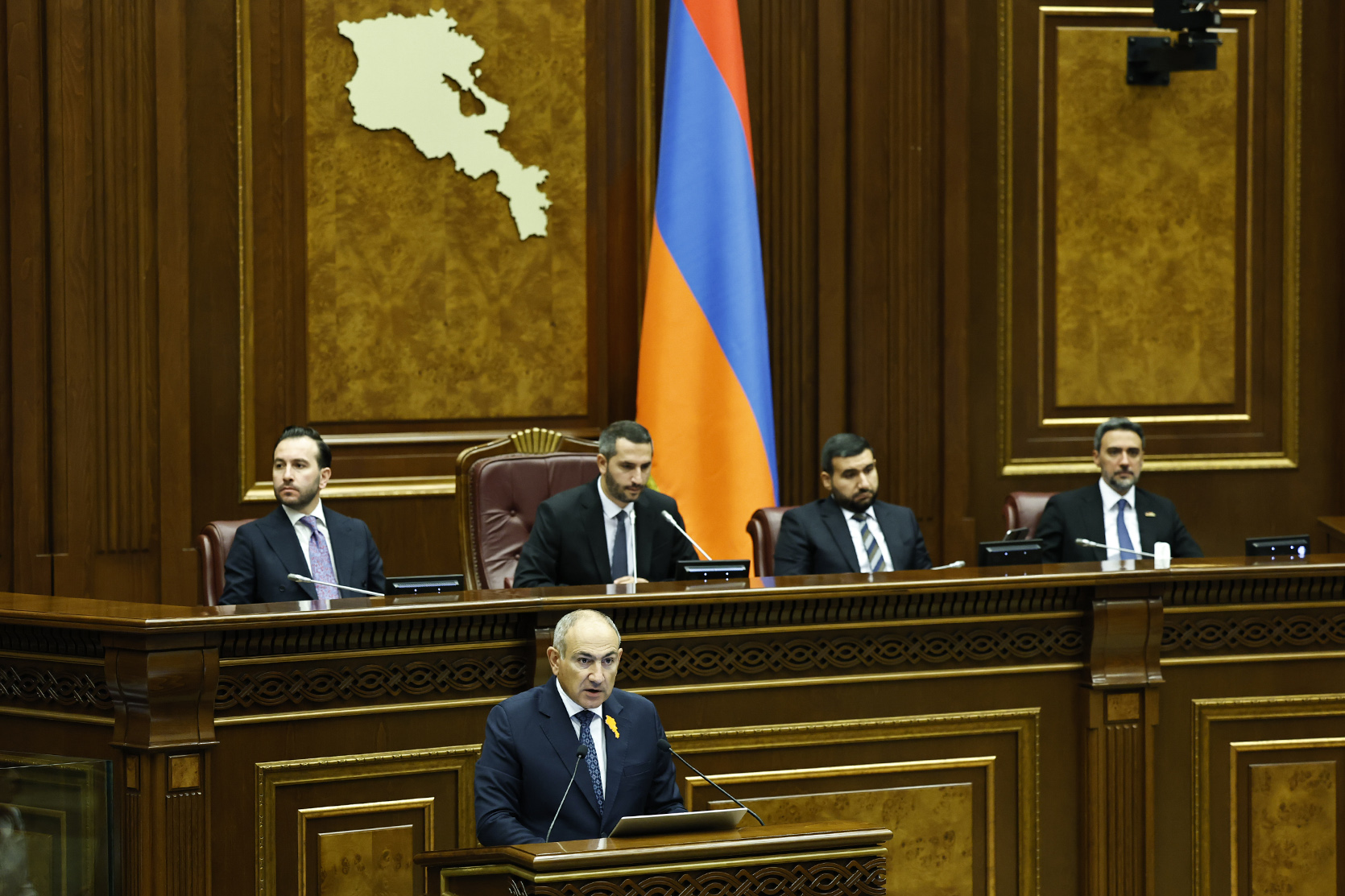

Prime Minister Nikol Pashinyan presented his government’s 2026-2031 program to the National Assembly on Monday, August 24, declaring the founding of what he called Armenia’s “Fourth Republic” and announcing that Yerevan will soon begin applying for European Union membership.
The June 7 elections returned his Civil Contract party to power with 49.81 percent of the vote. Under the “Real Armenia” ideology voters endorsed, Pashinyan said, the sole functional significance of the Republic of Armenia is to ensure peace, freedom, security and well-being for its citizens within its internationally recognized territory of 29,743 square kilometers, and to preserve and develop the identity of the people.
“We can state that the Fourth Republic has been established; it is a reality,” he said. The current state is known as the Third Republic, successor to Soviet Armenia, which followed the First Republic of 1918 to 1920. Pashinyan unveiled the “Real Armenia” doctrine in 2025 and has since said it made peace with Azerbaijan possible.
Pashinyan Calls to End Weaponizing the Armenian Genocide
Pashinyan reaffirmed that international recognition of the Armenian Genocide is no longer a priority of Armenia’s foreign policy, a position he first stated to Turkish journalists in March 2025, and accused outside actors of using the “bones of our martyrs” as a weapon against one another.
He pointed to Israel, whose cabinet unanimously backed recognition on June 28. The Knesset then ran out its four-year term on July 17 without holding the vote that would have made it state policy, after Azerbaijani back-channel lobbying of Prime Minister Benjamin Netanyahu’s office reported by Haaretz.
“We must put an end to this process of weaponizing the Armenian Genocide, because even if we are naive enough to think that it is a weapon in our hands as well, we have been killed again and again by the shots of that weapon, and we will be killed again and again,” he said.
“April 24 is our April 24. The Tsitsernakaberd Memorial Complex is our Tsitsernakaberd Memorial Complex,” Pashinyan told lawmakers, adding that Armenia should be a homeland-state rather than a graveyard for the victims of massacres, deportations and genocide and their descendants. Armenians should stop dreaming of another homeland, he said, because Armenia is “the homeland of our dreams.”
Pashinyan: The Artsakh Movement Was a Project to Nullify Armenia’s Statehood
Pashinyan returned to his 2019 declaration that “Artsakh is Armenia, period,” telling lawmakers he wanted to put it to rest for good. Armenia spared nothing for Artsakh (Nagorno-Karabakh) across 35 years, he said, and his government allocated more than $1 billion there, measured against the same span under previous administrations.
“We had the courage to open the curtain and see that the Karabakh movement was nothing other than a project aimed at nullifying Armenia’s statehood and future, and with the mandate given by the people, we closed that project,” he said.
Armenians should stop searching for Armenia in Azerbaijan, Turkey, Iran and Georgia, Pashinyan said, because doing so invites all four neighbors to search for their own homelands inside Armenia’s internationally recognized territory. He called the result a one-against-four situation, and described the conflict over Artsakh as a trap the Armenian people recognized long before their leaders did.
PM: Armenia and Azerbaijan Must Both End Talk of Return
Making the peace irreversible requires ending discourse inside Armenia about the return of Artsakh Armenians and the right of Armenian refugees from Azerbaijan to return home, Pashinyan said, and ending discourse inside Azerbaijan about the “right of Western Azerbaijan and Western Azerbaijanis to return.”
“We must stop looking for Armenia in Azerbaijan, and Azerbaijan must stop looking for Azerbaijan in Armenia,” he said.
Azerbaijan’s September 2023 offensive ethnically cleansed Artsakh, forcibly displacing more than 120,000 Armenians from a homeland now under Azerbaijani occupation. An international fact-finding mission found that Baku waged a deliberate campaign to empty Artsakh of its Armenian population, meeting the definition of ethnic cleansing set out by a UN commission of experts, and that the acts documented constitute war crimes and crimes against humanity.
“Western Azerbaijan” is a term Baku applies to the sovereign territory of the Republic of Armenia, and Azerbaijani officials have used it to assert a right of settlement there.
Both states must also accept that independent Armenia’s territory is identical to Soviet Armenia’s, and independent Azerbaijan’s to Soviet Azerbaijan’s, no more and no less, he said, calling this the socio-psychological condition for lasting peace.
Armenians Unlawfully Held in Baku Sentenced to Life, With No Timeline for Release
The release of Armenians held in Azerbaijan and their return home has never left the government’s working agenda and will not leave it until the issue is resolved, Pashinyan said. He gave no timeline. Delimitation of the border will continue, he said, and he expects exports from Armenia to Azerbaijan to begin soon alongside imports moving the other way.
A Baku military court sentenced 15 Armenians on February 5 on fabricated charges, after a closed trial Amnesty International called a travesty. Life terms went to former Artsakh president Arayik Harutyunyan, Defense Army commander Levon Mnatsakanyan, his deputy Davit Manukyan, parliament speaker Davit Ishkhanyan and foreign minister Davit Babayan, with 20 years each for former presidents Arkadi Ghukasyan and Bako Sahakyan.
Former state minister Ruben Vardanyan was tried separately and given 20 years. The Baku Court of Appeal rejected the appeals on August 6, leaving all sentences in place and 16 Armenians unlawfully imprisoned. Neither the initialed peace agreement nor the Washington declaration commits Azerbaijan to release them.
New Constitution Will Carry No Reference to the Declaration of Independence
The text of the new constitution will be published in the coming months, Pashinyan said, and it should contain no reference to Armenia’s 1990 Declaration of Independence.
“Referring to the Declaration of Independence in the new Constitution would mean continuing the Karabakh movement, would mean returning to the logic of conflict,” he said. “We cannot do this, especially after the 2026 elections, in which our people voted for peace.”
Armenia and Azerbaijan initialed a peace agreement in Washington on August 8, 2025, and Baku has since made constitutional change its condition for signing, claiming the preamble’s reference to the Declaration, which cites a 1989 act of the Soviet Armenian and Artsakh legislatures, amounts to a “territorial claim.” The Armenian government rejects that reading, and Armenia’s Constitutional Court has ruled the constitution contains no territorial claim against any country.
Pashinyan called the constitutional agenda domestic, adopted in February 2020 and carried in the Civil Contract election program. His substantive case rests on the courts, which he described as caste-based, still serving former elites, and generating judicial power through procedures with no organic connection to the people. Only a new constitution can change that and introduce trial by jury, he said, which is why corrupt circles work to brand the agenda an Azerbaijani one.
No adoption date has been set. Any new constitution requires a nationwide referendum, and Civil Contract fell short of a constitutional majority in June.
Armenia to Apply for EU Membership Before Holding a Referendum
Armenia will begin submitting an official application in the near future, Pashinyan said, and a referendum will follow rather than precede it. He argued at a Eurasian Economic Union summit earlier this month that putting the question to voters first would ask them to choose between two options, one of which does not exist.
He cited the May 29 statement in which the leaders of the four other Eurasian Economic Union members called for a referendum in Armenia on joining the EU or remaining in the EAEU as soon as possible, calling it a friendly gesture. Russian restrictions on Armenian exports, imposed in stages since April and covering nearly all agro-food shipments, contradict EAEU regulations and amount to a crisis for the bloc rather than for Armenia, he said.
Armenia is the only country now in active visa liberalization talks with the EU, with visa-free travel targeted during 2029. The National Assembly adopted a law launching the accession process in March 2025.
Pashinyan Would Be “Very Happy” if the CSTO Expelled Armenia
Asked about withdrawal from the Collective Security Treaty Organization, Pashinyan said Armenia’s interest in the bloc has been exhausted and that no answers ever came to the questions Yerevan raised.
“I would be very happy if the organization decided to expel the Republic of Armenia from the CSTO, as this would free us from the dilemma of whether or not to leave,” he said. Armenia froze its participation in February 2024 and has no plans to return within five years.
Kremlin spokesman Dmitry Peskov responded that Yerevan is free to leave if it no longer considers membership necessary, and warned that aligning Armenian trade, phytosanitary and customs law with European standards would contradict EAEU standards and harm Armenia first.
Pashinyan went further on Russia’s export restrictions, saying they are encouraged and requested by Armenian opposition figures who promised circles in Russia that economic pressure would deliver them victory on June 7 and who now promise to force a change of government through street protests.
He tied this to the “secret plan” described after the elections by Strong Armenia Alliance leader Samvel Karapetyan, whom he called a leader of the “three-headed war party.” Similar plans have failed before, he said, and this one will fail because Armenians will not surrender their statehood to the mafia.
Closer ties with Brussels have caused concern in Moscow, but the deeper cause is the transformation of Armenia-Russia relations, which he called a natural process. For two centuries those relations rested on Russia guaranteeing Armenian security, he said, and the events of 2021, 2022 and 2023 showed Moscow can face significant limitations in that role.
Pashinyan Asks Moscow to Sell the Railway Concession as TRIPP Advances
The Trump Route for International Peace and Prosperity, which grew out of the Crossroads of Peace project and the Washington summit of August 8, 2025, will run along the Nrnadzor-Agarak route on Armenia’s southern border and carry pipelines, roads, cables and power lines alongside rail. Power lines will likely go in first.
Armenia will hold 26 percent of TRIPP Development Company and the United States 74 percent for at least 49 years, after which, if both sides extend, the split becomes 49 and 51 percent for another 50 years with no further Armenian investment. The framework agreement is in ratification. TRIPP entails no foreign military or armed presence, Pashinyan said.
He then repeated his call for Moscow to give up Armenia’s railway. Investors and freight carriers are looking for ways to bypass the Yeraskh-Akhurik section because Russian Railways operates it under concession, he said, and sanctions on Russia make them treat the infrastructure as a risk.
“The railway is owned by Armenia and is merely under the management of Russian Railways, and we have no problem with this fact,” Pashinyan said. “This is why we ask our partners in the Russian Federation to show flexibility and sell the concession rights to a third country acceptable to both Armenia and Russia.”
Russian Railways took over under a 30-year concession signed in 2008 during Robert Kocharyan’s presidency, running through 2038. Pashinyan first raised the transfer in January, has floated Kazakhstan and Qatar as operators, and has been rebuffed by Moscow. Meanwhile construction of the Kars-Nakhichevan railway in Turkey has picked up pace, and the fourth section of the government program commits to revising the railway’s management system so it does not obstruct Armenia’s integration into international transport.
Armenia to Decide Within a Year on a New Nuclear Plant
Armenia is adopting a strategy of energy independence, Pashinyan said, a goal that solar development has only recently made realistic. Installed solar capacity has gone from 16 megawatts in 2018 to 1,213 megawatts, and the government will add at least 800 megawatts of storage by 2031, roughly twice the capacity of the operating nuclear plant, so that power generated during the day can supply the grid at night.
“Over the next year, we must finally decide with whom and what kind of nuclear power plant we will build, because the operating life of the existing nuclear power plant expires in 2036,” he said, adding that Armenia assumed the obligation to shut the plant down before the 2018 revolution. Developing technologies may allow another extension beyond 2036, and talks with potential partners are underway, with any decision taken alongside competent international bodies.
Government Targets $2 Billion in Recovered Assets by 2031
Pashinyan committed his government to completing the unfinished agenda of the 2018 velvet revolution, covering justice, the end of impunity and oligarchy, and recovery of illegally acquired property.
About 304.2 billion drams have already been returned to the state, and Armenia now holds stakes in the Zangezur Copper Molybdenum Combine, the Amulsar project and Viva Armenia. The program targets about $2 billion in recovered property by 2031, with proceedings around Electric Networks of Armenia, AraratCement and the Tsaghkadzor cable car underway. He also told lawmakers the government has come very close to ending extreme poverty and expects fresh international studies to confirm it.
The 2026-2031 program remains before the National Assembly, where it requires a parliamentary vote.