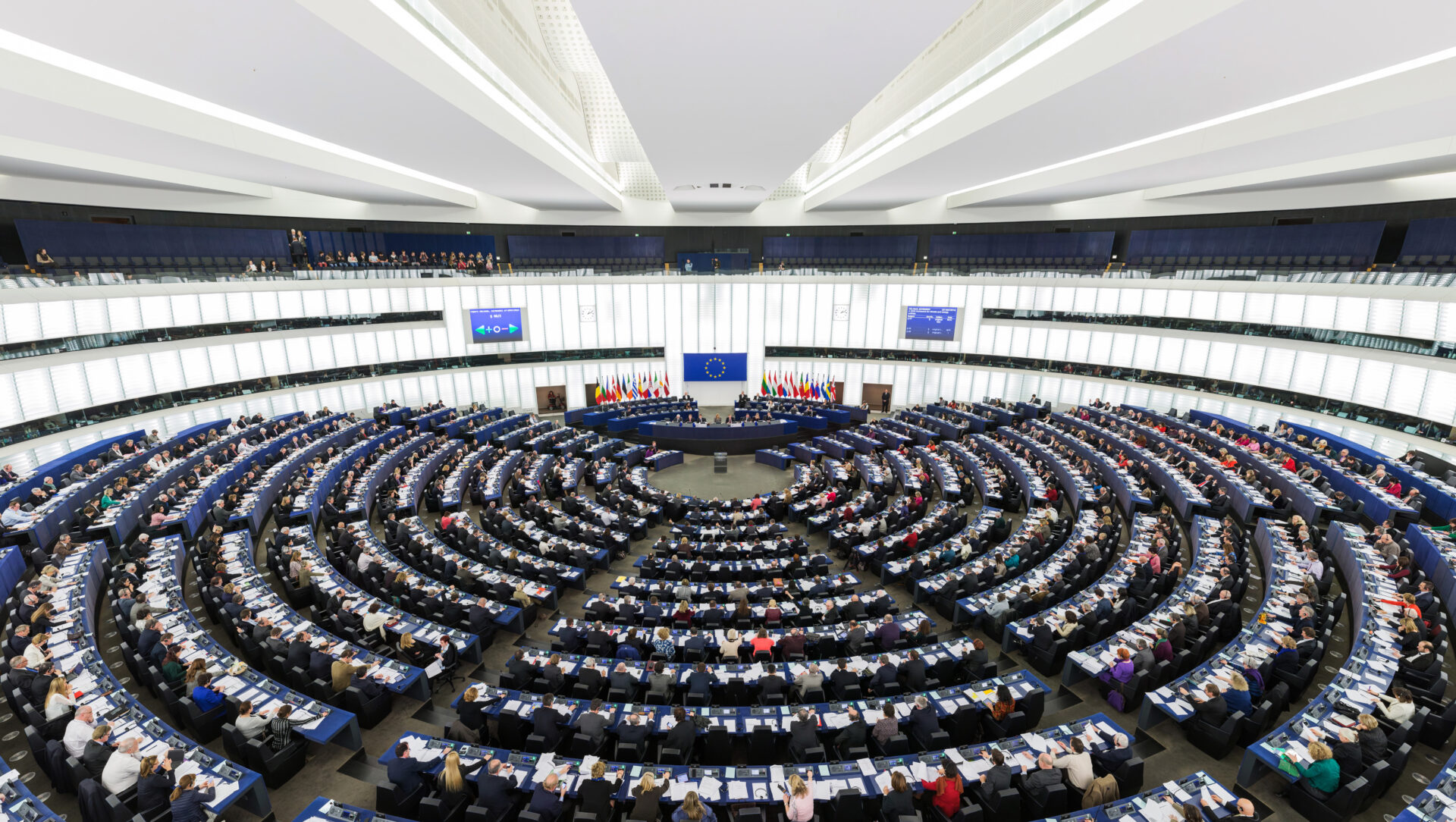

The European Parliament has demanded the immediate and unconditional release of the Armenian hostages held in Azerbaijan, just days after 101 members of the United States Congress asked Secretary of State Marco Rubio to withhold military aid to Baku until it frees them.
MEPs adopted the resolution on October 8 by 492 votes to 23, with 60 abstentions, out of 575 voting. It condemns political repression in Azerbaijan and calls for the release of all those held on politically motivated grounds.
The Armenian prisoners were not in the original text. French MEP Marina Mesure, a co-author, said she secured their inclusion during final negotiations the day before the vote.
“In negotiations this week, I obtained that they appear in the final text,” she said afterwards.
She had explained how the day before, in an interview with the Armenian outlet Factor TV. “I know this issue would normally have been considered outside the scope of the resolution, but I said that since we are discussing political prisoners in Azerbaijan, we must also discuss Armenian political prisoners,” Mesure said.
The motion she tabled on behalf of The Left Group expressed deep concern over the continued detention of Armenian political prisoners and prisoners of war in Azerbaijan, including former high-ranking representatives of Artsakh (Nagorno-Karabakh), and called for their immediate and unconditional release. Mesure says that language made the final text.
She Named Two EU Visits. The Final Text Did Not.
Mesure said she regretted the gap between the Parliament’s positions and the reality of the EU’s relations with Azerbaijan, and her motion put names to it.
Commission President Ursula von der Leyen visited Baku on July 1 and met Ilham Aliyev, with talks focused on energy and deepening EU-Azerbaijan relations. In September, Magdalena Grono, the EU Special Representative for the South Caucasus and the crisis in Georgia, visited occupied Artsakh on a trip organized by the Azerbaijani authorities.
Her motion deplored the failure of EU representatives during those visits to publicly raise the cases of political prisoners, and warned that such silence risks undermining the credibility of the EU’s human rights policy.
The adopted resolution asks the EU High Representative to ensure that diplomatic engagement upholds democratic values. It names no visit and no official.
“I would also have preferred wording expressing regret that, during recent high-level visits to Azerbaijan, EU representatives did not call for the release of political prisoners,” Mesure said.
The Men the Resolution Is Named For
The formal subject is Azerbaijani rather than Armenian. The text is titled for the cases of Ali Karimli, Anar Mammadli and political prisoners in Azerbaijan, filed as 2026/2914(RSP).
MEPs condemned the detention of Karimli, who heads the Azerbaijan Popular Front Party, of Mammadli, and of Mammadli’s co-accused, journalist Anar Abdullayev, and called for their immediate and unconditional release.
Karimli has been held since November 29, 2025, on charges of attempting to seize power and forcibly change the constitutional order, carrying a potential life sentence. He denies them and no credible supporting evidence has been publicly disclosed. Citing human rights organizations, the resolution describes restricted contact with relatives, restricted food deliveries, limited access to drinking water, lack of ventilation, sleep deprivation, dehydration and fainting, calls those conditions torture or cruel treatment, and demands an independent investigation.
Mammadli, a human rights defender and election monitor, was sentenced on September 7 to 13 years. Abdullayev received 12. The European Court of Human Rights previously found Mammadli’s detention politically motivated, and in the Mammadli group of cases found a pattern of politically motivated arrests aimed at silencing government critics. Azerbaijan has not fully implemented those judgments.
Azerbaijan holds more than 300 political prisoners, and a local campaign group published a national list of 322 names on October 6.
MEPs asked the EU High Representative to prepare targeted measures under the EU Global Sanctions Regime, said any future EU-Azerbaijan partnership agreement must be conditional on tangible human rights improvements including the release of political prisoners, and called on the Commission to support civil society and independent media in Azerbaijan and in exile. They condemned transnational repression of opponents abroad and asked member states to scrutinize Baku’s extradition requests.
The resolution also raised the detention of EU citizens, naming French national Anass Derraz. He is the second Frenchman held in Baku. Aliyev pardoned Martin Ryan, a businessman sentenced in March 2026 to 10 years for espionage, among a group of 20 in September. Derraz, serving 12 years on corruption charges, was not included. France has blocked Azerbaijan’s NATO partnership programme over Ryan’s detention, and Turkey blocked Armenia’s in response.
The Resolution Named No Azerbaijani Official
It was one of 3 human rights resolutions adopted that Thursday. The Iran text passed 541 to 11, the Georgia text 445 to 37.
Finnish MEP Sebastian Tynkkynen accused the EU of double standards for maintaining economic relations with Azerbaijan amid repression and more than 300 political prisoners, and said partnership with Europe is incompatible with political persecution.
An analyst in Baku told Caucasian Knot the resolution kept its diplomatic restraint. The rhetoric hardened, he said, but on sanctions it lacks specificity and targeting, because the previous resolution identified specific addressees while this one refrains from naming individuals.
The comparison holds across all 3 texts that day. For Georgia, MEPs named Bidzina Ivanishvili, Irakli Kobakhidze, Shalva Papuashvili and Kakha Kaladze as sanctions targets. In March 2025, on the Armenian hostages, they named prosecutors and judges Jamal Ramazanov, Anar Rzayev and Zeynal Agayev. The Azerbaijan text names no official at all.
The analyst said Baku would dismiss the resolution but argued they still matter, noting the Parliament raised Gubad Ibadoghlu’s case repeatedly before he was finally allowed to leave for urgent medical treatment in Europe. The October 8 text welcomed his arrival and called for all prosecutions against him to be dropped.
Congress Asked the Same Thing Days Earlier
The congressional letter, dated October 5 and announced on October 7, was signed by 26 senators and 75 representatives from more than 25 states. It asks Rubio to enforce Section 907 of the FREEDOM Support Act and withhold military assistance to Azerbaijan unless Baku releases the Armenian hostages, protects Armenian cultural heritage and withdraws its forces from Armenian territory.
Both bodies reached for the same lever, tying aid and partnership to the prisoners. Neither is binding. The letter asks a secretary of state to use discretion he already holds, and a resolution does not direct the Commission or the Council.
Hours before the vote, Parliament President Roberta Metsola and the Irish Minister of State signed the measure on temporary trade liberalisation for Armenian products.
The Parliament Has Asked Before, and Baku Stopped Listening
In May 2021 the Parliament demanded the immediate and unconditional release of all Armenian prisoners by 607 votes to 27, citing reports that around 200 were held. It condemned Azerbaijan’s attack on Artsakh in October 2023 by 491 to 9, and passed 3 more resolutions on Azerbaijani repression across 2024, two of which cited 23 Armenian prisoners including 8 former leaders of Artsakh. In March 2025 it adopted a text specifically on the unlawful detention and sham trials of Armenian hostages by 523 votes to 3, noting Ruben Vardanyan’s hunger strike and Baku’s order to close ICRC and UN offices, calling on the International Criminal Court to investigate the ethnic cleansing of Armenians, and demanding suspension of the 2022 EU-Azerbaijan energy memorandum.
Baku broke off contact earlier this year, after a resolution supporting democratic resilience in Armenia backed the right of Artsakh Armenians to return and demanded the prisoners’ release. Azerbaijani parliamentarians suspended all ties between the Milli Majlis and the European Parliament, the Foreign Ministry handed a note of protest to the EU ambassador, and speaker Sahiba Gafarova said the last 10 years had shown the Parliament has no intention of abandoning what she called its biased activities, which the restoration of our territorial integrity had only intensified. Analysts called the rupture largely symbolic, costing Azerbaijan little while removing a channel for European pressure.
Armenia says 19 Armenians remain unlawfully held in Azerbaijan. In February 2026 Azerbaijan sentenced 16 of them, the political and military leadership of Artsakh, to terms ranging from 15 years to life, following trials that international human rights organizations, legal experts and the European Parliament condemned as a miscarriage of justice. June 23, 2026 marked the 1,000th day of their detention.
Follow @ZartonkMedia, your home for all things Armenian. ??