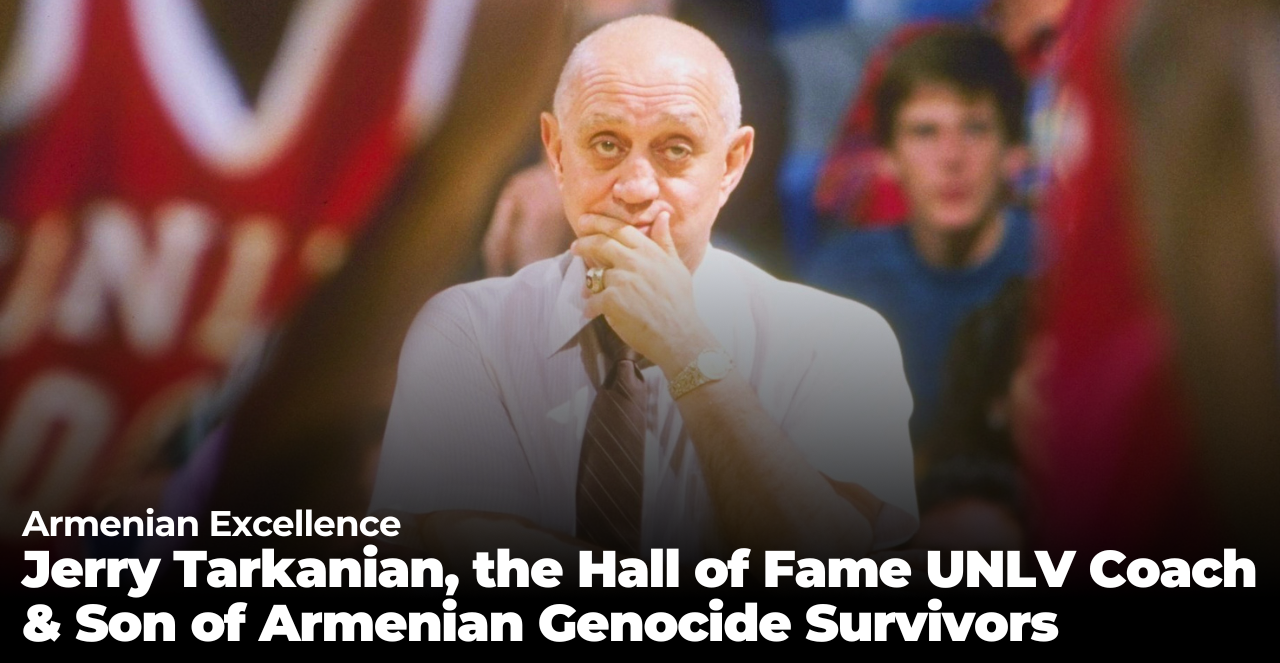

Jerry Tarkanian revolutionized college basketball and became one of the most legendary coaches in the sport’s American history. He compiled the 6th-highest winning percentage in the history of the sport. He won a national championship at UNLV in 1990. He was inducted into the Naismith Memorial Basketball Hall of Fame in 2013.
Tarkanian coached college basketball for 31 seasons across five decades. He compiled a Division I record of 784 wins against 202 losses. He took UNLV to four Final Fours, won a national championship in 1990, and never had a losing season.
His mother, Haigouhie “Rose” Tarkanian, had fled the Ottoman Empire on horseback with only the clothes on her back. Her father and brother had been beheaded by Turkish authorities. The rest of her family had been herded into a church and burned alive. She escaped to Lebanon, where she met and married George Tarkanian, another survivor of the Genocide. They immigrated to Euclid, Ohio. Their eldest son, Jerry, was born on August 8, 1930.
Jerry Tarkanian had a brother, Myron, and a sister, Alice. His father George died when Jerry was 13. Jerry’s stepfather told him he would never amount to anything and should look into becoming a barber. His mother told him otherwise.
The family lived in poverty. Jerry later told the story of his college years at Fresno State: he and his friend Harry Gaykian would go to a coffee shop, order hot water, add ketchup and crackers, and call it tomato soup.
Tarkanian graduated from Fresno State in 1955. He earned a master’s degree in educational management from the University of Redlands. He began his college coaching career in 1961 at Riverside City College in California, then Pasadena City College, and in 1968 was hired to run the basketball program at California State University, Long Beach.
In 1973 he became head coach of the University of Nevada, Las Vegas Runnin’ Rebels. He would hold the post for 19 years.
His pressing defense forced turnovers that his team converted into fast-break points at the other end of the floor. His teams averaged over 90 points per game. He recruited players other coaches would not touch, including junior college transfers and young men from difficult backgrounds, and made them into national contenders.
He took the Runnin’ Rebels to four Final Fours: 1977, 1987, 1990, and 1991. On April 2, 1990, in Denver, UNLV defeated Duke 103 to 73 in the NCAA championship game. It remains the largest margin of victory in any NCAA men’s basketball championship final in history.
He was known as “Tark the Shark.” His towel-chewing habit began in 1956, when he was coaching a Redlands High School team in a championship game in a Riverside gym with only one water fountain. He soaked a towel under the fountain and carried it back to the bench. He chewed the towel at every game he coached for the next 46 years. UNLV’s equipment manager kept a diagram on file showing how the towel had to be folded before each game.
Tarkanian fought the NCAA for the entirety of his professional career. He believed the organization went after him because of the players he recruited. “Nine out of 10 schools are cheating,” he once said. “The other one is in last place.” He sued the organization in 1992 and eventually won a $2.5 million settlement, but remained bitter about how the NCAA had treated him. “They’ve been my tormentors my whole life,” he said at his 2002 retirement press conference. “It will never stop.”
After leaving UNLV in 1992, he briefly coached the San Antonio Spurs, going 9-11 before being fired in a dispute with ownership. In 1995 he returned to his alma mater, Fresno State, where he had six straight 20-win seasons before retiring in 2002.
In 2013, Jerry Tarkanian was inducted into the Naismith Memorial Basketball Hall of Fame, the first UNLV coach or player ever enshrined. That same year, UNLV announced that a statue of Tarkanian would be installed outside the 18,500-seat campus arena his program had built.
In his Hall of Fame acceptance speech, he spoke about his mother: “Here, the eldest son of an Armenian immigrant whose mother fled her homeland on horseback with only the clothes on her back, after her father and brother were beheaded by Turkish soldiers, it was my mother who gave me her unconditional love and many second chances. I was 13 when my father died. My stepfather said I would never amount to anything so much with sports all the time, and that I should look into becoming a barber. But my mother never gave up on me. So to mom, and all my Armenian family, especially my brother Myron and my sister Alice, thank you for your loyalty and love all these years.”
The night before Jerry Tarkanian died, fans attending UNLV’s game against Fresno State draped white towels over the statue outside the arena. The statue shows him sitting in a courtside chair, chewing on a towel.
Jerry Tarkanian died at Valley Hospital Medical Center in Las Vegas on February 11, 2015. He was 84. His son Danny Tarkanian, who had played college basketball for him at UNLV, announced his father’s death that afternoon.
Rose Tarkanian had survived the Armenian Genocide on horseback and raised the man who would become one of the great American basketball coaches of the 20th century. Jerry Tarkanian never forgot who she was.
#JerryTarkanian #TarkTheShark #UNLV #ArmenianGenocide #ArmenianHeritage
Follow @ZartonkMedia, your home for all things Armenian. ??