
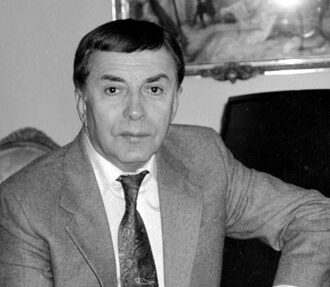

98 years ago today, on July 29, 1928, the legendary Armenian composer, pianist, and conductor Konstantin Orbelyan was born in Armavir, Russia, into the Armenian princely house of Syunik.
He was descended from the Orbelian dynasty, the medieval Armenian princely house that ruled Syunik from the early 13th century. Liparit and Tarsayich Orbelian, patrons of the Noravank monastery, had held the hereditary titles of prince, prince of princes, and commander-in-chief.
Across 36 years leading Armenia’s State Estrada Orchestra, he turned a provincial variety band into what critics recognized as the finest big band in the Soviet Union. He wrote symphonies, ballets, jazz, film scores, and popular songs across four decades of Soviet musical life. In 1975 his orchestra became the first Soviet jazz ensemble to tour the United States.
His father was martyred by firing squad in 1938 and his mother sent to the Stalinist camps until 1953. Konstantin and his brother Harry became children of “enemies of the people” overnight, at age 10.
Expelled from the school for gifted children in Baku because of his parents’ status, he worked from age 11 to survive. At 14 he was pianist for the jazz orchestra of the 8th Aviation Corps. When the band toured Yerevan, Artemi Ayvazian, founder of Armenia’s State Estrada Orchestra, heard the young improviser. Orbelyan offered him several unsolicited criticisms of the orchestra’s latest concert. Ayvazian’s response was to push him onstage at the next performance with no rehearsal. Orbelyan joined the orchestra the following year, at 15. In 1956, at 28, Ayvazian handed the orchestra to him. He would lead it for the next 36 years.
He converted the amateur variety band into a modern jazz orchestra and arranged Armenian folk material into jazz idioms. He smuggled Western records into Yerevan at personal risk and studied Glenn Miller and Michel Legrand underground. Party officials denounced his interest in improvisation as ideological sabotage and demanded that the orchestra abandon American jazz music, alien to the Soviet people. The orchestra continued. It was one of the very few Soviet big bands to survive both the Second World War and the Stalinist campaign against jazz. Around Yerevan it was known as “the bank of talent.”
Alla Pugacheva, Larisa Dolina, Jean Tatlian, and Datevik Hovanesian passed through its ranks. Pugacheva’s recording of Orbelyan’s “A Hundred Hours of Happiness” became a standard on Soviet radio. Aram Khachaturian, whom Orbelyan had met in 1948, remained a supporter for the rest of his life. Dmitri Shostakovich chaired the jury that awarded Orbelyan’s String Quartet the gold medal at the Moscow World Festival in 1957.
In 1975 the orchestra became the first Soviet jazz ensemble to tour the United States, playing 25 concerts across eight American cities including Lincoln Center in New York. The critic John Wasserman wrote that the visit was as culturally significant as a tour by the Bolshoi or the Kirov, if not more so. In New York, Orbelyan was photographed with the Armenian-American jazz producer George Avakian, who had recorded Miles Davis.
In 1977 the orchestra took the Grand Prix at the Belgrade jazz festival. Across his career it performed in more than 40 countries across Europe, the Middle East, Africa, and South Asia. In Beirut alone it gave 44 sold-out concerts.
His Symphony (1960), his “Festive Overture” (1968), and his ballet-choreographic symphony “Immortality” (1969) each won All-Union prizes across the 1960s and 1970s. He wrote five Soviet film scores between 1956 and 1970. His songs, including “Whisper of the Birches,” became Soviet standards.
For the orchestra’s 50th anniversary in 1989, Orbelyan reconstructed Ayvazian’s “Armenian Rhapsody” entirely from memory. The original score had been lost decades earlier. The reconstructed rhapsody returned to the concert program and stayed there.
Konstantin Orbelyan left Soviet Armenia for the United States in 1992, when the economic and energy crisis at the end of the Soviet Union emptied his orchestra and forced him to dissolve the ensemble he had led for 36 years. He settled in San Francisco, then Los Angeles, and continued to compose until his death. He passed away in Los Angeles on April 24, 2014, at 85. He is buried in the Komitas Pantheon in Yerevan.
He was named People’s Artist of the USSR in 1979 and received Armenia’s Order of St. Mesrop Mashtots in 2003.
His nephew, the conductor Constantine Orbelian, carries the namesake forward today as music director of New York City Opera.
“Serious music,” he once said, “is a daily, hourly bulletin of the human mood.”


