
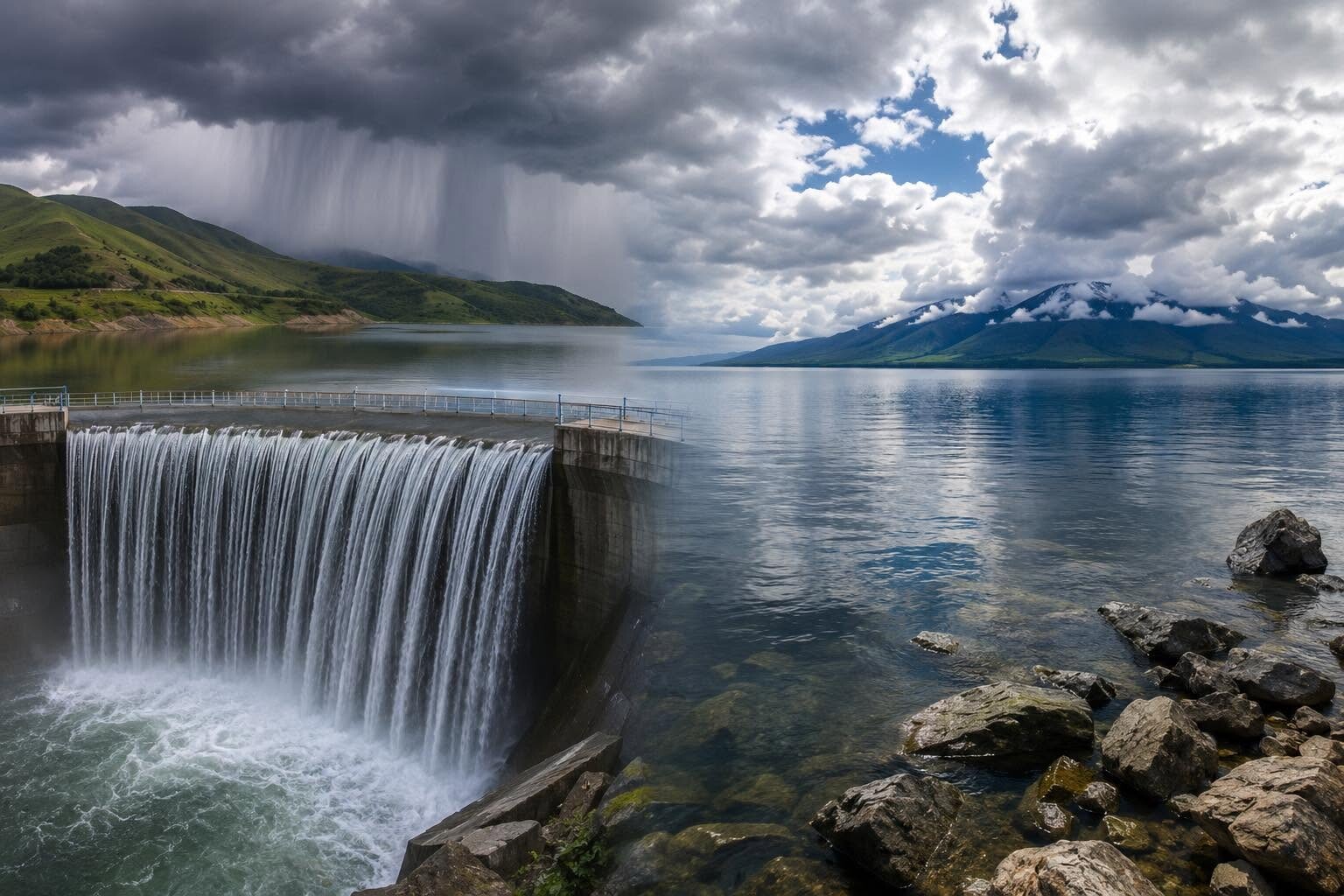

Days of intense rainfall and rising river inflows have replenished Armenia’s water resources and improved the country’s overall water picture, officials said, even as the heavy weather keeps the risk of flash floods and mudflows in play. The boost has pushed the country’s major reservoirs to high levels and lifted Lake Sevan, though specialists caution that a hot, dry summer could still shift the balance.
The rain over the past several days hit a number of provinces, including Shirak, Lori, Tavush, Aragatsotn, Kotayk, and Gegharkunik, driven by unstable weather and rising air currents. The downpours were short but heavy, in places bringing thunderstorms and hail, with daily totals reaching 20 to 25 millimeters. As of June 12, most of the country had received about 50 to 60 percent of the normal rainfall for June, which specialists say is not an extreme deviation but reflects how unevenly and intensely the rain has fallen.
The standout development came at the Aparan Reservoir, which filled to 100 percent for the first time since 2011. “Yesterday’s heavy rainfall left its mark on water resources,” said Levon Azizyan, Director of the Hydrometeorology and Monitoring Center, noting that Aparan was full and Lake Sevan had risen 2 centimeters from the previous day. A full Aparan keeps irrigation running steadily across the Aparan and Ashtarak regions and feeds the Arzni-Shamiram canal, which in turn reduces how much water has to be drawn from Lake Sevan, easing pressure on the country’s overall water balance.
Sevan itself is still rising. From January 1 to June 12, 2026, the lake’s level climbed 44 centimeters, ahead of the same stretch last year and nearing its long-term average. A rise of up to 2 centimeters in a single day is rare, Azizyan said, and usually happens when river inflows spike from heavy rain or snowmelt. “Overall, precipitation during the spring of 2026 reached about 198 millimeters, or 131 percent of the norm, which helped restore soil moisture, replenish surface and groundwater, and balance the water system as a whole,” he said.
The gains extend across the country’s reservoir network. Minister of Territorial Administration and Infrastructure David Khudatyan told lawmakers during a joint committee session on the 2025 budget that all major reservoirs have reached near-full capacity. “Due to precipitation in 2025 and 2026, all major reservoirs in the republic have reached near-full capacity. In some places, we have already carried out water releases due to overflow beyond capacity,” he said, adding that the storage indicators are positive and create favorable conditions for managing the country’s water resources.
The minister also addressed the Vedi Reservoir, the largest in Armenia, where preparatory works are ongoing. He said the reservoir is being filled and emptied in stages so the dam and base can build the strength needed for full-capacity filling, a routine technological step. Construction was completed in early 2025, and the first phase of filling officially began that April.
Specialists say the current conditions point to a positive irrigation season, with river flows near or above normal, major reservoirs running high, and Sevan in steady recovery. They caution, though, that the system remains highly sensitive to sudden weather swings, and that high summer temperatures and a drop in rainfall could still tip the balance.
The Kaps Reservoir
The Kaps Reservoir in Shirak province is set to become the largest project in the country’s reservoir construction sector, with a new design and tender now being prepared, Khudatyan said. “Last year, we terminated the contract with the Chinese company regarding the Kaps Reservoir, as significant deviations from the work schedule were noted. At the same time, the project is being updated. We are currently close to completing the design for the construction of a 60 million cubic meter reservoir, which is approximately two and a half times larger than the originally planned volume,” he said.
Construction of the Kaps Reservoir on the Akhuryan River in Shirak Province is currently suspended. In December 2025, the Ministry of Territorial Administration and Infrastructure and the Territorial Development Fund announced that work had been halted and the contract with the Chinese company Shanxi Construction Investment Group terminated over its persistent failure to meet the schedule and terms of the deal. The minister said that once the updated project is finished and clears all necessary assessments, a new tender will be announced in the hope of bringing in a company that can complete the reservoir on time.
The agreement to build the Kaps Reservoir was signed between the Armenian government and the German bank KfW in April 2023. The project budget was 97.8 million euros, including a 68.5 million euro loan from KfW with the rest co-financed by the Armenian government, while some reports put the total at roughly 95 to 120 million euros. The work is planned in two phases: a first phase holding 25 million cubic meters, and a second expanding it to 60 million. At 25 million cubic meters, the reservoir is meant to supply water to about 17,000 hectares of land through the Akhuryan and Shirak canals, shift 2,280 hectares from mechanical to gravity irrigation, and save roughly 1.3 million kilowatt-hours of electricity a year. With the expansion to 60 million cubic meters, land in the Talin district will move to gravity irrigation, and yearly energy savings will rise to 11 million kilowatt-hours.
The Kaps Reservoir project has a long history.
Originally conceived in 1985 to provide irrigation water for more than 30,000 hectares of farmland, construction was halted in 1993 amid the severe economic challenges that followed the 1988 Spitak earthquake and the collapse of the Soviet Union.


