
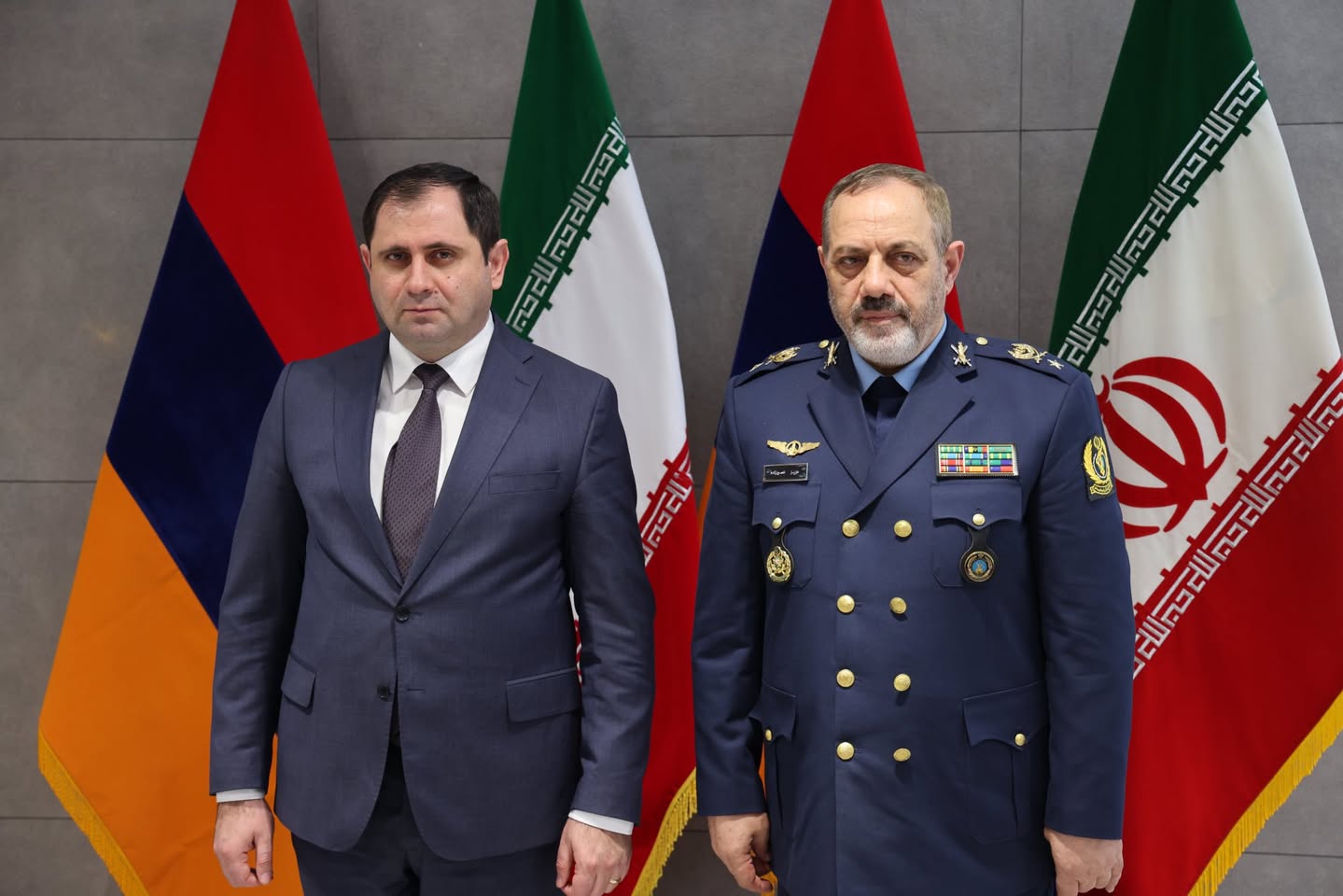

Iran’s newly appointed Ambassador to Armenia, Khalil Shirgholami, said joint Armenian-Iranian military exercises may continue in the future and could even expand in scale, underscoring what he described as strengthening defense cooperation between the two neighboring states.
Speaking to reporters while attending a ceremony honoring Professor Vardan Voskanyan of Yerevan State University, Shirgholami noted that special forces units from Armenia and Iran conducted joint drills in April 2025 and suggested similar exercises could follow.
“Given the relations and ties between our two countries in various fields, including defense, such events are routine and ongoing. It is possible that similar events will take place again in the future, and they may be more large-scale,” the ambassador said.
His remarks came as Armenian Defense Minister Suren Papikyan is on an official visit to Tehran. During the trip, Papikyan met with Major General Abdolrahim Mousavi, Chief of the General Staff of the Iranian Armed Forces, as well as his Iranian counterpart, Brigadier General Aziz Nasirzadeh.
“During the meeting, we discussed various issues related to Armenia–Iran cooperation in the defense sector and regional security,” Papikyan wrote on social media following his meeting with Mousavi.
Shirgholami emphasized that Papikyan’s visit had been planned in advance and should not be interpreted solely through the lens of broader regional tensions involving Iran.
“This reflects the cooperation and ties between the two countries in various fields. The visit was planned through different delegation formats of both sides. During the visit, the parties will have the opportunity to exchange views on various issues and further deepen the existing cooperation,” he said.
The Iranian envoy described the Armenia–Iran border as “a border of peace” that holds special importance for both nations. He stressed that military cooperation is grounded in historical ties and in shared principles of preserving territorial integrity and the inviolability of internationally recognized borders.
“The military sectors of both countries are based precisely on these historical ties and on the principles of preserving the inviolability of the border and the territorial integrity of both states,” Shirgholami stated.
Beyond defense ties, the ambassador said Armenia and Iran are expanding cooperation across academic, economic, political, and cultural spheres, adding that relations are developing “on a daily basis.”
Shirgholami also addressed remarks he made earlier this year regarding anti-Iran protests and demonstrations near Iran’s embassy in Yerevan. Mass protests erupted in Iran on December 28, 2025, initially over exchange rate volatility and rising prices, before escalating in some cities into clashes with security forces and political slogans targeting Iran’s leadership.
The ambassador characterized the protests as having begun peacefully before being influenced by external actors seeking to destabilize the country. He thanked Armenian authorities for steps taken in response to demonstrations near the embassy in Yerevan.
“Political actions and regime-change slogans under such circumstances are condemnable. Those people are also our citizens; we love them as well. We are confident that disagreements arising within our family must be resolved within the family,” Shirgholami said.
The protests in Iran intensified in early January, following statements by exiled opposition figure Reza Pahlavi and comments by U.S. President Donald Trump expressing readiness to support Iranian citizens if force were used against them — a position condemned by Tehran.
Despite regional tensions, both Yerevan and Tehran have signaled continuity in bilateral cooperation. The ambassador’s remarks, coupled with Papikyan’s high-level meetings in Tehran, indicate that defense coordination remains a stable pillar of Armenia–Iran relations amid shifting geopolitical dynamics in the South Caucasus and the wider Middle East.


