
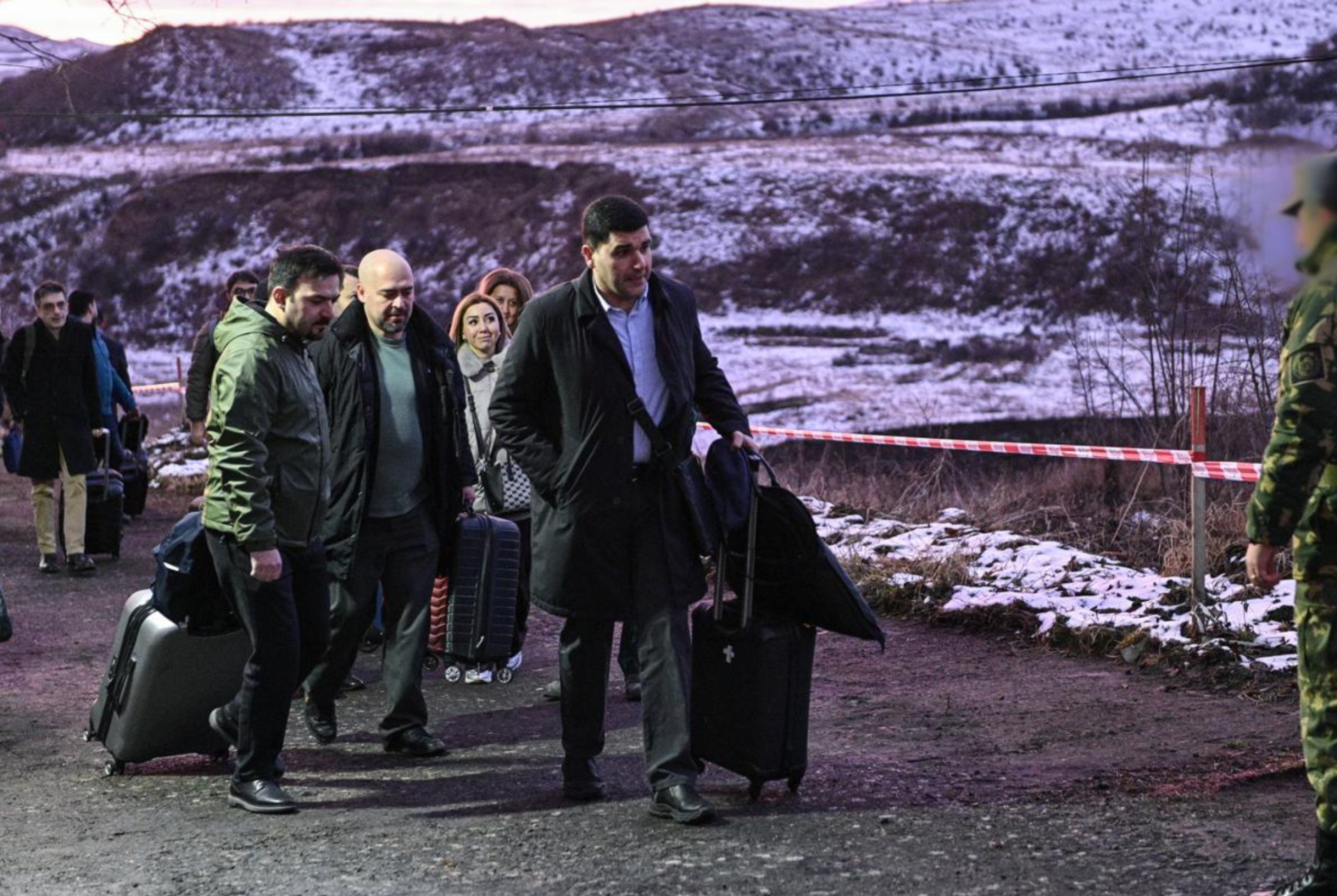

For the first time since Armenia’s independence, an Azerbaijani “civil society” delegation entered Armenia through an Armenian–Azerbaijani border checkpoint during the “Peace Bridge” initiative’s bilateral roundtable on February 13–14, 2026, crossing the land border at the delimited and demarcated Voskepar (Armenia)–Ashaghy Eskipara (Azerbaijan) section, completing all relevant procedures, and then proceeding to the meeting venue.
The roundtable brought together representatives of Armenian and Azerbaijani civil societies with the aim of fostering dialogue and sustained engagement. In addition to the core participants of the initiative, a broader circle of experts, analysts, journalists, researchers, and civil society leaders from both countries took part in the discussions.
According to the official press release on the results of the Armenian–Azerbaijani conference, the discussions focused on the current stage of Armenian–Azerbaijani relations and possible pathways for their future development, as well as on the implementation of the peace agenda endorsed during the Washington Summit of August 8, 2025, and its regional implications.
Participants exchanged assessments of the evolving regional security environment and the economic opportunities emerging from the peace process. A separate session was dedicated to cooperation among the dialogue participants, including discussions on joint project ideas, public communication strategies, and mechanisms for intersocietal engagement. Attention was given to confidence-building measures, public diplomacy, and the development of practical proposals aimed at fostering people-to-people contacts.
Further discussions addressed regional security, borders, and communications, with both sides presenting their respective views and expectations. In parallel with the formal sessions, informal cultural and social events were organized, facilitating personal interaction among participants.
On the second day, participants discussed the potential social and economic benefits of sustainable peace and the normalization of intersocietal relations. Views were exchanged on public expectations in both societies and on ways to ensure that the peace process delivers tangible outcomes for citizens.
Within the framework of the program, participants also met with senior Armenian officials, including Security Council Secretary Armen Grigoryan and Deputy Foreign Minister Vahan Kostanyan.
The meetings provided an opportunity to exchange views on the role of civil society in advancing the peace agenda and on how public initiatives can complement official efforts.
The event concluded with a press conference summarizing the discussions. The Azerbaijani delegation returned via the same delimited section of the border.
Within the “Peace Bridge” initiative, Armenian and Azerbaijani delegations had previously conducted reciprocal visits in smaller formats last year.
On October 22, a discussion was held in Yerevan with the participation of representatives of the civil societies of Armenia and Azerbaijan. Subsequently, on November 21–22, 2025, a group of Armenian civil society representatives visited Azerbaijan, continuing the dialogue process.


