
On Friday, Azerbaijan’s National Olympic Committee said it filed a complaint regarding the music selected by an Armenian figure skating pair for their performance at the 25th Winter Olympic Games which begin today in Milan, Italy.
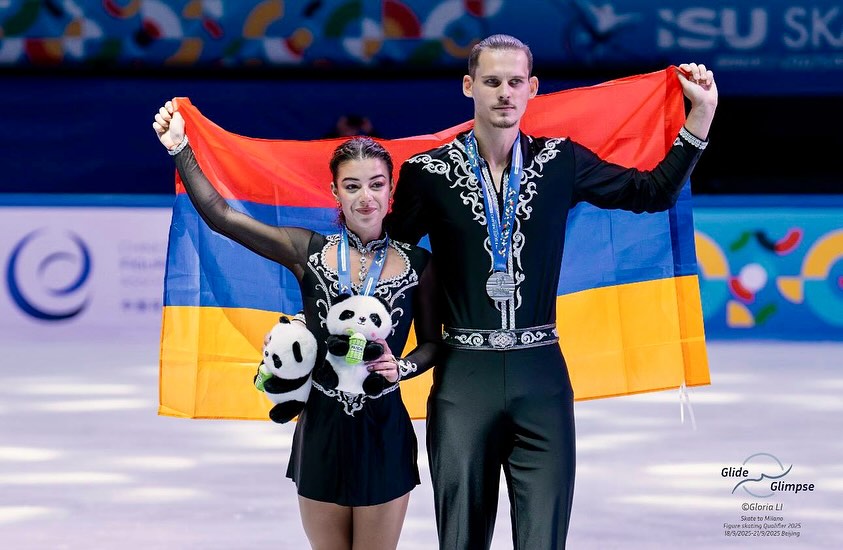
Azerbaijan’s National Olympic Committee (NOC) expressed serious concern over the use of Ara Gevorgyan’s “Artsakh” music in the competition program of Armenian figure skaters Nikita Rakhmanin and Karina Akopova.
The NOC described the song as carrying “political and separatist content” and conveyed its protest to the International Olympic Committee (IOC), arguing that the term “Artsakh” reflects what it calls Armenia’s “long-standing illegal and separatist policy regarding territories internationally recognized as part of Azerbaijan.”
Highlighting the IOC’s commitment to neutrality, the NOC said the use of such music at an international sporting event carries political and ideological meaning, contradicting Olympic values. It emphasized that, under the Olympic Charter, political, ideological, or separatist messaging is prohibited at the Games.
The NOC added that such actions harm the spirit of the Olympics, sports ethics, and international sporting principles, and threaten peace and mutual trust in the region. It stressed that the Olympic Games are meant to symbolize peace, friendship, and mutual respect, and should not be used for political or separatist purposes.
Figure skating allows athletes to perform routines using music of their own choosing. Armenia’s first pair figure skaters since independence, Karina Akopova and Nikita Rakhmanin, announced last month that they would skate to “Artsakh” for their short program, a composition by Armenian composer Ara Gevorgyan. Their performance is scheduled for February 15.
Akopova and Rakhmanin will also serve as Armenia’s flag-bearers at the Winter Olympics opening ceremony. Before departing for Milan, the pair held their final training session in Yerevan.
In the past, Azerbaijani sources have attempted to attribute Gevorgyan’s “Artsakh” composition to Soviet-era Azerbaijani composer Fikret Amirov. Gevorgyan has said he officially registered the copyright for the piece with the U.S. Library of Congress in 1998, and later produced a documentary titled “Story about Artsakh Music” detailing its creation.