
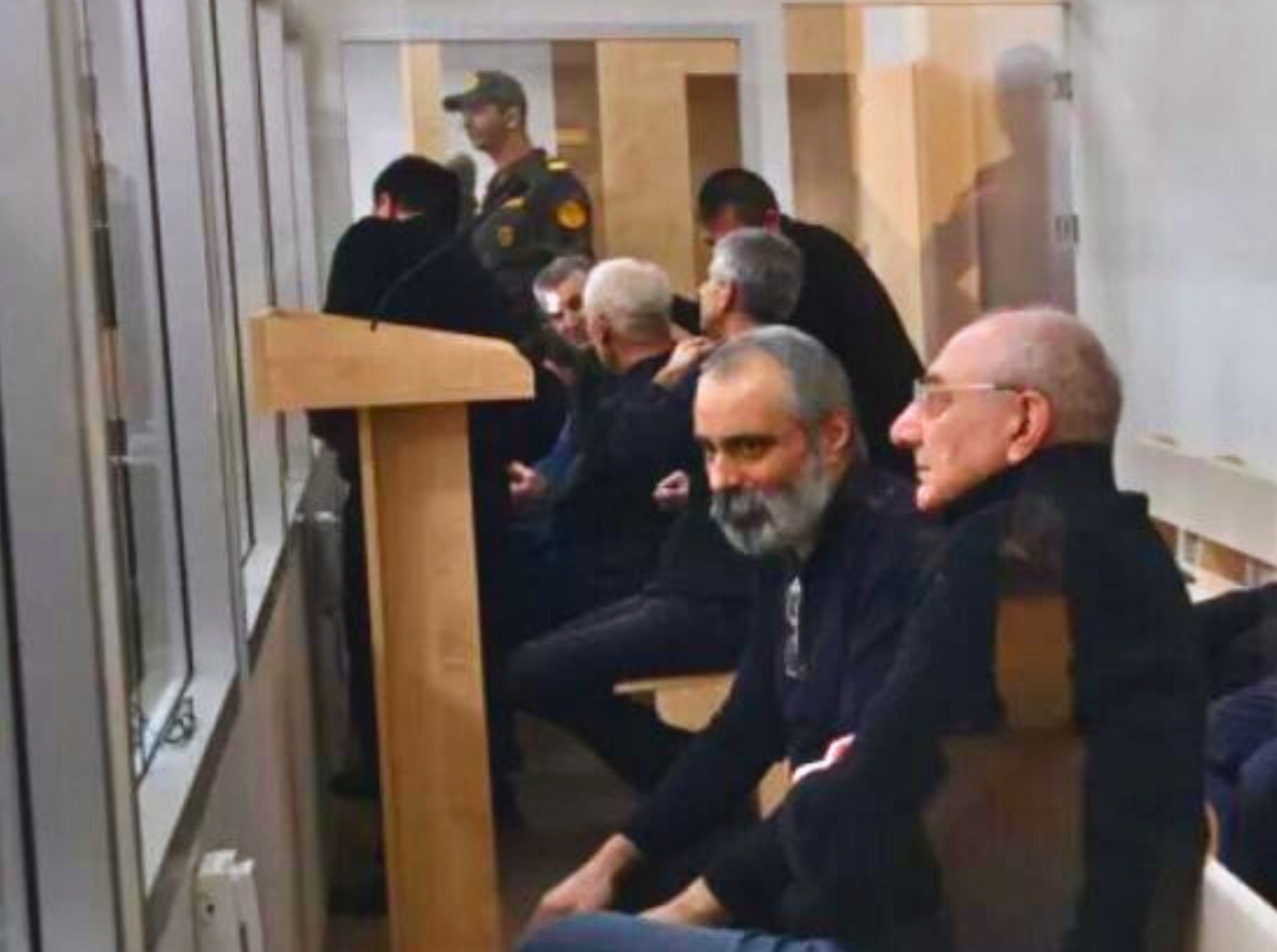

The Baku Military Court on Thursday sentenced five former Artsakh (Nagorno-Karabakh) officials to life imprisonment, while two former presidents received 20-year prison terms due to age restrictions under Azerbaijani law. The verdicts were issued amid what Armenian officials and human rights advocates describe as sham trials based on fabricated charges.
Those sentenced to life imprisonment include former Artsakh President Arayik Harutyunyan; former commander of the Artsakh Defense Army Levon Mnatsakanyan; Major General David Manukyan; former parliamentary speaker Davit Ishkhanyan; and former foreign minister David Babayan, according to the Azerbaijani pro-government outlet APA.
Former Artsakh presidents Arkadi Ghukasyan and Bako Sahakyan were sentenced to 20 years in prison. The court stated that under Azerbaijan’s criminal code, life imprisonment cannot be imposed on individuals who have reached the age of 65.
Among the other defendants, Madat Babayan and Melikset Pashayev were sentenced to 19 years, while David Alaverdyan received a 16-year prison term. Garik Martirosyan was sentenced to 18 years, Levon Balayan to 16 years, and Vasil Beglaryan, Gurgen Stepanyan, and Erik Ghazaryan each received 15-year sentences.
In total, 15 Artsakh Armenians were tried on charges encompassing 2,548 alleged crimes, including genocide, slavery, enforced disappearances, torture, financing of terrorism, and the creation of a criminal organization. All were captured following Azerbaijan’s final military offensive in September 2023, which came after a nine-month blockade of Artsakh.
The final court hearing in the case took place on December 26, 2025, after which the presiding judge withdrew to deliberate before issuing the verdicts.
Azerbaijan has charged the former military and political leadership of Artsakh under dozens of criminal articles, including planning and waging war, illegal resettlement, and torture. Armenian officials have rejected the accusations as politically motivated and legally unfounded, characterizing the proceedings as sham trials built on fabricated evidence.
The trials have been conducted behind closed doors, attended exclusively by Azerbaijani state-run media. No international observers were present, and the defendants were represented solely by Azerbaijani lawyers, conditions that have intensified concerns over due process and the right to a fair trial.
Separately, the case of former Artsakh State Minister Ruben Vardanyan remains ongoing. His trial was separated from the others from the outset, and an Azerbaijani court rejected his request to merge the cases.
Shortly after the trials began, Armenian Prime Minister Nikol Pashinyan accused Azerbaijan, citing intelligence information, of using banned psychoactive methods against imprisoned Artsakh Armenians to extract testimonies aimed at inciting regional escalation. Armenian authorities later alleged that detainees had been subjected to torture, pointing to signs visible in photographs released by Azerbaijani officials.
The verdicts were announced days before the planned visit of U.S. Vice President JD Vance to Armenia and Azerbaijan. According to the Associated Press, Vance is expected to travel to both countries after attending the opening ceremony of the Winter Olympics in Milan. The rulings also came one day after Azerbaijani President Ilham Aliyev and Armenian Prime Minister Nikol Pashinyan received the UAE’s Zayed Award for Human Fraternity for the initialling — but not signing, of a peace agreement between the two countries.
As of publication, Armenian government officials had not yet publicly reacted to the verdicts, while the Mother See of Holy Etchmiadzin condemned the proceedings as sham trials and reaffirmed its commitment to work through international and interchurch channels for the release and return of the Armenians held illegally in Baku.


