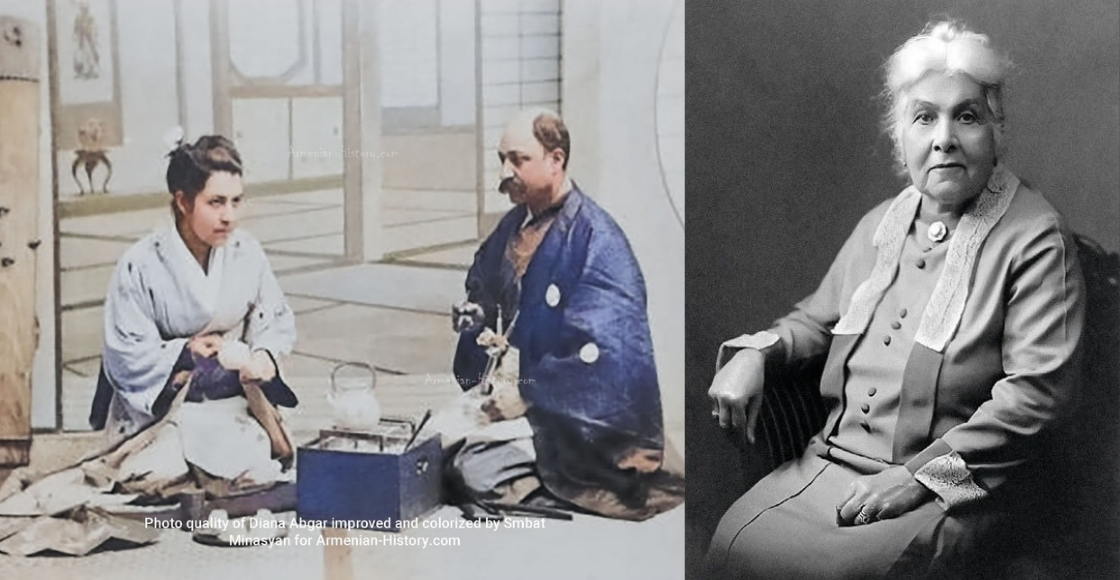

Today marks the 167th birth anniversary of Diana Abgar, born on October 17, 1859, in Rangoon, British Burma. One of the earliest English-language voices to document and advocate against the Armenian Genocide, Abgar became the first Armenian woman diplomat and one of the first women ever appointed to a diplomatic post in the 20th century, serving as Honorary Consul of Armenia to Japan after securing Japan’s recognition of the First Republic of Armenia in 1920. She did all of this without ever setting foot on Armenian soil, earning her the name by which history remembers her: The Stateless Diplomat.
Her story begins with a 400-year-old wound. In 1604, Shah Abbas I of Safavid Persia forcibly deported more than 150,000 Armenians from the ancient trading city of Julfa, razed the city to the ground, and resettled the survivors in a new district outside Isfahan called New Julfa. Over the next three centuries, those exiled Armenian merchants built one of the greatest trading networks in the world, stretching from Isfahan to Calcutta, Rangoon, Hong Kong, Singapore, Manila, and Shanghai, becoming known across the Indian Ocean trade system as the “Merchant Princes of India.” Diana was born into that network. Her father’s family came from New Julfa in Isfahan, Iran, and her mother’s family from Shiraz. Her father ran a trading post in Rangoon, which is why she was born there. She was raised in Calcutta, educated at a convent school, and grew up fluent in English, Armenian, and Hindustani.
In 1889 she married Michael Apcar, a descendant of the House of Apcar of New Julfa and heir to the Apcar & Co. shipping dynasty based in Calcutta. In 1891 the couple moved to Japan to expand the family’s trading operations into East Asia, settling first in Kobe and later in Yokohama, where Diana would live for the rest of her life.
Japan is where everything changed. After the Adana Massacre of 1909 and the beginning of the Armenian Genocide in 1915, Abgar turned her writing, her reputation, and her home into a lifeline for her people. She wrote for The Japan Advertiser, The Far East, The Japan Gazette, and the diaspora journal Armenia, becoming one of the first voices in the English-speaking world to document the destruction of the Armenian people. She lectured publicly in Japan on the Armenian cause and corresponded directly with President Woodrow Wilson, pleading for international attention to the “Armenian agony.”
As Genocide survivors escaped the Ottoman Empire eastward across more than 6,000 miles of Siberian railroad to the port of Vladivostok, they discovered that the only boats out of Russia went to Japan, a country that had no refugee policy and would not let them in. Abgar intervened personally with Japanese officials, using her reputation to vouch for them one by one. According to her great-granddaughter and biographer Mimi Malayan, Abgar helped between three and four thousand Armenian refugees enter Japan and continue onward to the United States and Canada, personally funding, housing, feeding, and arranging transit visas and ship passage for them from her home in Yokohama.
On July 21, 1920, in recognition of years of work she had already carried out without any official title, Armenian Foreign Minister Hamo Ohanjanyan appointed her Honorary Consul of Armenia to Japan “for defending the interests of the newly-born Fatherland, and mitigating the conditions of our compatriots.” She authored 9 books in total, including “Betrayed Armenia” (1910), “The Truth about the Armenian Massacres” (1910), “Peace and No Peace” (1912), “The Great Evil” (1914), and “On the Cross of Europe’s Imperialism: Armenia Crucified” (1918), all published from Yokohama by the Japan Gazette Press at a time when Western governments were still refusing to acknowledge what was happening to the Armenian people in the Ottoman Empire.
Diana Abgar passed away on July 8, 1937, in Yokohama, at the age of 77, and is buried at the Yokohama Foreign General Cemetery beside her husband and two sons. Her grave is cared for today by the Japan-Armenian Friendship Association in Tokyo. In 2020, HayPost issued a commemorative postage stamp in her honor as part of its “Armenian history” series, and a park in Yerevan on Aram Street now bears her name.
Born in Burma, raised in Calcutta, settled in Japan, Diana Abgar carried Armenia with her across three continents and seven decades of work for her people, serving a homeland she loved but never saw.