
Iran’s Foreign Minister Abbas Araghchi said in Yerevan on October 16 that Tehran trusts Armenia on the Trump Route for International Peace and Prosperity, the planned transit route through southern Armenia that would connect mainland Azerbaijan to its Nakhichevan exclave and to Turkey.
“We don’t have any concerns. We trust our Armenian brothers,” Araghchi told RFE/RL’s Armenian Service. He declined to comment further on the project.
Other reporters at the COP17 Leaders’ Summit asked whether Iran still has concerns about the route and about the American presence in the region. “We have concerns about any US presence in the region and around us,” Araghchi said. “We trust them, and we know that they will do nothing against Iran’s security.”
Armenia’s Foreign Minister Ararat Mirzoyan said the same day that there will be no American military presence along the route, and that coverage of Iran’s concerns in some Armenian media outlets has been significantly exaggerated.
Mirzoyan Said There Will Be No American Military Presence Along TRIPP
Mirzoyan was asked at a press briefing whether he had resolved Iran’s concerns during his visit to Tehran. He said the Iranian side had asked whether there would be an American military presence along TRIPP.
“There will not be,” Mirzoyan said. “People ask, and we tell them there will not be.” He said the documents and the situation on the ground both support that answer.
“The Iranian side has questions, and those questions have been answered,” Mirzoyan said. He added that his impression is that Iran is satisfied with the transparency of the process.
Asked about Iranian statements that a third party’s presence could destabilize the region, Mirzoyan said it is a textbook truth that an outside armed presence would complicate relations between two countries. He said he was not clear what Iran was referring to specifically.
Mirzoyan was in Iran on October 4 and 5, where he met Araghchi, President Masoud Pezeshkian, and Parliament Speaker Mohammad Bagher Ghalibaf, and briefed Pezeshkian on the implementation of TRIPP. Araghchi referred to that visit in Yerevan, calling Mirzoyan his good friend and describing the talks as productive consultations.
The Signed Agreement Gives a U.S.-Controlled Company 74 Percent of the Project for 49 Years
The framework agreement between Armenia and the United States on strategic cooperation concerning TRIPP was initialed in Yerevan on May 26, 2026 by Mirzoyan and Secretary of State Marco Rubio, signed in Washington on June 1, and signed in Yerevan on June 4.
Its published text creates a TRIPP Development Company incorporated in Armenia as a joint stock company, in which a Delaware subsidiary of the United States International Development Finance Corporation holds a 74 percent controlling stake and Armenia holds 26 percent. Article 6 grants the company land and development rights for an initial term of 49 years, with an option by mutual consent to extend for a further 50, at which point Armenia’s stake would rise to 49 percent. Either party can terminate the agreement with written notice, effective one year later.
The preamble states that Armenia retains full sovereignty, territorial integrity, and jurisdiction over all TRIPP project areas. Under Article 8, Armenia keeps responsibility for security, law enforcement, border control, customs, immigration, and tax collection, and has the right to maintain a physical presence at all of its border control facilities. The text contains no clauses on military presence or deployment.
“If the term is extended, it will be ensured that the Republic of Armenia holds 49% of the company’s shares,” Mirzoyan said when he presented the ratification bill in July. The government referred the agreement to the Constitutional Court, which ruled that its obligations comply with the Constitution, and it now awaits ratification by the National Assembly.
The Route Runs 43 Kilometers Through Meghri Along Armenia’s Border With Iran
TRIPP was agreed at a White House meeting on August 8, 2025, hosted by United States President Donald Trump with Armenian Prime Minister Nikol Pashinyan and Azerbaijani President Ilham Aliyev, where the two leaders initialed the text of a peace agreement without signing it.
The route covers a 43-kilometer (27-mile) section through the town of Meghri in Syunik, running along the Arax River and Armenia’s border with Iran. Its main objective is to restore the old rail line, and the development company is to form separate vehicles for rail, road, oil and gas pipelines, fiber optic cable, and electricity.
Iran’s Ambassador Has Called for a Mechanism to Manage the Risks of a U.S. Presence
Iran’s ambassador to Armenia, Khalil Shirgholami, said in September that Tehran would not object to the route if Armenia’s sovereignty and territorial integrity are respected and any threatening American military presence is ruled out. He has also called for a mechanism to manage what he described as the potential risks of an American presence and threats to Iran arising from the project, and said the American and Israeli military campaign against Iran had made those risks clearer.
Iran raised its objections within days of the Washington meeting in August 2025. Deputy Foreign Minister Vahan Kostanyan traveled to Tehran, where he said Armenia had taken Iran’s concerns into account and that the arrangement does not mean American involvement in regional security. Araghchi told IRNA the following day that no American troops would be stationed near Iran and that all of Iran’s red lines had been respected.
Ali Akbar Velayati, then a senior adviser to Supreme Leader Ayatollah Ali Khamenei, told Tasnim News Agency in August 2025 that the project is “a political plot against Iran and other neighboring countries” and “not merely a trade route.” He said, “NATO wants to lie between Iran and Russia like a viper, but Iran will not permit it.”
Tehran has long opposed the “Zangezur corridor” concept and any change to the Armenian-Iranian border. A Carnegie Europe analysis published in March 2026 described Iran’s government as divided, with its security establishment opposed outright while officials in the economic affairs and transportation ministries under Pezeshkian saw room for dialogue and suggested Iran could tolerate a railroad under Armenian jurisdiction.
Pashinyan and Pezeshkian Met in Yerevan, Their Third Meeting in Under a Month
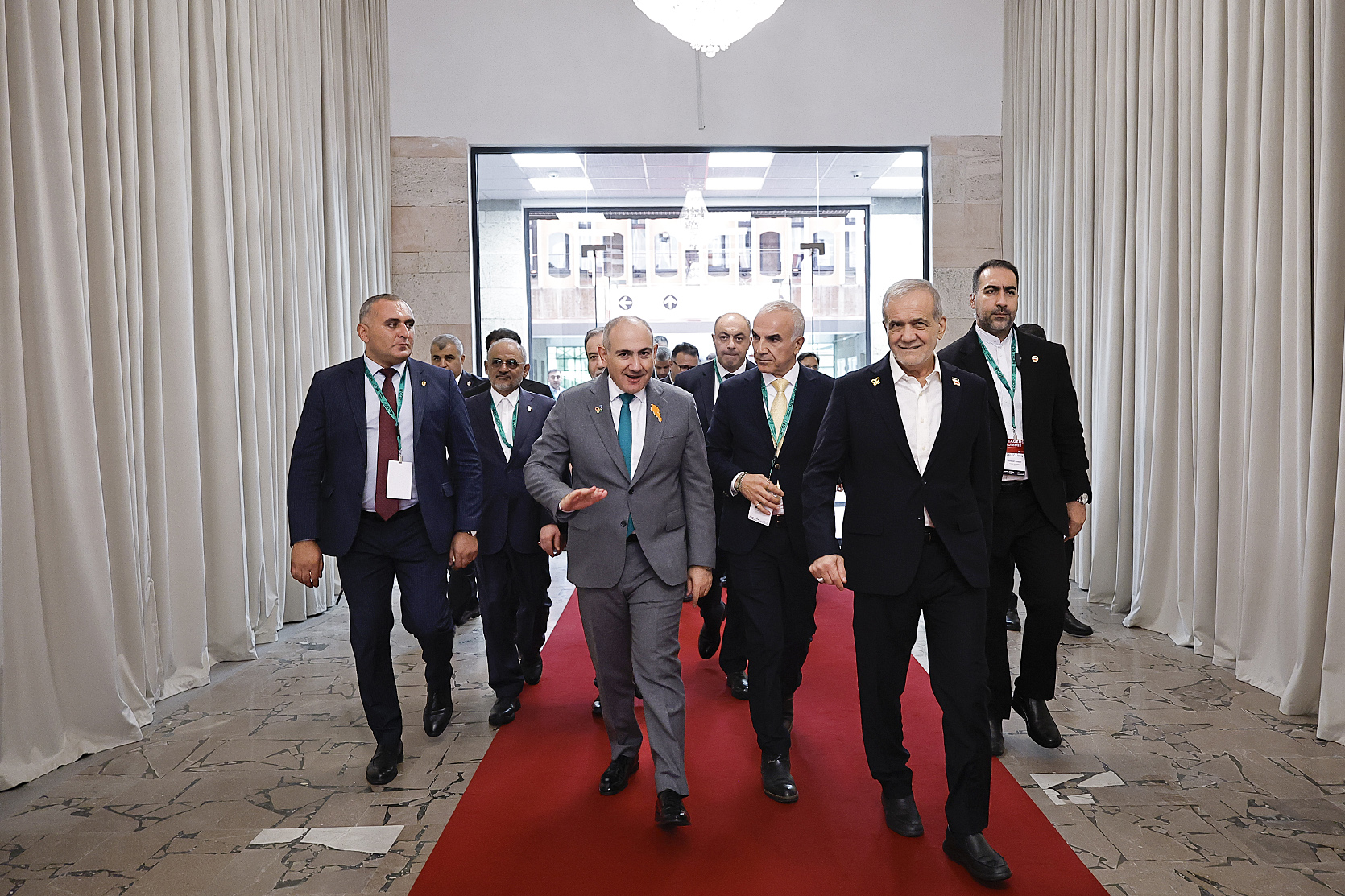
Pezeshkian arrived in Yerevan on Friday morning and was welcomed at Zvartnots Airport by Armenian Deputy Prime Minister Mher Grigoryan. Pashinyan met him that afternoon on the sidelines of the Leaders’ Summit.
Pashinyan said the frequency of high-level meetings shows that both countries want to keep developing relations, according to the Armenian government’s press service, and Pezeshkian said expanding ties across multiple sectors carries critical strategic importance. It was their third face-to-face meeting in under a month, after talks in New York on the margins of the United Nations General Assembly on September 24 and a meeting in Turkmenbashi, Turkmenistan, on October 9.
The Leaders’ Summit was held on October 16. COP17 runs from October 19 to 30 at the Meridian Expo and Event Center in Yerevan, with its opening ceremony on October 18.