
A bone marrow transplant matches on human leukocyte antigen, a set of proteins on the surface of nearly every cell that the body uses to tell its own tissue from foreign tissue. Blood type plays no part in it.
Six of these matter most for a transplant, labeled A, B, C, DR, DP, and DQ. Each one has a large number of possible variants, and each person inherits one full set from their mother and another from their father.
With that many variants across 6 positions, doubled by two parents, the odds of two unrelated people carrying the same combination are remote. A transplant fails when the match is wrong, because the patient’s new immune system reads the surrounding body as an invader.
Inside a family the odds improve. Siblings share the same two parental sets, which gives roughly a 1 in 4 chance of a full match, and only 25 percent of leukemia patients end up finding a donor among their own relatives.
The other 75 percent search the unrelated registries.
HLA variants cluster by population. Groups that stayed geographically and socially distinct over long periods carry recognizable profiles, which is why a Northern European patient searching a registry full of Northern European donors has reasonable odds.
ABMDR’s own typing data places Armenians apart from most European, Mediterranean, and East Asian populations. The registry attributes the separation to centuries of geographic isolation in the highlands, a distinct language and alphabet, and a religious identity that limited intermarriage with the surrounding Turkish, Iranian, Azerbaijani, and Georgian populations.
An Armenian patient is most likely to match another Armenian, and a search of the large international registries can return nothing at all.
That gap is the reason the Armenian Bone Marrow Donor Registry was founded in 1999 by Dr. Frieda Jordan and Dr. Sevak Avagyan. It has since typed more than 33,500 donors across 35 countries, processed over 9,000 patient referrals, and facilitated 45 bone marrow transplants.
Finding a match is only the first step in a long exchange between the registry and a transplant center. The center submits a search request, ABMDR runs the database and returns potential matches, the center selects a few for further testing, and only after additional samples and confirmatory typing does one donor become the match.
Every donor in that database registered by filling out a short form and giving a few cheek swabs, usually at a community event or a campus drive.
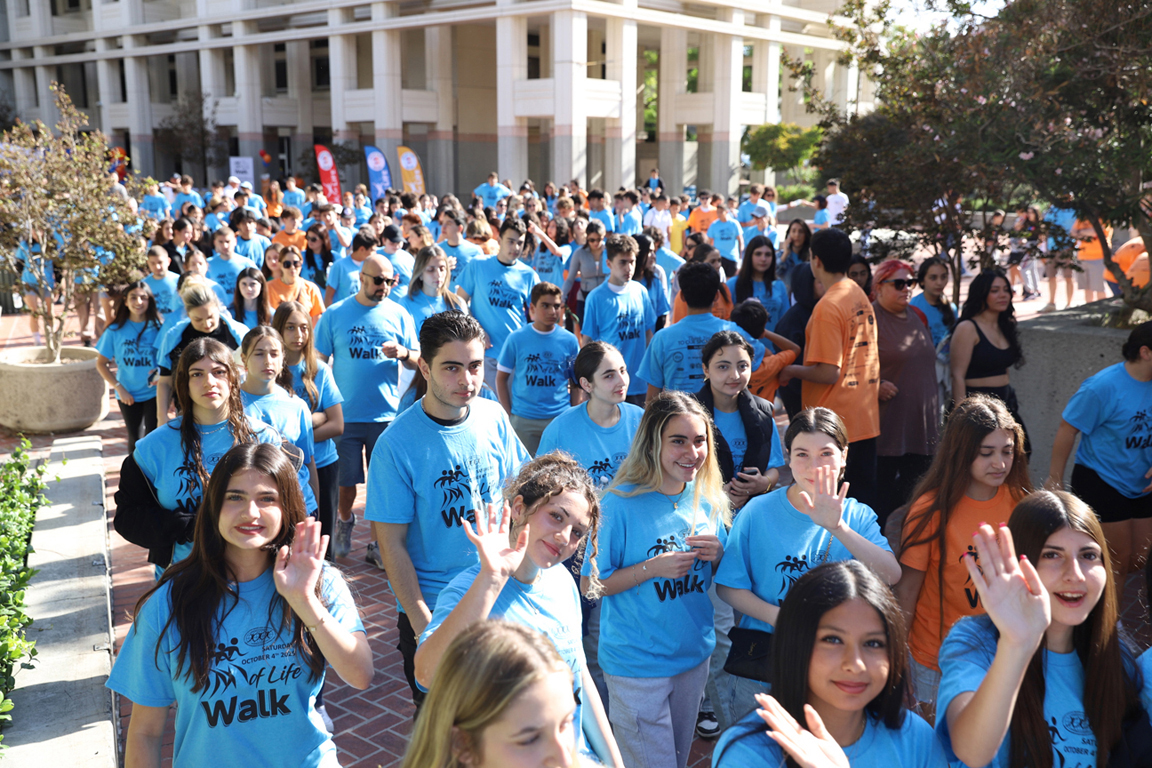
ABMDR holds its 21st annual Walk of Life this Saturday, October 3, at the plaza of the Glendale City building, 633 E. Broadway Ave. Registration opens at 8:30 a.m. and the 5K walk-run begins at 9:00.
Volunteers will swab and register new donors through the morning. Anyone between 18 and 50 in good general health is eligible, and a donor stays in the database until age 55.
Adult registration is $25 in advance and $30 on the day, students and kids pay $10, and students receive 8 hours of community service for walking. Last year’s walk drew close to 400 supporters.