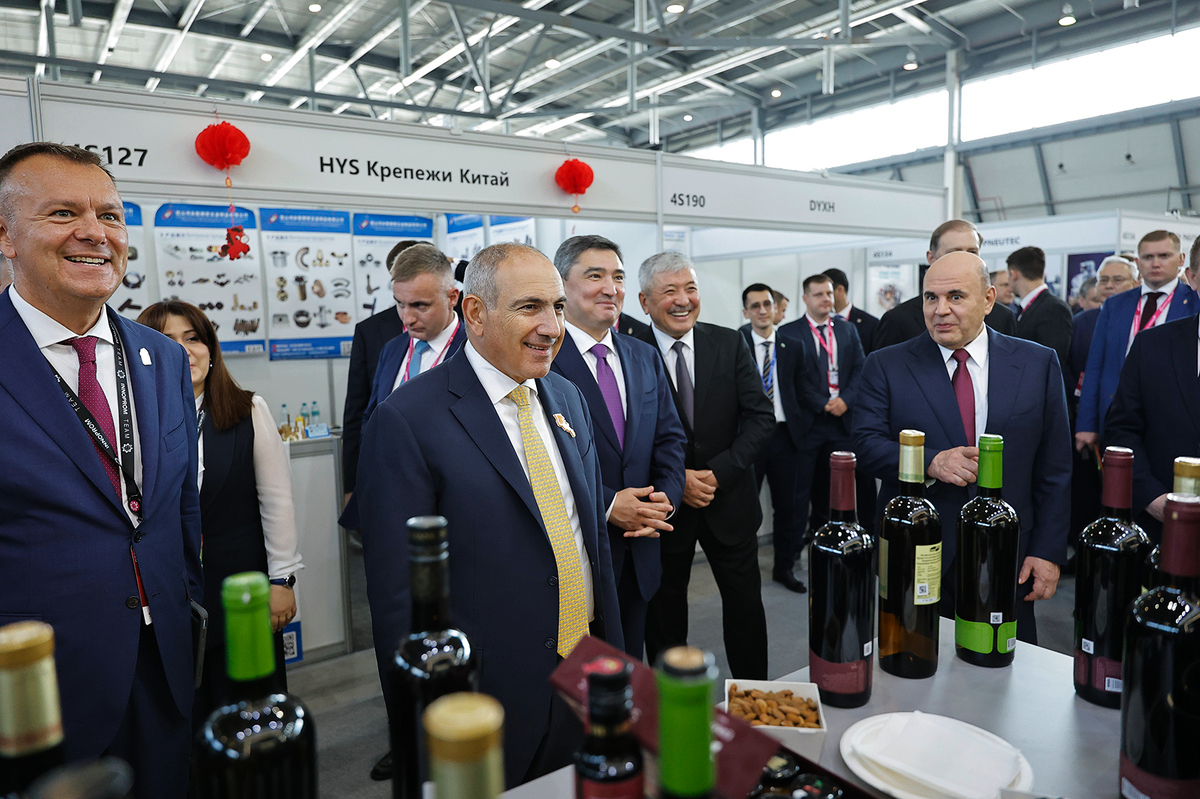

Armenian Prime Minister Nikol Pashinyan met with Russian Prime Minister Mikhail Mishustin during a working visit to Russia on Monday, his first trip to the country since Armenia’s June 7 parliamentary elections, telling his counterpart that Yerevan remains committed to developing relations with Moscow and intends to stay in the Eurasian Economic Union (EAEU), as the two sides discussed the trade restrictions, energy cooperation, and geopolitical frictions that have strained ties in recent months.
The roughly hour-and-a-half meeting, held on the sidelines of the INNOPROM international industrial exhibition in Yekaterinburg, produced warm language on both sides but no breakthrough, and no meeting with President Vladimir Putin, despite Pashinyan’s pre-election statement that the two had agreed he would travel to Moscow after the vote.
Pashinyan’s first post-election foreign trip was to Iran on July 3, where he attended the farewell ceremony for the late Supreme Leader of the Islamic Republic of Iran, Ali Khamenei.
Pashinyan, Mishustin Meet on INNOPROM Sidelines
“Today’s meeting is a good opportunity to discuss the full scope of our relations, and after the elections, it is also a good opportunity, as they say, to synchronize our watches,” Pashinyan said.
He acknowledged that “some problematic issues” had emerged in recent months but said he hoped they could be discussed and resolved. “Both before and after the elections, we remain committed to the further development of our relations with the Russian Federation,” Pashinyan said. “We are also interested in our participation in the Eurasian Economic Union and in ensuring that the mechanisms provided for in the EAEU Treaty function as intended.”
He added that Armenia was taking a constructive approach to clarifying all outstanding issues and expressed hope that the talks would produce concrete results.
Mishustin expressed hope that Armenia’s new government would continue strengthening relations with Russia “in the spirit of friendship, good-neighborliness, mutual respect, and consideration of each other’s interests.”
Days before the June 7 vote, Pashinyan said that during a phone call with Russian President Vladimir Putin, the two had agreed that he would travel to Moscow after the elections to discuss bilateral issues in person. While Pashinyan’s working visit to Russia has now taken place, no meeting with Putin has been announced, and Putin has neither met nor spoken with Pashinyan since the vote. The talks in Yekaterinburg followed a July 1 phone call between Pashinyan and Mishustin, held at the initiative of the Armenian side.
Despite global economic turbulence, Mishustin said Russia remains Armenia’s largest trading partner and investor, accounting for about 35 percent of Armenia’s foreign trade last year. He highlighted Russian investment in Armenia’s mining, engineering, transport infrastructure, energy, including peaceful nuclear energy, and digital economy sectors.
“It is important that the Armenian government continues to create a favorable environment for Russian investors and ensures that their rights and legitimate interests are protected,” Mishustin said.
He also emphasized expanding industrial cooperation, business partnerships, cultural exchanges, educational initiatives, and regional cooperation between the two countries, noting that all issues of bilateral cooperation remain under the constant supervision of the two governments’ intergovernmental commission.
Nearly a month after Armenia’s parliamentary elections, Russia has still not publicly congratulated Pashinyan on his victory. In his opening remarks, Mishustin referred to the vote and to the new government it would produce, but pointedly stopped short of offering congratulations. Pashinyan’s name had also briefly disappeared from the INNOPROM list of invited speakers before being reinstated, fueling speculation that the visit might be canceled.
According to Russian media, the Russian delegation included Deputy Prime Minister Alexey Overchuk, Rosselkhoznadzor chief Sergey Dankvert, Rosatom Director General Alexey Likhachev, Russian Railways CEO Oleg Belozerov, Rospotrebnadzor head Anna Popova, Deputy Foreign Minister Mikhail Galuzin, as well as deputy ministers responsible for finance, transport, economic development, energy, and trade. Armenia’s delegation included Deputy Prime Minister Mher Grigoryan, Economy Minister Gevorg Papoyan, the head of Armenia’s Food Safety Inspectorate, deputy ministers of foreign affairs and territorial administration, and the director of the Metsamor Nuclear Power Plant.
On the sidelines of the exhibition, Papoyan held a separate meeting with Russian Minister of Industry and Trade Anton Alikhanov, where the two discussed trade and economic relations, expanding industrial ties, and promoting investment projects. Papoyan also took part in the eighth meeting of the EAEU Industrial Policy Council in Yekaterinburg.
Pashinyan Touts Industrial Growth at INNOPROM Plenary
Speaking at the exhibition’s main plenary session, “Industry 360: Production Without Borders,” Pashinyan thanked Mishustin for the invitation and praised the event’s organization, describing INNOPROM as one of the largest international platforms for showcasing industrial solutions and building business ties. Pashinyan, who also toured the exhibition’s pavilions during the visit, addressed a session that brought together the prime ministers of Belarus, Kazakhstan, and Kyrgyzstan, Alexander Turchin, Olzhas Bektenov, and Adylbek Kasymaliev.
He said Armenia’s industrial output grew 4.7 percent in 2025 compared with 2024, and rose 13 percent in the first four months of 2026 against the same period a year earlier, adding that the country’s manufacturing sector has doubled over the past nine years. He cited investment in digitalization, artificial intelligence, and data analytics, and the development of microelectronics, biopharmaceuticals, and robotics, as priorities of Armenia’s industrial policy.
Pashinyan also framed industry as one of the key drivers of the EAEU, saying Armenian enterprises are already participating in several joint industrial projects with partners across the bloc. He closed with a human-centered message on technology.
“Technologies are meant not to replace people, but to free them from routine work, opening new horizons for intellectual and creative activity,” he said.
Rosatom Proposes New Reactor Models for Armenia
In an interview with Russian media during the INNOPROM exhibition, Rosatom Director General Alexey Likhachev said the company is ready to offer reactor models designed to meet Armenia’s long-term energy needs.
He suggested that the best option for the Armenian Nuclear Power Plant could be either a single large-capacity unit or two medium-capacity units.
Likhachev noted that work is underway to extend the current Armenian Nuclear Power Plant’s operating life to 2036, and said the upgrades, carried out with the participation of Rosatom subsidiaries, also increased the plant’s capacity by around 10 percent.
He added that Armenia currently generates around 30 percent of its electricity from nuclear power, but demand is expected to grow in the coming decades, potentially leading to a power deficit of up to 1 gigawatt.
“To be prepared for this, our answer is: either a single large plant or a two-unit medium-capacity station that would cover the future energy gap for decades,” Likhachev said, adding that nuclear capability is a sign of a “high-quality economy,” and noting Armenia’s long-standing experience with nuclear technology dating back to the 1970s.
Russian officials have pressed Armenia to decide quickly. Deputy Prime Minister Overchuk has argued that Armenia risks a future energy shortfall if it does not commit to building a new plant by the end of 2026, since the design, construction, and commissioning cycle for a new station typically takes about a decade.
The comments come as Armenian officials continue evaluating options for the country’s next-generation nuclear energy strategy, with proposals reportedly received from the United States, France, Russia, South Korea, and China. Armenian authorities have said the new plant will be modular, with the specific model to be selected during 2026 or early 2027.
Armenia–Russia Tensions Over Trade Restrictions
The meeting comes amid a prolonged trade dispute between the two countries. For nearly a month, Russia has imposed restrictions on Armenian exports, including a complete suspension of fruit and vegetable imports, citing quality concerns and alleged violations discovered during inspections. The measures cover products including Jermuk mineral water, flowers, certain alcoholic beverages, tomatoes, cucumbers, strawberries, and a range of stone fruits. Moscow has also restricted the transit of Armenian goods through Russian territory to other EAEU member states while urging Yerevan to clarify whether it intends to remain in the bloc or pursue membership in the European Union.
Pashinyan has rejected the notion that Armenia must choose between the two.
Speaking at a government meeting in late June, he argued that if the EAEU’s principles of the free movement of goods, services, labor, and capital were not upheld, “then there is no Eurasian Economic Union.” He warned that a failure to resolve the current problems would carry consequences beyond Armenia, saying, “If there are no solutions, that means something entirely different, first and foremost for the Eurasian Economic Union.”
Pashinyan has also criticized a declaration adopted at the EAEU summit in Astana on May 29, in which the leaders of Russia, Kazakhstan, Belarus, and Kyrgyzstan called on Armenia to hold a referendum as soon as possible on whether it intended to remain aligned with the EAEU or pursue European Union membership. The declaration stated that the issue would be revisited at the bloc’s December summit.
The Armenian prime minister argued that if individual EAEU member states could unilaterally make such decisions regarding another member, it would amount to the organization “declaring its own dissolution.”