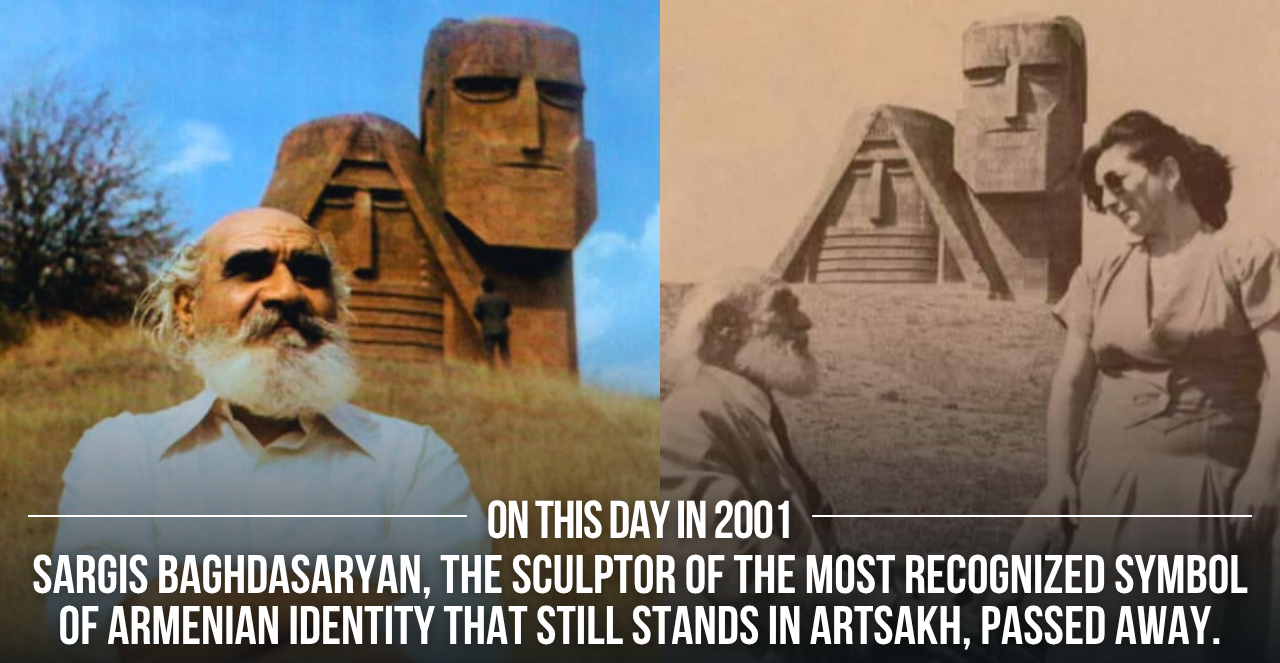

25 years ago today, on June 19, 2001, Sargis Baghdasaryan, the visionary Artsakh-born Armenian sculptor who carved his own grandparents into the symbol of his homeland and the soul of Artsakh into stone, passed away in Yerevan at the age of 77. He would spend his life giving sculptural form to the spirit of his nation.
He is best known for “We Are Our Mountains,” locally known as Tatik-Papik (Grandmother and Grandfather), carved from red volcanic tuff on a hilltop outside Stepanakert in 1967. It became the visual identity of the Armenian people of Artsakh, the symbol of their roots, their longevity, and their endurance. The monument is an image etched in the memory of Armenians worldwide. It still stands, occupied, waiting for them to return.
From Banadzor To Yerevan
Sargis Ivani Baghdasaryan was born on September 5, 1923, in the village of Banadzor (???????), in the now-occupied Hadrut Province of Artsakh (Nagorno-Karabakh). At 7, his family moved to Yerevan. In 1942, at 18, he was drafted into the Soviet Army to fight in the Great Patriotic War. He graduated the Baku Artillery School as a lieutenant and was sent to the front, wounded twice as an artillery battery commander in the Armenian Taman Division while fighting across Poland, Czechoslovakia, and Hungary.
He returned home a decorated WWII hero and dedicated his life to sculpture, becoming one of the most prolific and defiant Armenian sculptors of his generation, the architect of identity for a nation that had survived everything and now needed to see itself.
Tatik-Papik: A Nation Carved Into Stone
In 1965, Soviet-Armenian authorities invited Baghdasaryan, an Artsakh native and celebrated sculptor, to exhibit his work in Stepanakert. The exhibition moved everyone who saw it, and the Armenian administration of Artsakh, in quiet defiance of Baku, asked him to create a monument expressing the collective will of his people.
Working with architect Yuri Hakobyan, Baghdasaryan carved an elderly couple, a tatik (grandmother) and a papik (grandfather), from the red volcanic tuff of the Artsakh earth, representing the indigenous mountain people of Artsakh. The figures were modeled on his own grandparents. He deliberately placed the monument on a hilltop with no traditional pedestal, so the grandparents literally rise out of the soil itself, feet planted in their native land. Baghdasaryan himself said the figures resembled a sturdy oak tree, roots entrenched in the earth and crowns reaching for the sky.
The monument was inaugurated on November 1, 1967, and carried a name that became a declaration: ???? ??? ??? ???????? We Are Our Mountains. Locally, it was, and remains, simply Tatik-Papik.
Despite fierce Soviet-Azerbaijani objections during its construction, it transformed from a local tribute into a universal symbol of Armenian permanence, later codified as part of the official Coat of Arms of the Republic of Artsakh.
A Sculptor’s Hand Across Three Republics
“We Are Our Mountains” was Baghdasaryan’s crowning work, but not his only one. His hand shaped public squares from Yerevan to Syunik to Artsakh, and his genius reached beyond Soviet borders, permanently installed in Western Europe.
His classical style defines Yerevan’s urban landscape, from the Hagop Baronian statue (1965), which anchors one of the city’s beloved cultural corners, to the “Melody” sculpture (1965) beside Swan Lake. In Syunik, his statue of David Bek (1978), the 18th-century Armenian commander who fought Persian and Ottoman armies, stands in Kapan as a regional icon of historic defense. In Carrara, Italy, his “The Thinker” (1966) remains permanently displayed at the heart of the world’s most famous marble city.
A Symbol Larger Than Its Sculptor
In the decades that followed, “We Are Our Mountains” became the most recognized image of Artsakh and one of the most cherished symbols of Armenian identity across the diaspora. It appeared on the Artsakh coat of arms, on letterheads, on flags carried in the streets of Yerevan, Glendale, Beirut, and Paris. It became the picture every Armenian saw and instantly understood.
It also became a gathering place: the day before the 2020 Artsakh war broke out, families picnicked at its feet.
A Sculptor’s Death, A Monument’s Endurance
Sargis Baghdasaryan passed away on June 19, 2001, in Yerevan, at 77. He lived long enough to see the First Artsakh War, the independence of Artsakh in 1991, and the years of fragile peace that followed. He did not live to see what came next: the 2020 war, the September 2023 forced exodus of more than 100,000 Armenians from Artsakh, or the occupation of his birthplace and the place his monument stands.
Banadzor lived a parallel story to the monument he carved. During the First Artsakh War, it was destroyed in 1991 as part of Operation Ring, along with 16 other settlements in the Hadrut and Shushi districts. Armenian forces liberated it on October 2, 1992. It fell under Azerbaijani occupation again during the 44-Day War in 2020.
Today, “We Are Our Mountains” stands in occupied Stepanakert. The Armenians who picnicked at its feet are gone. The monument itself is at risk of demolition by Azerbaijani forces who have systematically erased Armenian cultural heritage across the territory since 2023.
But the tatik and papik still stand. Their feet still planted in the rock. Their gaze still steady. And the words carved into their name still ring true.
25 years after his death, the sculptor’s hands have rested, but Sargis Baghdasaryan endures through what he made. His grandparents, immortalized in tuff, still hold their post on a hilltop above Artsakh. His sculptures still anchor the public landscapes of Yerevan and Syunik. His creations still fuel the cultural pride of the Armenian world. The Republic he lived to see lost. The mountains remain.