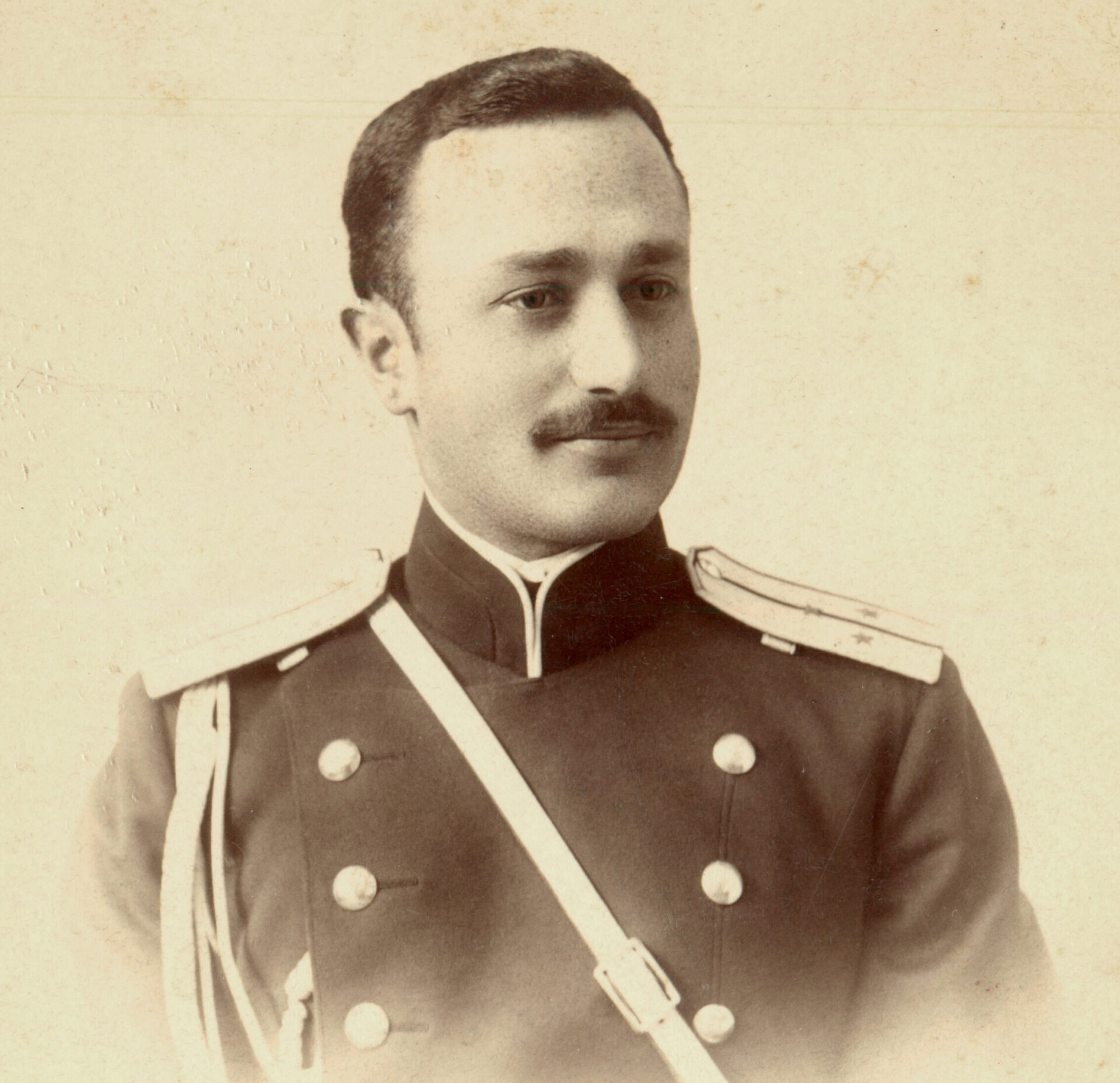

150 years ago today, on June 18, 1876, one of the most consequential military commanders in modern Armenian history was born in Tiflis, the city now known as Tbilisi. Major General Christophor Araratian (Araratov) would lead the artillery that saved the Armenian nation from extinction in May 1918, serve as Minister of Military Affairs of the First Republic of Armenia, and be martyred in 1937 during Stalin’s Great Purge, executed by firing squad alongside his fellow Sardarabad hero General Movses Silikyan and other Armenian colonels for the very independence he had once helped secure.
From The Tiflis Cadet Corps To The Russian Empire
Araratian was born into a noble Armenian military family. His father Karapet was a lieutenant colonel of the Russian Imperial Army, and the son was raised to follow him. At 10 years old, he entered the Tiflis Cadet Corps, where he studied for 7 years. From there he advanced to the prestigious Mikhaylov Artillery School in Saint Petersburg, finishing in the top three of his class, an achievement that earned him the right to choose his post.
He chose the Caucasus, returning to serve in the Caucasian Brigade of Grenade Artillery near Tiflis. He served on the front of the Russo-Japanese War of 1904 to 1905 by his own request, fought in the First World War on the Romanian front, and rose steadily through the ranks of the Russian Imperial Army.
Sardarabad, May 1918
In late 1917 and early 1918, as the Russian Empire collapsed and Ottoman armies pushed eastward to finish what the Armenian Genocide had begun, the Armenian National Council in Tiflis began to assemble a national army from the Armenian officers of the Russian service. Under Sparapet Tovmas Nazarbekian, Colonel Araratian was given command of the 2nd Artillery Brigade of the Armenian Corps.
In May 1918, the Ottoman army marched on Yerevan with the stated aim of erasing the surviving Armenian nation from the map. What followed at the village of Sardarabad, between May 21 and May 29, was the most consequential battle in modern Armenian history. Outnumbered and outgunned, Armenian forces stopped the Ottoman advance and turned it back. The independence of the First Republic of Armenia, declared three days after the battle ended, was made possible by what happened on that field.
Araratian’s artillery brigade was at the center of the victory. The Russian press would later call him “Bog Sardarapata,” the God of Sardarabad. After the battle, he was promoted to Major General.
Minister Of Military Affairs
In March 1919, Major General Araratian was appointed Minister of Military Affairs of the First Republic of Armenia, a post he retained through the coalition, interim, and regular cabinets of Prime Minister Alexandre Khatisian. As military minister, he carried the burden of defending a young republic surrounded by collapsing empires and hostile neighbors, with limited resources and impossible odds.
The City’s General
After the fall of the First Republic in 1920 and his return to Soviet Armenia in 1921, Araratian took up academic positions, including head of the military chair at Yerevan State University. He became a beloved figure on the streets of Yerevan, always immaculately dressed, walking down Alaverdyan Street to a chorus of greetings from the citizens who knew him as the city’s general.
Martyred At Nork
On September 2, 1937, during the Great Purge, Stalin’s secret police arrested Christophor Araratian. The charges were nationalism, the crime that for an Armenian patriot of his generation meant precisely the act of having helped found the Republic. After three months in prison, on December 10, 1937, he was driven to the Nork gorge outside Yerevan, on the site of what is now the Yerevan Zoo, and shot alongside his fellow Sardarabad hero General Movses Silikyan and other Armenian colonels.
His wife took packages to the KGB for years afterward, asking them to be delivered to her husband, not knowing he was already dead. The family was given a false death certificate in 1955 stating he had died of a heart attack in 1943. Only in 1956, when the Supreme Court of the Armenian SSR declared the 1937 sentence null and void, did they learn the truth.
A Legacy Restored
Christophor Araratian was rehabilitated posthumously. His medals were returned to his family. His name was restored to the history books. The Republic he helped found, lost, and helped found again now stands as the Republic of Armenia, and the battle that made it possible is taught in every Armenian school as the day a nation refused to die.
150 years after his birth, the man whose artillery saved Armenia at Sardarabad belongs to the small number of figures whose lives define the boundaries of the modern Armenian nation. His enemies were many: Ottoman armies that wished to finish the Genocide, Soviet purgers who wished to erase his role in independence. Both failed. The Republic stands. The general endures.