
A new Los Angeles Times feature has put the Armenian banquet hall at the center of the city’s cultural story, following it across four decades from a refuge for newly arrived immigrants to one of the defining settings of Armenian American life in Los Angeles.
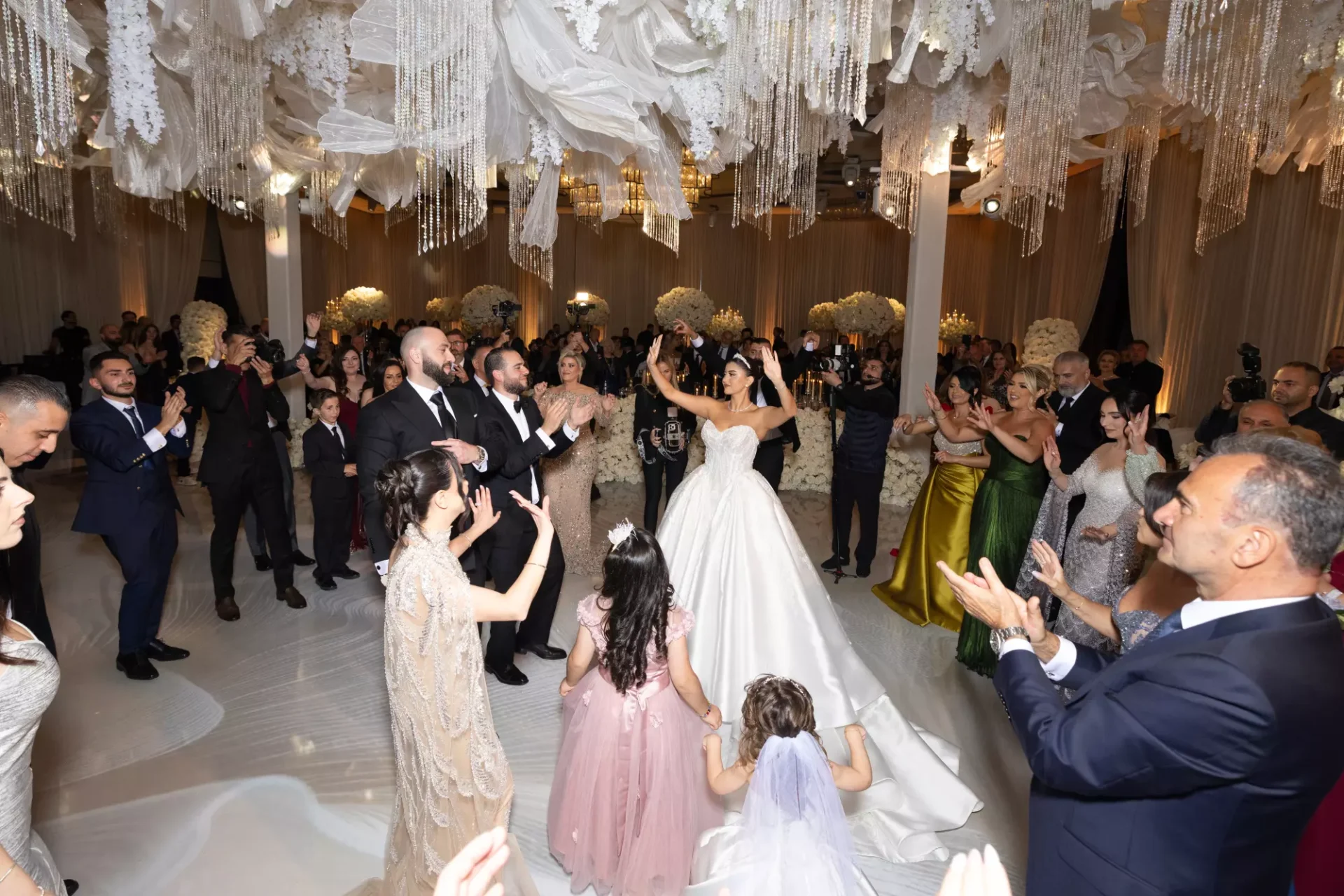
The story opens on a Saturday evening in Mission Hills, where a convoy of luxury cars and four police motorcycles pull up outside the Landmark Venue. It is not a diplomatic delegation but an Armenian wedding, arriving after a ceremony at St. Leon Cathedral in Burbank. Newlyweds Nelly Nazarian and Sahak Ter-Sahakyan step out of a white Rolls-Royce onto a red carpet, greeted by a live violin performance. Inside, thousands of candles and a sea of white roses climb toward a 25-foot ceiling strung with pearls and wisteria, while plates of chi kyufta sit alongside enough caviar to serve 450 guests and cooks work two-foot skewers of khorovats through the smoke.
Parties like theirs sit at the center of Armenian American culture in Los Angeles, and their foundation is the banquet hall, built for a community that values outsize celebrations: hundreds of guests, extravagant decor, massive dance floors, famous singers and DJs, flowing wine and tables that never empty.
Over the past 40 years, the report notes, banquet halls have evolved to embrace more of Los Angeles, hosting quinceañeras, bar mitzvahs and nonalcoholic “coffee raves” while extending an Armenian notion of hospitality across the city.
“The most important change in the banquet halls is the easiest one to picture,” Vrej Sarkissian, chief executive of Anoush Catering and L.A. Banquets, told the Times. “You can see it on the table.” The food has grown more lavish and varied, with sushi boats and shrimp ceviche spoons appearing beside the classics, and food trucks serving pizza and burgers at midnight in place of the traditional pamidorov dzvadzegh.
The first Armenian banquet halls opened in Hollywood in the late 1980s and later spread to Glendale, Burbank, North Hollywood, Pasadena and beyond, following the growth of the Armenian American community itself. Rooted in community and resilience, these venues became information hubs for immigrants navigating a new home, places where a parcel could be passed along to reach the airport or where newcomers could learn about government assistance. They also offered many immigrants their first jobs.
Sarkissian, whose family started one of the first banquet halls in the city, recalled that his father acted as a friend and counselor to immigrants suffering severe culture shock. “That restart proved to be very difficult, and my father guided a lot of people,” Sarkissian said, “helping them establish businesses, start or connect with families, continue education and a plethora of resources.”
He oversees Anoush, founded by his father Sebooh Sarkissian in 1986 and originally located on the corner of Sunset and Harvard in Hollywood. From the start, Sebooh, his wife and three sons handled every part of the business, from moving furniture to dishwashing to playing the latest hits as DJs. Over three decades the company expanded to seven more locations before consolidating into two venues, Gleonaks Anoush and Landmark.
“The food complements the way we like to celebrate,” Sarkissian said. “The music is going, people are dancing, and the food is always on the table! You’re doing a toast in 30 minutes with your uncle, you’re dancing with somebody else later, and the good food is still there!”
Food has always been at the center of Armenian celebrations, the article observes, a way for a community surviving far from the homeland to show care in times of grief and to express sharing and joy in times of celebration. That spirit drew non-Armenian clientele as well, attracted by the variety of food and the singular atmosphere: guests dancing all night to live performances, children asleep on chairs untroubled by the music, elders trading family news over cups of black coffee.
The feature also profiles Michael Keshishian, co-owner of Vertigo Event Venue in Glendale, who launched his hall in 2014 with the goal of reinventing the banquet menu into a fusion of Armenian, Greek, Russian and Persian influences, and Robert Shahnazarian, a former Sony Music producer who founded Noor Events in Pasadena in 2010 with dishes spanning bao buns, char siu and his father’s Persian classics.
For Sarkissian, the through line is the community itself. “Throughout the years, this concept proved to work for our community,” he said. “These events bring everyone together. We do it really well, and we also set the trend for the other communities.”
Read the full feature, written by Ani Duzdabanyan with photography by Armen Keleshian, in the Los Angeles Times.