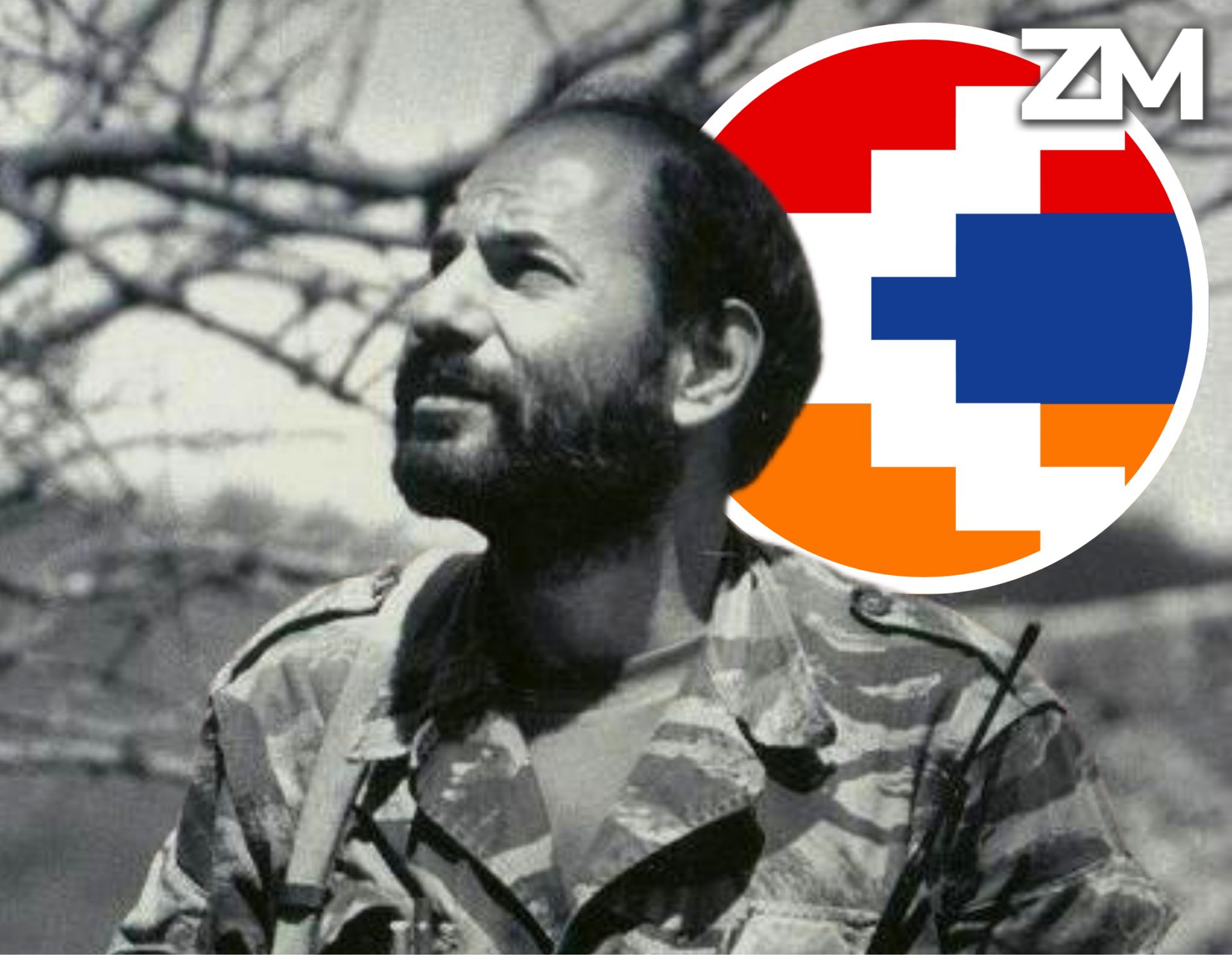

33 years ago today, on June 12, 1993, one of the greatest military commanders in modern Armenian history was martyred at 35 years old during the war of liberation that returned Artsakh to its people. He fell on the soil he had crossed an ocean to defend.
Monte Melkonian, the commander, freedom fighter, and intellectual who left a quiet life abroad to fight for Artsakh, was an American-born son who chose his nation over every other path open to him, a scholar who picked up a rifle, and a leader whose name has carried across generations as the embodiment of conviction, sacrifice, and service to the nation.
The Making Of A Hero
Monte Melkonian was born November 25, 1957, in Visalia, California, the third of four children in a third-generation Armenian-American family. His parents rarely spoke of the old country, but the silence taught him to listen harder. As a teenager he traveled with his family through more than forty countries, including the ancestral lands of Western Armenia where his grandparents had survived the Tseghaspanutyun. From that moment the question of his Hayrenik would never leave him.
He studied ancient Asian history and archaeology at the University of California, Berkeley, where he founded the Armenian Student Union and organized one of the campus’s first exhibitions on the Armenian Genocide. He spoke eight languages. He was awarded a doctoral scholarship to Oxford. He turned it down. The path he chose was the harder one, and he chose it without flinching.
The Years Of Struggle
By his early twenties, Monte was teaching in Armenian schools in Iran during the revolution and in Lebanon during the civil war. He fought alongside Armenian militias in Bourj Hammoud and the broader Lebanese-Palestinian resistance, learning the craft of war in a region where Armenians had been forced, again, to defend themselves. He joined ASALA and helped force the world to remember the Tseghaspanutyun in an era of imposed silence, then broke from the organization over questions of strategy and conscience.
He spent years in a French prison, where he read, wrote, and theorized about the Armenian national question, producing the essays later collected in “The Right to Struggle.” Five years before he would die for Artsakh, Monte wrote to his future wife Seta from afar: “We should be very, very proud and encouraged that today our people, especially our compatriots in Artsakh, that small population of 130,000 in a country with 282 million people, have taken on the role of a vanguard. It is very clear that the initiative of the people of Artsakh is right and just.”
Sparapet Of Artsakh
When the First Artsakh Liberation War began, Monte went where every fiber of his being had been calling him. To his men he was Avo. With no day of formal service in any army, he was placed in command of an estimated 4,000 azatamartiks along the Martuni front. He did not smoke. He did not drink. He did not allow his soldiers to drink. He insisted on the protection of civilians, the observation of ceasefires, and the dignity of every life under his command. In a brutal war he became known as unwaveringly just and immovably principled, the rarest kind of commander a nation can produce.
In April 1993, he helped plan and lead the operation that liberated Karvachar (Kalbajar), opening a land corridor between Hayastan and Artsakh that reshaped the strategic map of the war. His tactical brilliance, his moral clarity, and his command of Armenian history made him not only a sparapet on the battlefield but the most articulate voice the First Artsakh Liberation War produced. He told the world, in English and in Armenian, why this land mattered.
“If we lose Artsakh,” he said, “we turn the final page of our people’s history.”
Amaras, April 1993
Weeks before his death, Monte and his wife Seta Kabranian-Melkonian set out together one morning for the fourth-century Amaras Monastery, the church where Mesrob Mashtots opened the first Armenian school in the fifth century. The staff car was full of European journalists who had come to document the Armenian victories. At the last moment, Seta stepped out so others could join. “Go, go,” she told him as the car pulled away. She would carry that regret, she wrote years later, for the rest of her life.
June 12, 1993
On the afternoon of June 12, 1993, Monte and a small group of his men passed through the village of Marzili after completing an operation in the Aghdam area. They came upon an armored vehicle with soldiers gathered around it. One of his comrades, in an Azerbaijani uniform, approached to ask if they were Armenians. They were not. A firefight broke out, and a fragment from a tank shell struck Monte in the head. He died in the arms of his closest comrade.
The Armenian nation lost more than a commander that afternoon. It lost the man who, more than any other, embodied the unity of the diaspora and the homeland in a single uncompromising life.
He was buried with full military honors at Yerablur Military Pantheon in Yerevan on June 19, 1993. In 1996, the Republic of Armenia posthumously named him a National Hero of Armenia. Artsakh named him a Hero of Artsakh. Schools and streets across both republics bear his name. Statues of him stand in Martuni and beyond.
The Weight Of His Warning
Monte spoke his most famous line in a different time. He said it before the 2020 war, before the September 2023 forced exodus of more than 100,000 Armenians from Artsakh, before the Armenian Genocide Centennial Memorial in occupied Stepanakert was destroyed by Azerbaijan during the European Political Community Summit in Yerevan. Thirty-three years after his death, his words carry a weight he could not have imagined, and yet seems to have foreseen.
He left behind another instruction, too, one that has guided every Armenian who has ever stood at his grave: “Don’t drink toasts for me, but continue my work.”
Monte Melkonian belongs to that small number of nahataks whose lives become permanent reference points for a nation. An American-born son who chose his Hayrenik, a scholar who picked up a rifle, a sparapet who never stopped being a teacher. He is the proof, in a single life, that Armenian identity is not a place but a calling, and that the diaspora and the homeland are one nation across one history.
We remember him today not only for what he did, but for what he asked the rest of us to remember.
????? ???, ????? ????????
Seta Kabranian-Melkonian shared these memories in Hetq today, on the 33rd anniversary of her husband’s death.