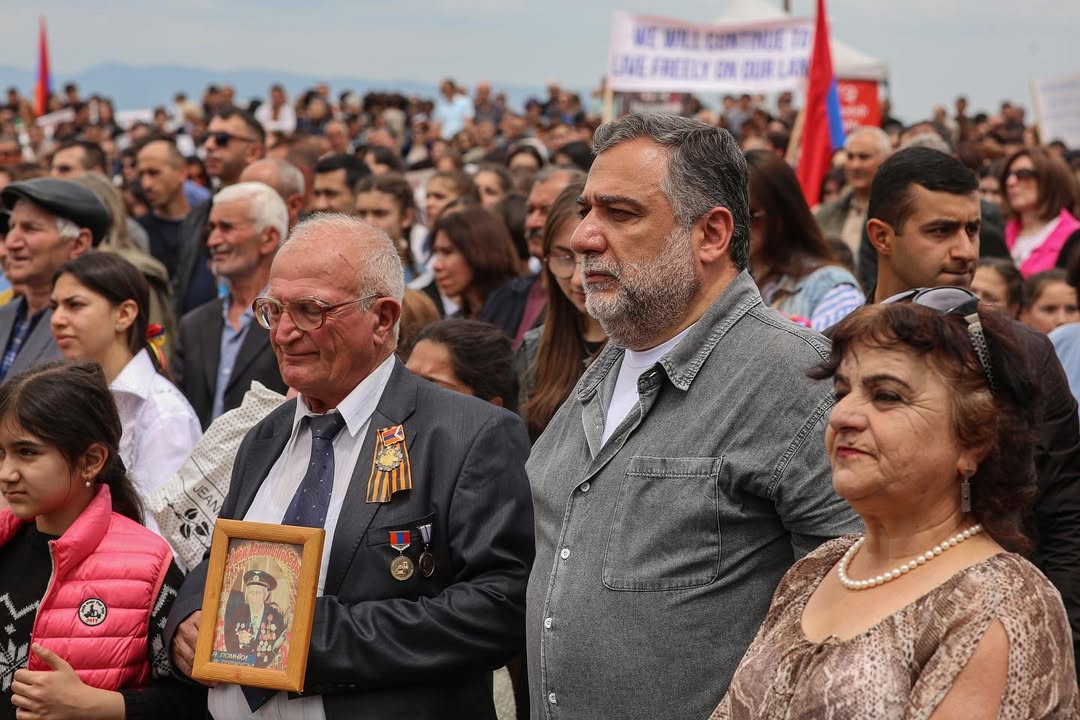

Former Artsakh State Minister Ruben Vardanyan, unlawfully imprisoned in Baku, has used a birthday address to the Armenian people to condemn the military parade planned for Armenia’s Republic Day as immoral, calling on true patriots of the country not to take part while Armenian soldiers and officers remain held in Azerbaijani prisons.
The address was delivered Monday during a phone call with his family and released as a full audio recording with subtitles in Armenian and English. May 25 marks Vardanyan’s 58th birthday, his third since his unlawful detention in Baku began.
Speaking in Armenian, which he said he considered important despite the difficulty, he structured the address around what he called “five thoughts” addressed to the Armenian public, ranging across the country’s political leadership, the prisoners held in Azerbaijan, Armenia’s geopolitical future, and what he described as growing indifference within Armenian society.
In the address, Vardanyan sharply criticized Armenian Prime Minister Nikol Pashinyan, returning to a folkloric figure he has used before to describe him. “It is the people who choose Brave Nazar as king; he does not become king by himself,” he said, invoking the Armenian fable character often associated with cowardice and incompetence.
Addressing Pashinyan directly as “Brave Nazar Nikol,” Vardanyan said the prime minister’s “luck ran out three times.” He recounted that during what he described as 800 days in a prison cell he had searched the library for books by Armenian writers and found only two, one by the Soviet-Armenian writer Vardges Petrosyan and one by Pashinyan himself.
After reading it, he said, he had concluded that the prime minister had “serious problems with moral and ethical standards” and was moreover “a liar, a fantasist, and a plagiarist,” adding that as a former journalist Pashinyan should have known not to steal intellectual property. He closed the passage with a warning drawn from Indian belief, that the gravest punishment for accumulated sin is rebirth as an earthworm for 84,000 years. “I fear that this is the punishment awaiting you,” he said.
Vardanyan also warned that the conflict with Azerbaijan had not ended, arguing that the war was continuing “in other forms” beyond direct military confrontation. “This is not a question of elections,” he said. “It is a question of the fact that the war is not over.”
He argued that Armenia was being turned into a bargaining chip between Russia and the European Union, and that the true danger lay in a “third force” waiting for the country to become fully dependent on it. “That third force is only waiting for the moment when we become fully dependent on it, economically, financially, informationally, technologically, in every way, and become a vilayet of Turkey and Azerbaijan,” he said, using the Ottoman administrative term for a province. If Armenians did nothing, he warned, that outcome would arrive quickly.
The central charge of the address concerned the military parade planned for May 28, Armenia’s Republic Day. Vardanyan called the idea of holding such a parade immoral while Armenian soldiers and officers remain in Azerbaijani captivity.
“An army is not built on parades, money, weapons, or ranks,” he said. “Above all, it is built on spirit, moral and patriotic spirit.” He called on “all true patriots of Armenia” not to participate.
The subject, he said, gave him no peace, and he tied it to a wider failure, that Armenian detainees had spent six years unable to receive photographs, letters, or clothing from their families. “Another problem is that Armenia is inactive,” he said. “The defeated commander-in-chief does nothing so that these people may at least feel that a state stands behind them.”
His final thought named what he called the most dangerous condition of all. “Indifference is more dangerous than any other vice,” he said. “The opposite of love is not hatred, but indifference. The opposite of good is not evil, but indifference. The opposite of faith is not heresy, but indifference. The opposite of life is not death, but indifference.”
No one owed Armenians anything, he said, and only by uniting could they preserve an independent state, because no single person could change the situation alone. “Each of us must understand: no one, no single person, can change the situation alone,” he said. “Only by uniting can we, together, do everything possible to preserve our country.”
Vardanyan ended the address on service and faith, reflecting on the Sanskrit concept of “dasa,” meaning a servant or one who has devoted himself to service, a term that also appears in Hermann Hesse’s novel The Glass Bead Game as the name of a figure who passes from illusion to service.
“I am dasa Ruben, the son of Karlen and Irina, an Armenian who thinks in Russian, a member of the Brotherhood of Translators of Meaning,” he said, describing himself as someone happy to dedicate his life to his homeland.
He said he forgave everyone, and closed with a final word to his compatriots: “Our future is in our own hands, and in no one else’s.”
Vardanyan, a businessman and philanthropist who served as State Minister of Artsakh, was detained by Azerbaijani forces following the September 2023 ethnic cleansing of occupied Artsakh. On February 17 of this year, the Baku Military Court sentenced him to 20 years in prison on charges including war crimes and terrorism, which he rejects as politically motivated. His case was heard separately from the other detainees, and prosecutors had demanded a life sentence. He has declined to appeal, saying he does not recognize the verdict as justice.
He is one of 19 Armenian detainees still held in Azerbaijan in connection with the Artsakh conflict. In a separate February proceeding, the same court sentenced fifteen former Artsakh leaders and residents, handing five of them life imprisonment, including former President Arayik Harutyunyan and former National Assembly Speaker Davit Ishkhanyan. The rest received terms of 15 to 20 years. Amnesty International called the verdicts a travesty and a mockery of justice. The International Committee of the Red Cross, the last independent monitor with access to the detainees, was expelled from Azerbaijan in September 2025.