
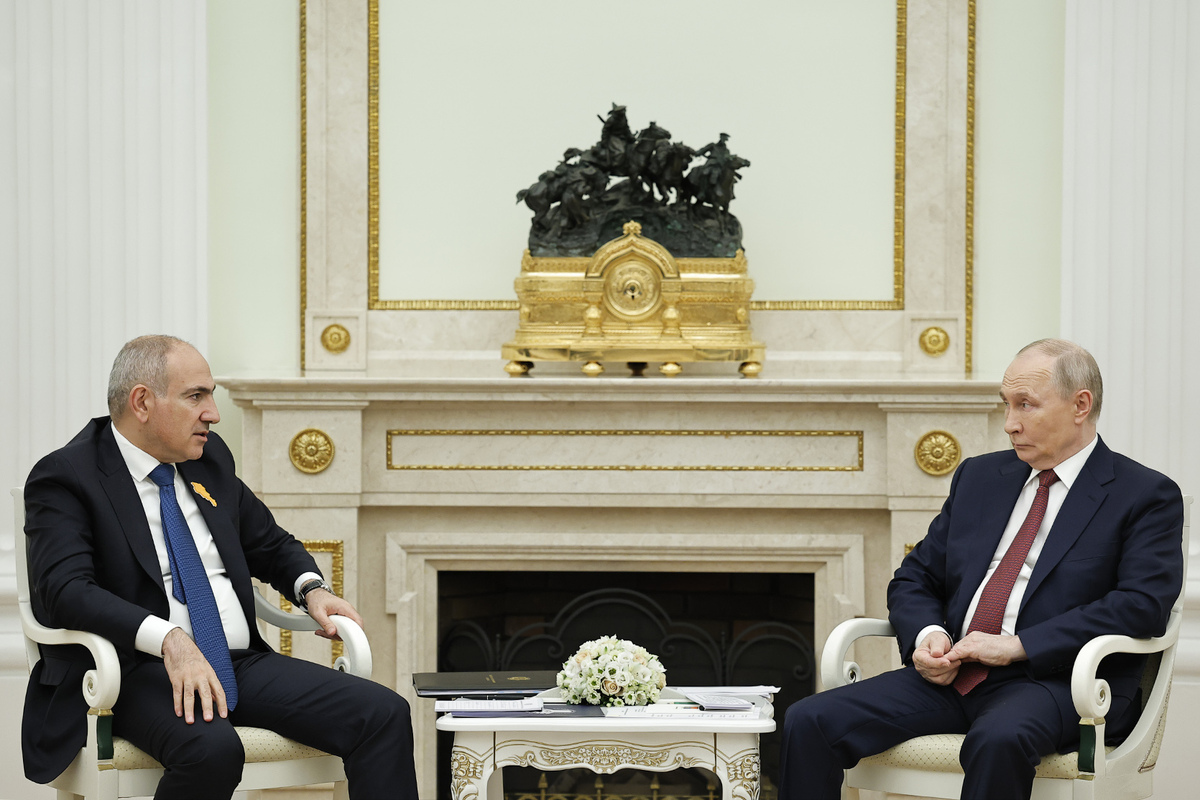

Armenian Prime Minister Nikol Pashinyan met Russian President Vladimir Putin in Moscow on Wednesday for talks centered on Artsakh, Armenia’s strained relationship with the CSTO, the upcoming June 7 parliamentary elections, and Yerevan’s ties with the European Union, as the two leaders openly exchanged views on regional security, domestic political participation, and Armenia’s broader geopolitical direction.
Artsakh and Regional Stability
The sensitive issue of Artsakh was also central to the discussions. Pashinyan reiterated that the Karabakh movement should not continue: “I have already publicly stated in Armenia that we should not continue the Karabakh movement, as Armenia and Azerbaijan have recognized each other’s sovereignty and territorial integrity under the Alma-Ata Declaration framework,” he said.
Putin responded by reminding Pashinyan that Armenia, in Prague in 2022, officially recognized Nagorno-Karabakh as part of Azerbaijan, and that any CSTO intervention at the time would have been inappropriate.
CSTO and Regional Security
Pashinyan addressed Armenia’s experience with the Collective Security Treaty Organization (CSTO), emphasizing that the country did not participate in CSTO operations in 2022 because it could not justify to citizens why the CSTO failed to fulfill its obligations.
“We have not hidden our problems with the CSTO. In 2022, there was a specific situation, and in my opinion, the mechanisms should have worked, but they did not,” Pashinyan said.
“We are not currently participating in CSTO activities simply because we cannot explain to our citizens why the CSTO did not respond, despite its obligations under the agreement.”
The Prime Minister’s remarks referred to the 2022 Azerbaijani attack on Armenian territory, which prompted tensions in Armenia’s relations with the CSTO. Despite Armenia’s requests, the organization did not condemn the attack or acknowledge Azerbaijan’s occupation of Armenian lands. In response, Armenia refused CSTO observers at the border, and Pashinyan later declared that Armenia’s membership in the alliance is effectively suspended.
Elections and Political Inclusion
Putin expressed that he wishes all political forces in Armenia, particularly pro-Russian parties, to be able to participate in the upcoming parliamentary elections.
“There are many Armenians living in Russia, our estimates put the number at two million. In Armenia, there are many political forces that are pro-Russian. We would very much like all these parties and political figures to be able to participate in internal political processes during the elections,” Putin said.
He noted that some individuals are currently imprisoned, despite holding Russian passports, but emphasized that participation is ultimately Armenia’s decision: “We do not interfere, but we would like them to be able to participate in the political process.”
Pashinyan responded that Armenia is a democratic country, with fully free social networks and no restrictions, and stressed that only citizens holding Armenian passports are eligible to participate in parliamentary elections: “There are no politically isolated participants locally. Only those with Armenian passports can take part in the elections. With all due respect to Russian passport holders, under the Armenian Constitution, they cannot run for parliament or prime minister,” he said.
The Prime Minister’s comments come ahead of the June 7 parliamentary elections, in which the pro-Russian party “Strong Armenia,” led by businessman Samvel Karapetyan, has declared participation. Karapetyan is currently under house arrest following accusations related to money laundering and his public defense of the Armenian Apostolic Church. His nephew, Narek Karapetyan, is set to lead the party’s electoral list and act as coordinator for the transitional period to facilitate potential constitutional procedures for Karapetyan’s prime minister candidacy.
EU-EAEU Relations and Energy Prices
For the first time during the talks, Putin addressed Armenia’s aspirations to develop closer ties with the European Union. He reiterated Moscow’s position that simultaneous membership in both the EAEU and the EU is impossible.
“We see discussions in Armenia about developing relations with the EU. We approach this calmly. We understand any country seeks maximum cooperation with third parties, but it must be transparent and honest from the start. Membership in a customs union with the EU and the EAEU at the same time is simply impossible,” Putin said.
He also highlighted the economic angle, noting the stark difference in energy prices: “Gas in Europe has risen to $600 per 1,000 cubic meters, while Russia sells to Armenia at $177.5. The difference is huge. We often argue about this, and I know you push for different pricing, but look at the numbers: $600 versus $177.5.”
Pashinyan acknowledged the challenge, stressing that Armenia is aware that dual membership is impossible, but emphasized that as long as both agendas can be reconciled, Armenia will attempt to do so:
“When a decision is needed, Armenian citizens will make that decision,” he said.


