
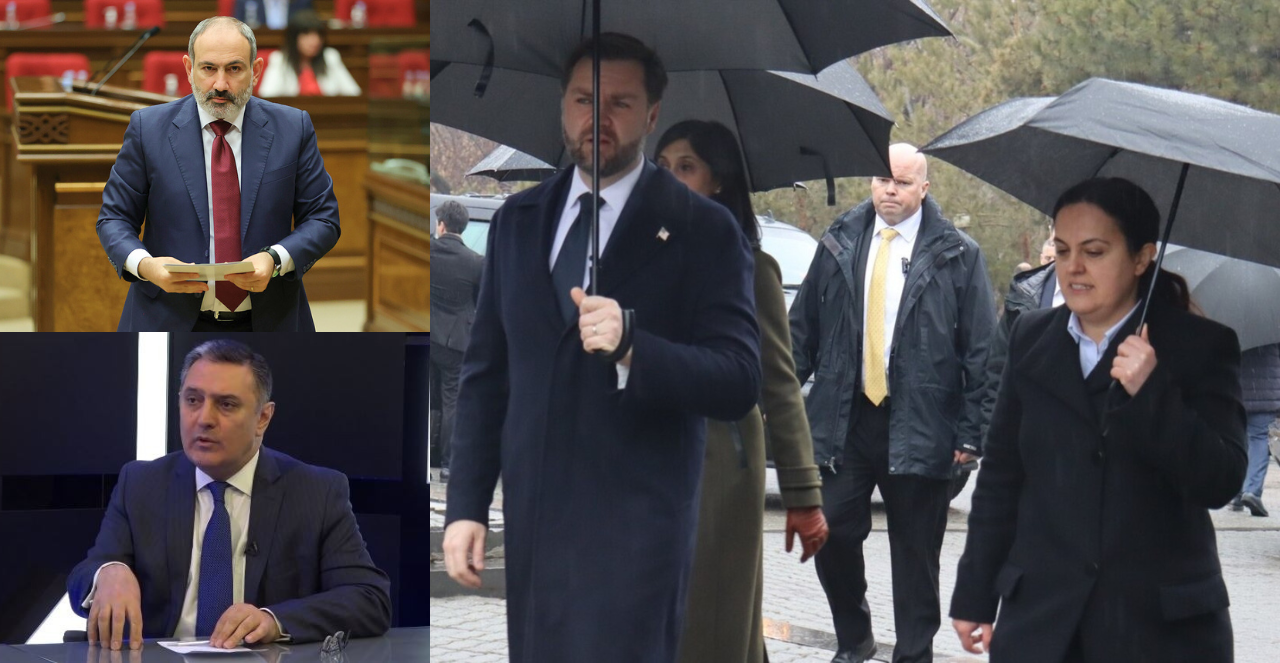

Twenty-five prominent internationalgenocide scholars from leading universities in the United States and Europe have issued a joint statement expressing deep concern over the resignation of Edita Gzoyan, director of the Armenian Genocide Museum-Institute (AGMI), which Prime Minister Nikol Pashinyan said he had ordered. The scholars called for her immediate reinstatement as the institute’s Board of Trustees appointed former Pashinyan aide Hrachya Tashchyan as acting director.
The scholars warned that Gzoyan’s forced departure threatens the institute’s independence, undermines its international standing, and sends a troubling message about political interference in academic institutions.
Despite the growing backlash, Tashchyan officially began his duties as acting director on March 13, 2026.
The statement, published by Bedross Der Matossian, professor of Modern Middle East History at the University of Nebraska–Lincoln, highlighted Gzoyan’s contributions to expanding archival collections, organizing international conferences, and producing scholarly publications that strengthened global understanding of the Armenian Genocide and related historical events.
The scholars also stressed that they have worked closely with AGMI through conferences, editorial and academic boards, joint scholarly initiatives, and academic publications, warning that Gzoyan’s removal could seriously jeopardize the institute’s future, discourage leading genocide scholars from collaborating with it, and weaken the international academic partnerships central to its mission.
The scholars also pointed to Gzoyan’s role in guiding U.S. Vice President J.D. Vance during his visit to the Tsitsernakaberd Memorial Complex, where she presented works on both the Armenian Genocide and the Artsakh conflict, and referenced later anti-Armenian violence in Sumgait, Kirovabad, and Baku.
Responding to the controversy, Prime Minister Pashinyan said: “I was the one who asked the director of the Armenian Genocide Museum-Institute to submit a resignation letter; it was done on my instruction. I considered giving a book about Artsakh to Vance to be a provocative act that goes against the government’s policy.”
In an interview with reporters earlier this week, prior to his appointment, Tashchyan praised Gzoyan and emphasized that she will continue to be involved with the museum.
“Of course, she will continue to work. Without her, I cannot imagine how the Institute could carry on its activities. One could say she is a central figure and an excellent scholar,” he said.
AGMI staff and members of the institute’s Board of Trustees have expressed strong support for Gzoyan. Several members of the Board of Trustees have also resigned in protest, including genocide historian Raymond Kévorkian.
The scholars warned that the episode reflects a broader and troubling trend of political influence over independent academic institutions. They stressed that the AGMI is not merely a museum but a key center of historical memory and scholarship, and that its leadership must remain independent.
They called for leadership appointments to be based on academic merit rather than political considerations in order to preserve the institute’s credibility, safeguard its mission, and maintain the trust of the international academic community.
It was signed by the following 25 scholars and academic figures:
- Prof. Bedross Der Matossian, Professor of History, Hymen Rosenberg Professor in Judaic Studies, University of Nebraska-Lincoln
- Prof. Elyse Semerdjian, Robert Aram and Marianne Kaloosdian and Stephen and Marian Mugar Chair of Armenian Genocide Studies, Strassler Center for Holocaust and Genocide Studies, Clark University
- Prof. Armen Marsoobian, Professor of Philosophy, Southern Connecticut State University
- Prof. Keith Watenpaugh, Professor of Human Rights Studies, University of California, Davis
- Prof. Melanie Schulze Tanielian, Associate Professor of History, University of Michigan, Ann Arbor
- Dr. Simon Maghakyan, Associate Member of the Faculty of Asian and Middle Eastern Studies, University of Oxford
- Dr. Boris Adjemian, Director of Bibliothèque Nubar de l’UGAB
- Mr. Marc Mamigonian, Director of Academic Affairs, National Association for Armenian Studies and Research (NAASR)
- Prof. Vahé Tachjian, Houshamadyan, Berlin, Ara Hrechdakian Chair of Armenian Studies, Saint Joseph University of Beirut
- Prof. Houri Berberian, Professor of History, Meghrouni Family Presidential Chair in Armenian Studies, University of California, Irvine
- Prof. Henry Theriault, Vice-Chair, Board of Directors, National Association for Armenian Studies and Research, and Co-Editor, Genocide Studies International
- Prof. Ronald Grigor Suny, William H. Sewell Jr. Distinguished University Professor of History Emeritus, the University of Michigan, Professor of Political Science and History Emeritus, University of Chicago
- Prof. Barlow Der Mugrdechian, Haig and Isabel Berberian Coordinator of Armenian Studies, California State University, Fresno
- Prof. Lori Khatchadourian, Associate Professor, Departments of Near Eastern Studies and Anthropology, Cornell University
- Dr. Hilmar Kaiser, Universität Bern
- Mr. Michael Bobelian, Adjunct Professor, Columbia University and Baruch College
- Prof. A. Dirk Moses, Anne and Bernard Spitzer Professor of International Relations, City College of New York
- Prof. Hervé Georgelin, Assistant Professor, National and Kapodistrian University of Athens
- Mr. Gregory Aftandilian, Senior Professorial Lecturer, American University, Washington, D.C.
- Prof. Julien Zarifian, Professor of U.S. History, University of Poitiers, France
- Prof. Fatma Müge Göçek, Professor of Sociology, University of Michigan
- Prof. David Gaunt, Emeritus Professor of History, Södertörn University, Stockholm, Sweden
- Prof. Tessa Hofmann, formerly of Freie Universität Berlin, Institute for Eastern European Studies
- Dr. Talar Chahinian, Continuing Lecturer in Armenian Studies, University of California, Irvine
- Prof. Samuel Totten, University of Arkansas, Fayetteville


