
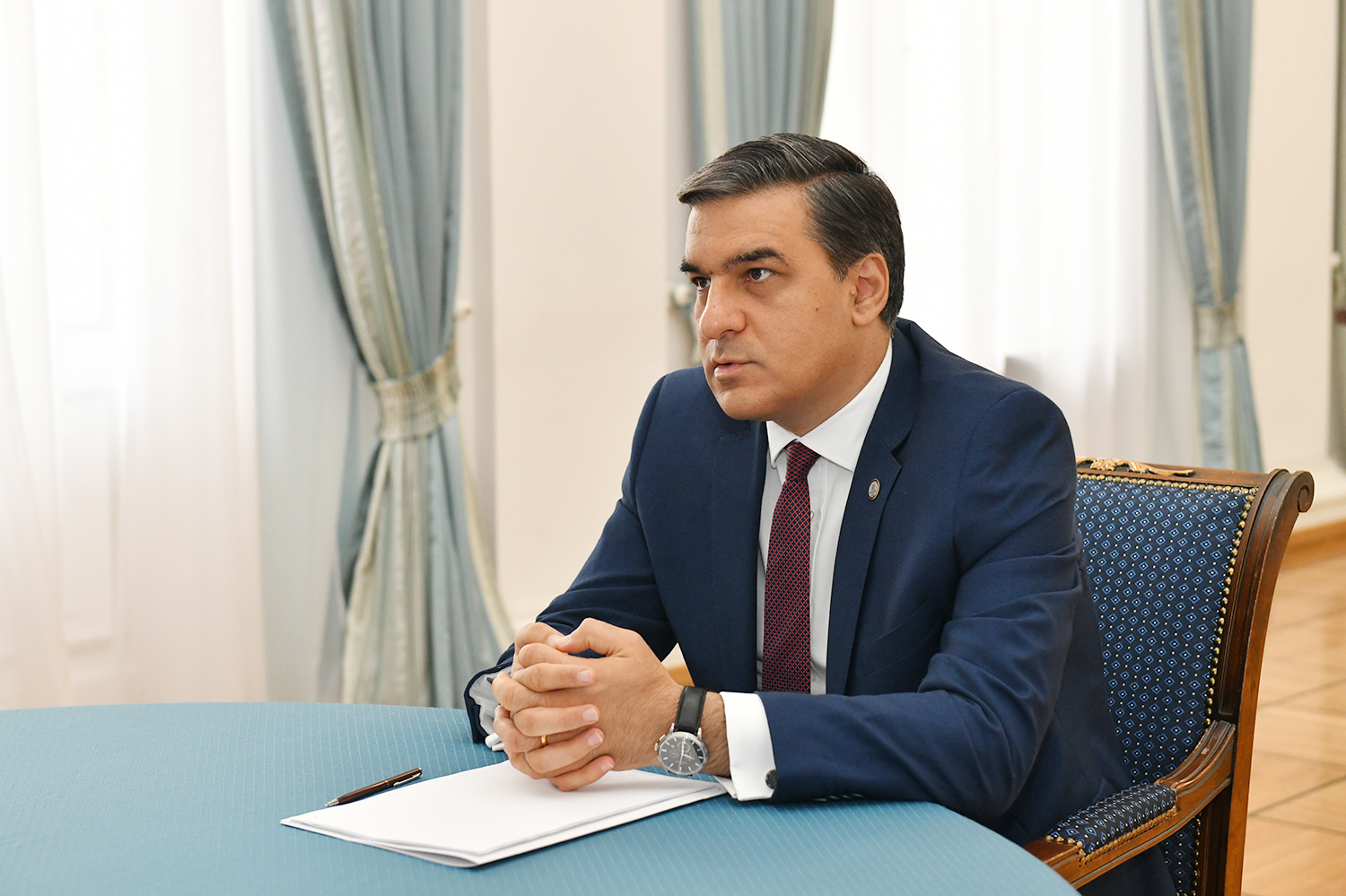

Establishing peace is essential, but the liberation of Armenia’s sovereign territories occupied by Azerbaijan cannot be postponed or consigned to oblivion, Arman Tatoyan, head of the Wings of Unity political initiative and former Human Rights Defender of Armenia, said in a statement published on Facebook, accompanied by a video message.
“We cannot live with fading hopes, and negotiations cannot proceed as if the seizure of territories by force does not exist,” Tatoyan said.
He emphasized the importance of the United States’ role in the peace process, calling on American and European mediators to clearly acknowledge what he described as an established reality: that Azerbaijani armed forces continue to occupy Armenia’s sovereign territory, a situation he said is fundamentally incompatible with any credible peace agreement.
“We must achieve a situation where mediators state openly what everyone knows—that Azerbaijan continues to occupy the internationally recognized territory of Armenia,” Tatoyan said.
Occupation Cannot Be Treated as Secondary
Tatoyan stressed that peace efforts must be tied to concrete obligations, warning that diplomacy detached from facts on the ground creates dangerous precedents.
“Since 2021, Azerbaijan has occupied more than 200 square kilometers of Armenia’s internationally recognized territory in the regions of Syunik, Vayots Dzor, and Gegharkunik, and in terms of de facto control, many additional hundreds of square kilometers,” he said. “After numerous negotiations, not a single centimeter has been returned, and not a single occupying unit has been withdrawn.”
According to Tatoyan, the military reality established through armed force has remained intact, while negotiations have continued as if occupation were a secondary issue.
“If negotiations proceed without binding obligations, this sends a dangerous message—to the Azerbaijani leadership and to bad actors worldwide—that territory seized by force can be held indefinitely, so long as talks continue,” he said. “It suggests that occupation can eventually be legitimized through delay.”
Peace Cannot Coexist with Occupation
Tatoyan also referred to agreements discussed along the so-called “Trump route,” noting that understandings reportedly recorded last August may have delayed or even disrupted Azerbaijan’s plans to occupy Syunik. He warned that agreements on transport corridors, regional integration, or confidence-building measures cannot exist in parallel with territorial occupation.
He further pointed to rhetoric from Azerbaijani leadership as incompatible with reconciliation. Following the August 8 meeting in the United States, Azerbaijani President Ilham Aliyev publicly described Armenian society as “sick,” Tatoyan noted, adding that Azerbaijan continues to promote a state-sponsored narrative portraying all of Armenia as “ancient Azerbaijani land.”
“This language is not the language of coexistence, but of hierarchy; not of compromise, but of coercion and racism,” Tatoyan said.
Peace Must Be Based on Clear Principles
Tatoyan concluded by stressing that lasting peace can only be achieved if negotiations are grounded in a clear and universal principle: borders cannot be changed by force, and occupation cannot be rewarded over time.
“Peace cannot depend on the ‘goodwill of the occupier,’” he said. “It must be the result of concrete mechanisms and guarantees firmly put in place.”
He added that these principles form the basis of his recent article published in The Washington Times, and said they would guide his approach should his political initiative enter governance.
“We will achieve peace,” Tatoyan said, “but it will be a peace built on accountability, not illusion.”


