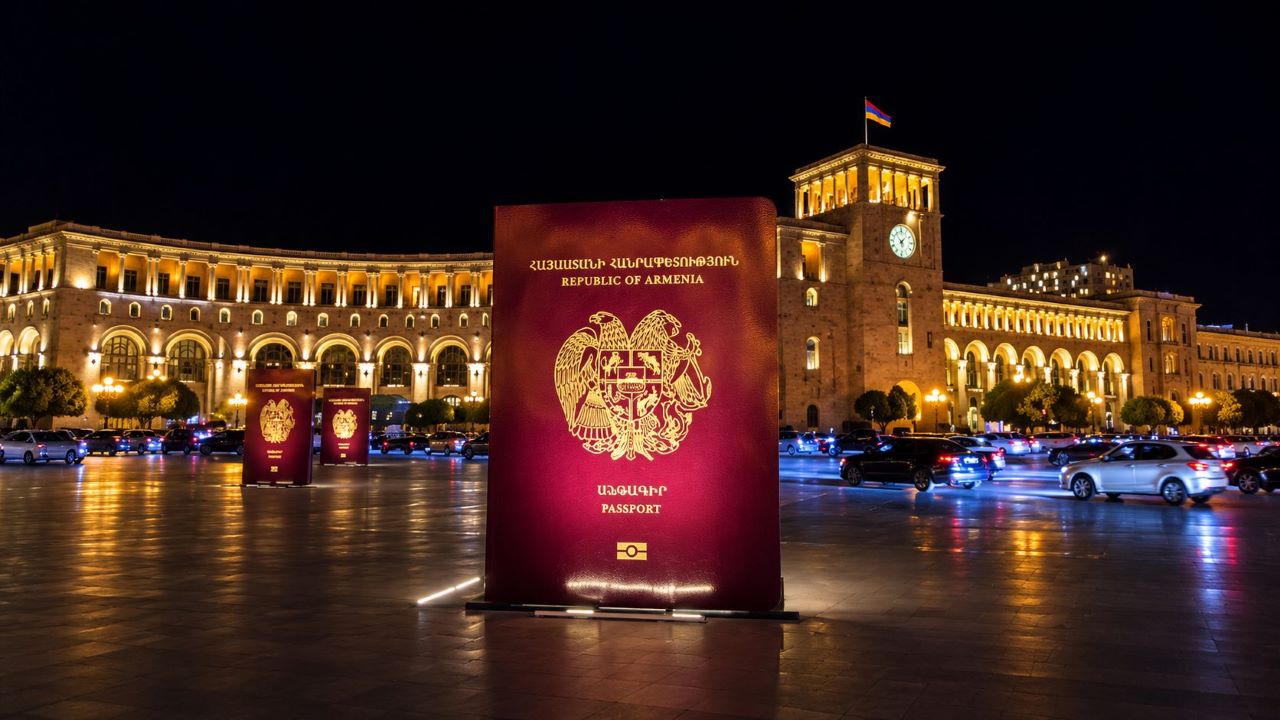

Armenia’s new biometric passports record the birthplace of forcibly displaced Artsakh (Nagorno-Karabakh) Armenians as “Azerbaijan,” replacing the names of the towns and villages they were born in, reports Zartonk Media.
The Migration and Citizenship Service, which falls under the Interior Ministry, said in a November 19 statement that the field is governed by the ISO 3166 standard, which it said ICAO’s 9303 standard refers to for identifying countries and geographical entities.
It said entries not recognized under those standards can cause problems at border crossings, that foreign border authorities had repeatedly raised concerns about Armenia’s old blue passports, and that the new system sets a uniform approach.
Interior Minister Arpine Sargsyan was asked at a briefing in the National Assembly on Tuesday why the field reads Azerbaijan when the holders’ birth certificates record Stepanakert, Shushi or Martuni. She said the standard allowed either. “Yes, a country can be indicated, or a city or settlement can be specified. We have opted to indicate the country, taking into account consultations with ICAO experts and the problems that have arisen for various countries in different situations,” she said.
She said the ISO list would have bound Armenia either way. “Even if we had decided to indicate the settlement, we would have had to follow the ISO standard. However, under the ISO standard, you will not find the place names cited by our compatriots from Karabakh under the names they wish to see in their passports,” she said.
Sargsyan said a settlement recorded on a birth certificate is not by itself grounds for recording it the same way in a biometric passport, and that the entry is not a matter of personal preference, because the state decides whether to indicate a place of birth and how to complete the field. She said the biometric rollout was meant to remove the administrative distortions that had crept into the field under the old system.
ICAO’s own rulebook does not say what the service and the minister say it says. Section 3.7 of Doc 9303 Part 3 states: “Inclusion of the place of birth is optional. If the place of birth is included it may be represented by the town, the city, the suburb and/or the State.” Part 4 of the same document lists the place of birth as Field 12 in Zone II of the data page, with the status “Optional element in mandatory zone,” described as a “Field optionally used for city and State of the holder’s birthplace.”
Under ICAO’s standard, printing “Stepanakert” alone is fully compliant. So is leaving the field blank, an option Sargsyan said was ruled out after Uruguayan citizens were refused entry by Germany and France in 2025 when their documents omitted the field. The same section tells issuing authorities to weigh any political sensitivities attached to a state or territory and whether visa-issuing authorities in other countries recognize it, the provision Sargsyan cited in support of naming Azerbaijan.
Armenian law also used to permit it. Article 5 of the Law on the Passport of a Citizen of the Republic of Armenia, as amended in December 2021, recorded the place of birth as the state or, at the person’s wish, the region, district, city, town or village. That provision is why Artsakh Armenians’ passports could read Stepanakert, Martuni, Askeran or Martakert without naming any state.
The service itself confirmed that option in April 2025. Asked then why Azerbaijan was appearing in the passports of Artsakh residents, it said they could apply to have the birthplace field show other data recorded on their birth certificate, naming the region, district, city, town or village, and warned that doing so could cause problems at border crossings. Sargsyan confirmed on Tuesday that the question had been raised in April 2025. That warning about border crossings is the same one the service now gives as the reason the option no longer exists.
The National Assembly repealed the provision. It adopted the Law on Identity Documents on May 11 at an extraordinary session, in a package Sargsyan presented herself, and the law took effect on October 30. Its Article 3 defines the entry as place of birth: state, which left no room for a town. Sargsyan told parliament in May that the law moved Armenia closer to visa liberalization with the European Union, whose first progress report on the action plan singled it out.
Which state goes in the field follows from Armenia’s position on Artsakh’s status. Prime Minister Nikol Pashinyan said at a press conference on May 22, 2023 that Armenia recognizes Azerbaijan’s territorial integrity across 86,600 square kilometers and that the figure “also includes Nagorno-Karabakh.” Asked directly whether his government recognizes Artsakh as part of Azerbaijan, he answered that every Armenian government has recognized Azerbaijan’s territorial integrity. Artsakh has no entry of its own in ISO 3166 because no United Nations member state, Armenia included, ever recognized it.
Artsakh Union, which condemned the service’s statement, said neither standard forbids naming a settlement and that the place of birth does not appear in a passport’s machine readable zone at all.
Other countries do what Armenian law used to allow. His Majesty’s Passport Office instructs its staff that the place of birth printed on a British passport is the town of birth, with a country shown only when the applicant’s own documents give nothing more. The United States Foreign Affairs Manual provides that an applicant born outside the country who objects to the Department’s listing of the country of birth may be offered the option of listing the city of birth alone. Canada drops the field altogether on request, through a form its passport program publishes for the purpose.
Artsakh Union also cited the European Court of Human Rights judgments in Chiragov and Others v. Armenia and Sargsyan v. Azerbaijan, delivered on June 16, 2015, which found continuing violations of the right to respect for private and family life and the home against people displaced by the conflict and unable to reach their homes. Making a forcibly displaced person carry a document naming the state that drove them from their birthplace is a disproportionate interference when neutral alternatives exist, it said.
In the case Armenia brought against Azerbaijan at the International Court of Justice, the court ordered Azerbaijan on November 17, 2023 to protect and preserve the identity and registration documents of Armenians who left Artsakh after September 19, 2023 and to have due regard to them in its administrative and legislative practices. Artsakh Union called it inconsistent for Armenia to defend the legal weight of those documents in The Hague while entering a birthplace in its own passports that does not match them.
It called on Armenians who object to submit a written application to the service when applying for a biometric document, and offered them a sample form and legal support.
Artak Beglaryan, who served as Artsakh’s human rights defender and later as its state minister, has submitted a formal request that Azerbaijan not be listed in his new biometric passport. He was born in Stepanakert in 1988, when the state that existed was the Soviet Union.
Arega Hovsepyan, a member of parliament from the Strong Armenia faction who is herself from Artsakh, said she will take the matter to international organizations. She said she met the head of the Migration and Citizenship Service, presented counterarguments, heard the service’s explanation and told its leadership she intends to pursue the issue through written and verbal appeals.
Boris Arushanyan, a veteran of the Artsakh movement, said he applied for an Armenian passport in order to access state housing support and will refuse to take the document if it names Azerbaijan as his birthplace. Artsakh organizations and former officials will take the question to international courts, he said.
Armenia began issuing the new biometric passports on November 1. Valid old blue passports remain in effect. About 50,000 displaced Artsakh Armenians have applied for and received Armenian citizenship, Sargsyan said.
Azerbaijani state-aligned media reported the passport entries as confirmation of Baku’s own account, describing the holders as Armenians who had “voluntarily relocated” from Azerbaijan.
Azerbaijan seized Artsakh in a 24-hour offensive launched on September 19, 2023 and ethnically cleansed it of its Armenian population. More than 115,000 Armenians were forced from their homes and reached Armenia within a week, emptying a region Armenians had lived in since antiquity. The European Parliament, in a resolution adopted on October 5, 2023 by 491 votes to 9 with 36 abstentions, considered that the situation amounted to ethnic cleansing and condemned the threats and acts of violence committed by Azerbaijani troops against the population of Nagorno-Karabakh. Azerbaijan had taken Shushi and Hadrut three years earlier, in the 44-day war of 2020, and has held the whole of Artsakh under occupation since.