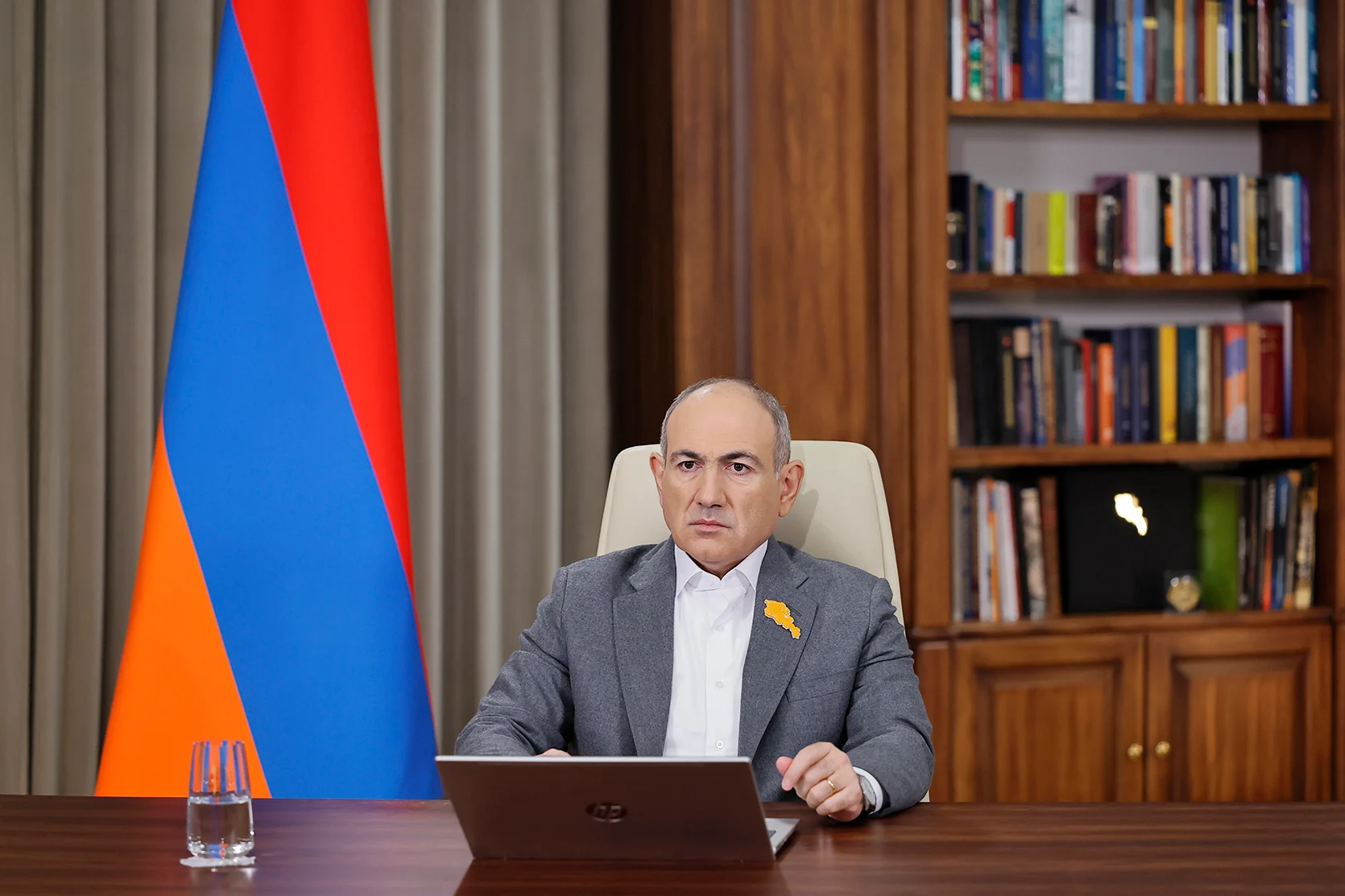

Prime Minister Nikol Pashinyan on Monday published the draft of a new constitution for Armenia that drops every reference to the 1990 Declaration of Independence, the founding document through which the Armenian Genocide and the unification of Armenia and Artsakh (Nagorno-Karabakh) entered Armenia’s constitutional order, reports Zartonk Media.
Pashinyan urged the country to back the draft as a guarantee of peace, vowed to resign if Armenians reject it in a referendum, and ruled out running for prime minister again if they approve it. Azerbaijan welcomed the draft the same day. The parliamentary opposition called it Aliyev’s constitution, launched a nationwide movement against it and demanded Pashinyan’s resignation.
The draft runs to 89 articles across 12 chapters, down from 220 articles across 16 chapters in the text now in force. A review of the full 176-page document found no mention of the Declaration, of Artsakh or Nagorno-Karabakh, of the Armenian Genocide, or of the December 1, 1989 unification act. Armenia would remain a parliamentary republic with much of its machinery rebuilt.
The change sits in the preamble. The current one opens with “The Armenian people” and cites the national goals enshrined in the Declaration of Independence. The draft opens with “We, the people of the Republic of Armenia” and sets out a mission to build an independent, peaceful, secure and prosperous state in Armenia’s internationally recognized territory.
Article 1 names the people as the founder of the state, and Article 3 defines that people as the collective whole of Armenia’s citizens.
The Ministry of Justice published the text at yourconstitution.am, where citizens can read it and submit proposals. Pashinyan presented it in a video address on Monday, November 23, and said the published version is not final. “The Constitution must be yours, the legal order must be yours, and in this way, the state must be entirely and completely yours,” he said.
Azerbaijan has set one condition for signing a peace treaty: that Armenia’s constitution carry no territorial claims against it. President Ilham Aliyev has said repeatedly that the preamble’s reference to the Declaration of Independence is such a claim, and that the constitution poses a territorial threat to Azerbaijan. Pashinyan now presents the reform as an internal Armenian process and rejects the opposition’s position that the agenda originates in Baku’s demand.
The demand has not come from Baku alone. German Foreign Minister Johann Wadephul, who travelled to Baku and Yerevan on November 17, told the German broadcaster Tagesschau on November 21 that “for a peace agreement, Armenia needs to make changes to its constitution or adopt a new constitution.” He added: “I am trying to support this, but, of course, this remains a matter of Armenian domestic politics.”
Azerbaijani Foreign Minister Jeyhun Bayramov welcomed the draft that afternoon, speaking in Baku alongside Italian Foreign Minister Antonio Tajani. “The only important issue for us is that there are no territorial claims against Azerbaijan in the new Constitution,” Bayramov said, adding that the matter is an internal one for Armenia. “Judging by the published text, there are currently no such claims. We consider this very positive. Once a final solution is reached on this issue, it will be possible to sign the peace agreement.”
Pashinyan had addressed outside pressure hours earlier. “Never, under any circumstances, succumb to the temptation to think that we are doing this due to external pressure or for the sake of anyone else,” he said. “I stake my entire political, personal, and moral credibility on this matter.”
The Declaration Was the Only Route by Which Artsakh & the Genocide Entered Armenia’s Constitutional Order
Neither Artsakh nor the Armenian Genocide has ever appeared in the articles of Armenia’s constitution. Both entered through the preamble’s single reference to the Declaration of Independence.
The Declaration, adopted on August 23, 1990, carries both. Its preamble invokes the December 1, 1989 joint decision of the Supreme Council of Soviet Armenia and the Artsakh National Council on the reunification of Armenia and Artsakh, and speaks of realizing the aspirations of all Armenians. Its eleventh point reads: “The Republic of Armenia stands in support of the task of achieving international recognition of the 1915 Genocide in Ottoman Turkey and Western Armenia.”
Removing the preamble reference removes the constitutional footing for both at once, which is why neither word needs to appear in the draft at all.
The Declaration itself is not repealed and remains a legal act of 1990. What it loses is its place in the constitution.
Ishkhan Saghatelyan of the Armenia Alliance rejected the premise behind the change. “The claim that Azerbaijan is not signing a peace agreement with Armenia because our Constitution contains territorial claims has absolutely no basis in reality,” he wrote on Facebook.
He argued that the removal nonetheless carries legal weight, because the Constitutional Court has already ruled that provisions of the Declaration not reproduced in the constitution have no independent legal force. On that reading, the preamble line was the whole of their legal existence. He also argued that the Washington peace agreement’s provisions on refraining from claims mean Armenia is being asked to write Azerbaijani conditions into its basic law.
Mount Ararat Would No Longer Be Named in Armenia’s Constitution
Article 21 of the current constitution describes the flag and the coat of arms. The coat of arms description names a shield bearing Mount Ararat with Noah’s Ark and the coats of arms of the four kingdoms of historical Armenia, held by an eagle and a lion, with a sword, a branch, a sheaf of wheat, a chain and a ribbon beneath it.
Article 16 of the draft names the coat of arms, the flag and the anthem as the state symbols and describes none of them, leaving all three to a law adopted by referendum. The words Ararat, Noah, ark, eagle and lion appear nowhere in the 176-page text.
The symbols would not change the day the constitution took effect, because laws adopted before it stay in force. What changes is that the mountain would no longer be named in the constitution, and any future change to the design would need a national vote.
Pashinyan has argued for years that Armenians should look to Mount Aragats instead. “Speaking of Ararat and Aragats, I am talking about the territories that are or are not the sovereign territory of Armenia,” he said. “Mountain Aragats is in Armenia, Mountain Ararat is not.”
He has said that half the schoolchildren he meets name Ararat as Armenia’s highest mountain.
An order he signed on September 11, 2025 redesigned Armenia’s border stamps without Ararat’s silhouette, effective that November 1. He defended it at a security conference in Yerevan. “You built your house within the confines of your neighborhood, but you paint a picture on your house, especially on the outer walls, that symbolizes your perception that your neighbor does not deserve to have what he has,” he said.
Peace Enters the Constitution as an Objective of Armenian Foreign Policy
Article 8 of the draft states that Armenia’s foreign policy is conducted on the basis of international law, to establish good-neighborly and mutually beneficial relations with all states and to ensure peace.
Pashinyan contrasted the draft with what he described as the logic of conflict built into the Declaration of Independence. “How does the 4th Republic differ from the 3rd Republic? By the absence of conflict,” he said, arguing that the Third Republic was established for the sake of conflict, and that his goal is to turn Armenia “from a place of trenches into a ‘crossroads of peace.'”
He also named freeing the judiciary from the oligarchy’s influence as a goal of the reform.
The Church & the Diaspora Keep Their Articles, & “Secular” Enters the Constitution for the First Time
Article 15 of the draft preserves the Armenian Apostolic Holy Church almost word for word from the current text, recognizing its exclusive mission as a national church in the spiritual life of the Armenian people, in the development of their national culture and in the preservation of their national identity.
One word changes. Article 18 of the current constitution says relations between the republic and the Church may be regulated by law. The draft says they are regulated by law, making legislative regulation a constitutional requirement rather than an option.
Article 14 guarantees freedom of activity for religious organizations and states that they are separate from the state.
Article 13 keeps the Diaspora, committing Armenia to a policy of developing comprehensive ties with Armenians abroad and preserving Armenian identity, with repatriation as a goal. The draft also keeps simplified citizenship for ethnic Armenians and keeps the definition of marriage as a union between a woman and a man of marriageable age.
Two words enter the definition of the state. Article 1 of the current constitution calls Armenia a sovereign, democratic, social state governed by the rule of law. Article 2 of the draft calls it a sovereign, democratic, legal, secular and social state.
Article 78 lists the provisions that can never be amended. They now include that definition of the state, the people as founder and source of power, the right to dignity, the principle of man as the highest value, and, for the first time, the status of Armenian as the state language.
Only Citizens Who Have Recently Lived in Armenia Could Vote
Article 48 of the current constitution gives the vote to citizens aged 18 and over on the day of an election or referendum, with no residency condition. The draft gives it to citizens aged 18 and over who have permanently resided in Armenia for at least 1 year during the 2 years preceding the vote.
Armenian citizens abroad can already vote only by travelling to Armenia. The Central Electoral Commission has said no polling stations open at Armenian diplomatic missions, with diplomats, military personnel posted abroad and students abroad able to vote electronically.
The difference is that a citizen living abroad can make that trip and vote today. Under the draft the same citizen could not, unless they had lived in Armenia for 1 of the previous 2 years.
The rule reaches beyond elections. Citizens’ initiatives need signatures from citizens with the right to vote, so it would narrow who can sign one and shrink the pool against which referendum thresholds are measured.
In local elections the draft goes the other way, extending the vote to foreign citizens and stateless persons who have lived in the community for at least 1 of the preceding 2 years.
Requirements to stand for parliament also rise. The current constitution asks for 25 years of age, 4 years of sole Armenian citizenship and 4 years of permanent residence. Article 35 of the draft asks for 25 years of age, 5 years of sole Armenian citizenship, 5 years of permanent residence, the right to vote and command of Armenian.
Armenia Would Be Able to Strip Citizenship, Which the Current Constitution Forbids
Article 47 of the current constitution states that a citizen of Armenia may not be deprived of citizenship. Article 24 of the draft allows a court to deprive a person of citizenship for crimes directed against the foundations of the constitutional order or the security of the state, with the cases and procedures set by law.
The draft also qualifies the rule against retroactive legislation. The current Article 73 states that laws and other legal acts worsening a person’s legal situation have no retroactive effect. The draft keeps that and adds an exception where retroactive application is necessary in a democratic society to protect the public interest.
Laws that decriminalize an act or reduce a penalty continue to apply retroactively. Article 23 keeps the bans on convicting a person for an act that was not a crime when committed, on imposing a heavier penalty than the one applicable at the time, and on trying a person twice for the same act.
The Prime Minister Would Be Supreme Commander in Peacetime, Not Only in War
Under Article 155 of the current constitution the prime minister is Commander-in-Chief of the Armed Forces at the time of war. Article 57 of the draft makes the prime minister Supreme Commander with no such limitation, places the armed forces under the Government with National Assembly oversight, assigns command to the Defence Minister and makes the Chief of the General Staff subordinate to that minister.
The draft requires the Government to obtain the consent of the National Assembly before sending the armed forces outside Armenia, except where a ratified international treaty provides otherwise. In cases of urgent necessity the prime minister may decide on the use of the armed forces inside the country, and the Government may annul that decision.
The Security Council is not mentioned anywhere in the draft. Under the current Article 152 the prime minister heads it, and under Article 155 it sets the main directions of defence policy.
Article 55 of the draft requires the prime minister to be a deputy of the faction that formed the parliamentary majority, or a person whose parliamentary mandate is suspended because they serve in the Government. The current constitution sets no such requirement.
Parliament Could Dissolve Itself, Remove Single Ministers & Cap a Landslide
Article 32 of the draft lets the National Assembly dissolve itself on the votes of at least three fifths of all deputies. The current constitution provides no comparable general option.
Article 44 extends no confidence beyond the prime minister. A faction could move to remove a deputy prime minister, a minister or a diplomatic representative, and a majority of all deputies would end that official’s powers. Under Article 37, nominees for those posts would first be discussed at a public committee session that sends the prime minister an advisory opinion.
Article 30 caps what a landslide delivers. If one party or bloc wins more than two thirds of the mandates distributed in an election, the other parties receive the minimum number of additional mandates needed to bring their combined total to one third of the National Assembly.
The route to a governing majority changes too. If no majority emerges and no coalition forms within 2 weeks, the newly elected parliament is not constituted and a fresh election is held.
The Opposition Would Get a Seat on Each Independent Body & Lose Its Veto on Senior Appointments
The draft reserves places for the opposition. One of the three deputy speakers of the National Assembly is elected from deputies in opposition factions. On the committee handling parliamentary ethics, the number of ruling faction members and the number nominated by opposition factions must be equal.
One non-judge member of the Supreme Judicial Council, one non-prosecutor member of the new Prosecutorial Council and one member of each independent state body are elected on the nomination of opposition factions.
The same draft reduces how often the ruling party needs opposition consent. A candidate for Constitutional Court judge, prosecutor general or human rights commissioner would still need three fifths of all deputies in the first round, but a majority of all deputies would be enough in the next.
Parliament Would Elect the Whole Supreme Judicial Council & Judges Would Face a One-Time Vetting
The Supreme Judicial Council has 10 members. Under the current constitution the General Assembly of Judges elects 5 and the National Assembly elects 5 by at least three fifths of all deputies, for 5-year terms.
Under the draft the National Assembly elects all 10 by at least three fifths, and terms run 7 years without re-election. The General Assembly of Judges keeps only the power to nominate candidates for the judge seats.
The draft also creates a Prosecutorial Council as an independent state body, handling candidate lists for prosecutor posts, promotions and disciplinary matters.
Article 85 provides for a single vetting of serving judges, to be carried out within 5 years of the constitution taking effect. It covers judges of every court except the Constitutional Court, along with the non-judge members of the Supreme Judicial Council.
A 5-member commission elected by the National Assembly on a majority of all deputies would review each judge’s integrity, professional competence and financial assets. Its conclusions would go to the President, who could act on them or return them with objections. The conclusions could not be reviewed by any court, though a decision not to appoint a judge or to end a judge’s powers could be appealed to the Constitutional Court.
Parties Could Be Banned for Foreign Funding & Media Would Face a Transparency Rule
Article 24 of the draft allows the Constitutional Court to suspend a party’s activity in cases set by law. It requires the court to ban a party on any of six grounds.
Those are propagating the violent overthrow of the constitutional order, propagating renunciation of the state’s independence, propagating national or religious hatred, using violence to overthrow the constitutional order, working to undermine the free expression of the voter’s will, and having received financing from a foreign source.
Article 27 provides that parties may be financed only through donations from citizens and, in cases and in the manner set by law, from the state budget.
Article 28 guarantees freedom of mass media activity and independent public television and radio, and states that mass media operate on the principle of financial transparency. That transparency rule is new to the constitution.
Under Article 88, the Television and Radio Commission keeps operating until parliament establishes an autonomous body to take over its functions, and no later than 1 year after the next National Assembly’s first session opens.
Every Future Amendment Would Need a Referendum, & the Bar to Call One Would Drop
Article 202 of the current constitution requires two thirds of all deputies to put a draft constitution or certain listed amendments to a referendum, and three fifths for other amendments the Assembly rejects. Article 77 of the draft states that the constitution and all amendments to it are adopted by referendum, and sets the National Assembly threshold for putting any of them to a referendum at three fifths of all deputies.
Approval thresholds move in the other direction. Under the current Article 207 a referendum carries if more than half of participants vote in favor and those votes amount to at least one quarter of citizens entitled to take part. The draft keeps one quarter for ordinary referendums and raises it to one third for a constitution or constitutional amendments.
Citizens’ initiative thresholds fall. Proposing a draft law would take 40,000 citizens with the right to vote instead of 50,000. Sending a bill rejected by parliament to a referendum would take 200,000 instead of 300,000, with the collection window doubled to 120 days.
One word disappears. Article 204 of the current constitution says laws adopted by referendum may be amended only by referendum. Article 79 of the draft says such laws may be amended by referendum, and drops the word only.
Territorial Change Would Still Need a Referendum, but Leaving the EAEU Would Not
Article 80 of the draft keeps the current rule that membership in supranational international organizations and changes to Armenia’s territory are decided by referendum, called by the National Assembly on the Government’s proposal by a majority of all deputies.
Article 89 adds a route out. Where Armenia joined a supranational organization by parliamentary ratification of a treaty before the referendum requirement of the 2015 constitution took effect, parliament could suspend or terminate that membership under the ordinary rules for treaties. Armenia joined the Eurasian Economic Union in January 2015, before that requirement, so an exit would not need a national vote.
Not everything would take effect at once. Under Article 83 the chapters covering the legislature, the executive, the judiciary and the independent bodies apply only from the opening of the next National Assembly’s first session.
The articles on the composition of parliament and the status of deputies are tied to amendments to the Electoral Code, and take effect no later than 1 year after publication.
Pashinyan Needs 6 Opposition Votes & Has Promised to Resign Within a Week if Armenians Vote No
Putting the draft to a referendum requires two thirds of all deputies under the current constitution. That is 70 of 105 seats. Pashinyan’s Civil Contract holds 64, Strong Armenia 29 and the Armenia Alliance 12, following the June 7, 2026 election.
He has asked the opposition for the remaining 6 votes. Speaking in parliament on November 20, he said that if Armenians reject the constitution in a referendum he will resign within one week of the official announcement of the results, and that if they approve it he will not run for prime minister in the next elections, scheduled or snap.
Both opposition blocs refused. Strong Armenia said Pashinyan is ready to “reject Armenia’s independence at the behest of his political patron” and summed up its position as “No to Aliyev’s constitution. Yes to an independent Armenia.”
“It is clear from the draft constitution that beyond being an Aliyev constitution, it is also undemocratic and contains authoritarian tendencies,” Strong Armenia lawmaker Tigran Abrahamyan said.
“Negotiating with Pashinyan is out of the question. We don’t negotiate with terrorists,” said Artur Khachatryan of the Armenia Alliance, referring to the arrests of senior figures in both blocs.
Saghatelyan said Aliyev’s purpose in pressing for the new constitution is to “humiliate the Armenian people and legitimize his actions.”
Pashinyan has said he will call snap parliamentary elections if the constitution does not clear the National Assembly, and has implied that the two opposition blocs would not be permitted to contest them. Earlier this month they joined roughly a dozen other opposition groups in a united front to block the referendum.
Civil Contract faction leader Arusyak Manavazyan said public discussion of the draft will run until the spring of 2027, after which the text goes to parliament. No referendum date has been set.
Pashinyan closed his address: “Glory to the martyrs, and long live the Republic of Armenia!”