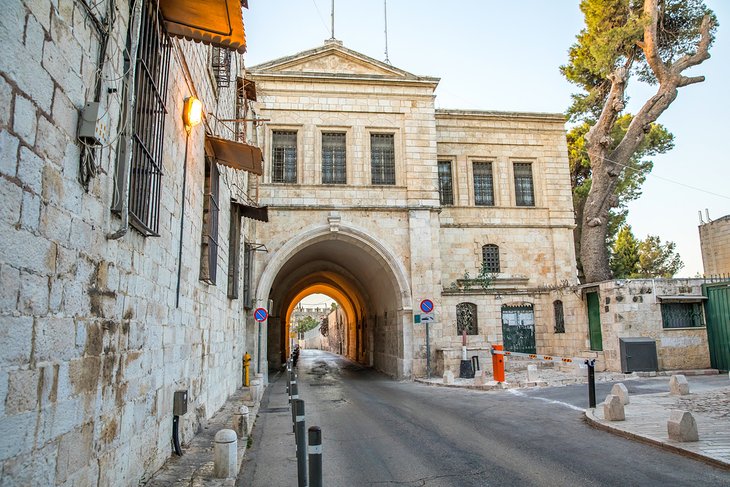

The Religious Freedom Data Center (RFDC) has published its quarterly report, “Incidents Against Christians in Israel,” documenting 106 acts of harassment across 96 incidents between July and September 2026. According to the report, 45 of the 77 incidents recorded inside Jerusalem’s Old City occurred on Armenian Patriarchate Street, in the heart of the Armenian Quarter. This was reported on X by Kegham Balian, a Jerusalemite Armenian, who said the figure is a record high.
That 58 percent is up from half in RFDC’s April to June 2025 report, when the Armenian Patriarchate was already the single most frequently targeted Christian site in Jerusalem. The Armenian Quarter is one of four quarters in the Old City.
The incidents included spitting, physical assault, throwing objects, verbal abuse, threats, defacement of signage, and vandalism. Of the 106 recorded acts, 77 involved spitting, 9 verbal abuse, 5 vandalism, 4 physical assault, 3 throwing objects, 3 defacement of signage, and 1 a threat. Another 4 were categorized as “other.”
Jerusalem accounted for 88 of the 96 incidents, or 92 percent. Within the city, 77 took place inside the Old City (88 percent), 7 at other Jerusalem locations (8 percent), and 4 on Mount Zion (4 percent).
Inside the Old City, Armenian Patriarchate Street led with 45 incidents (58 percent), followed by Via Dolorosa with 18 (24 percent) and other Old City locations with 14 (18 percent).
Outside Jerusalem, 4 incidents were reported in northern Israel (4 percent), 2 at airports (2 percent), and 1 each in Holon and Jaffa (1 percent each).
The report singled out the Armenian community’s exposure. “The Armenian community suffers particularly severely,” it said. “Thousands of people walk through its streets on their way to the Western Wall, and it has the highest number of documented incidents of harassment. Regrettably, the community has received no specific attention, response, or action plan to put an end to its suffering.”
RFDC identified the pepper-spray attack on a 9-year-old Armenian boy, logged as case 75, as the culmination of an escalation in attacks. The boy was sprayed in the face in Mamilla, outside the Old City walls, by a 22-year-old Israeli Jewish settler from the West Bank settlement of Ganei Modi’in. “If the punishment does not reflect the gravity of the act, the incident may send a message of tolerance toward religiously motivated violence, reinforce perpetrators’ sense of impunity, and encourage further attacks,” the report said. The settler was released on October 4 with a restraining order and four days of house arrest while the case proceeds.
During the quarter, RFDC filed 35 police complaints, most supported by photographs or video footage identifying the harassment, the suspects, or both. In the previous quarter, 12 police cases were opened, of which 10 were closed. In its April to June 2025 report, RFDC recorded that of 22 cases filed with Israeli police since January 2025, only 2 had been transferred to prosecution, 6 had been closed, and 14 remained without any status update.
The report documented clergy and monks leaving their institutions in ordinary clothes and community members concealing necklaces bearing crosses beneath their clothing. In informal conversations with clergy, RFDC said it repeatedly hears the same statement: “Not a week goes by without someone spitting at me.” The Center estimated that dozens of additional spitting incidents occur each month without being reported, documented, or countered, and said such acts have become established as a norm among perpetrators. In some cases, it noted, perpetrators justified their actions to RFDC volunteers, and on camera, as consistent with religious injunctions.
RFDC called on the Jerusalem Municipality to address the absence of visible Christian representation in public space, noting that from the Municipal Compound to Jaffa Gate the public sphere prominently reflects Jewish presence through posters, holiday greetings, and projections of images and films onto the city walls. It said signage at the entrance to the Armenian Quarter via Armenian Patriarchate Road should indicate that visitors are entering a Christian quarter and present its historical, religious, and cultural significance.
Volunteers were deployed on field shifts throughout the Old City during the Tisha B’Av fast and the Jewish High Holidays, which the report said doubled the number of documented incidents compared with the same periods in previous years. Following the April attack on a nun on Mount Zion, RFDC volunteers accompanied nuns every morning and evening, six days a week, for four consecutive months. The escorts ended recently when the nuns felt safe walking without one.
While the report was being prepared, prosecutors filed an indictment against a person who spat at a church entrance on July 25, 2025. RFDC urged the court and prosecution not to dilute the case through a plea bargain, calling instead for a judgment that establishes a clear principle and is publicized in the media.
The RFDC is an independent initiative founded in July 2023 by Yisca Harani, an Israeli activist, scholar, and expert in Christian history and interfaith relations. It is funded and operated exclusively by private citizens, without governmental or political affiliation, and runs what it describes as Israel’s largest volunteer network providing real-time assistance to the Christian community. The Israel Religious Action Center provides legal assistance on complaints RFDC files with police, and the Institute for the Study of Relations between Jews, Christians and Muslims at the Open University, headed by Prof. Denis Charbit, supports its work.
The Armenian community of Jerusalem traces its origins to the 4th century and has maintained an uninterrupted presence in the Holy Land for 1,700 years, the oldest living Armenian community outside Armenia. It now numbers approximately 2,000 Jerusalemite Armenians, a population that has declined sharply since 1948.