
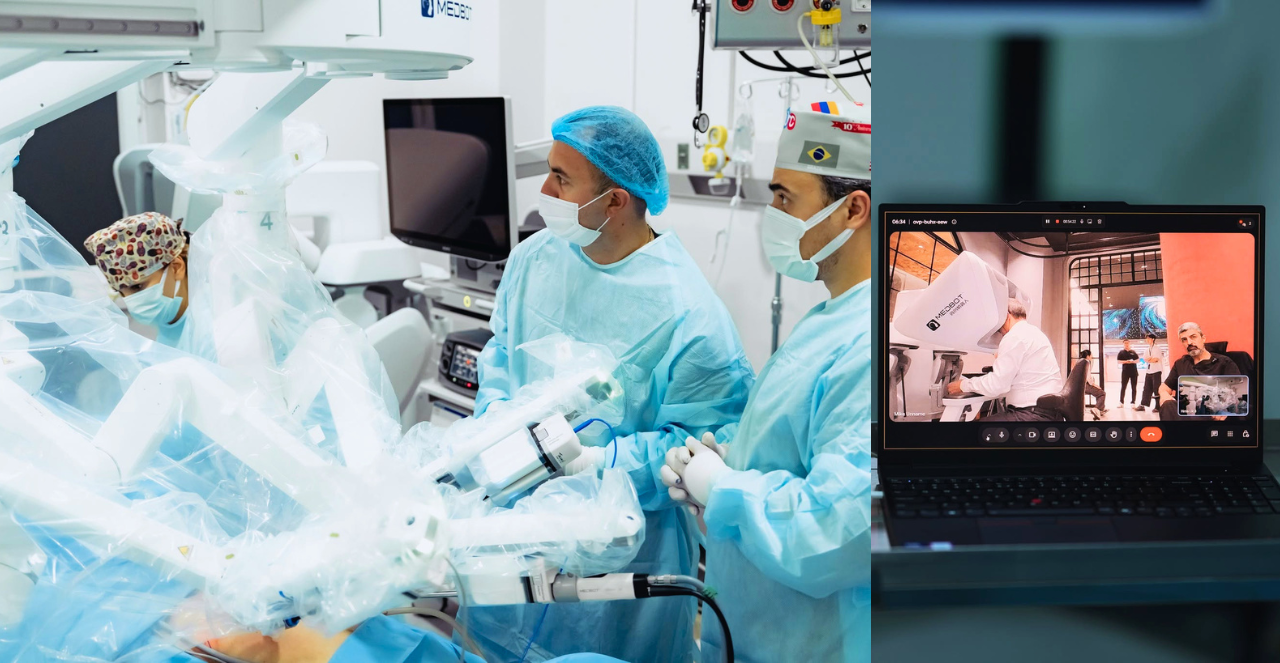

Operating from Shanghai, China, more than 6,800 kilometers away, an Armenian surgeon has performed remote surgery on 2 patients in Yerevan, Armenia, marking the country’s first intercontinental telesurgery, according to Armenpress. Dr. Levon Grigoryan, head of robotic surgery and endoscopy at SlavMed Medical Center, controlled a surgical robot in Yerevan from the other side of the world to repair abdominal wall hernias in both patients.
Grigoryan performed the operations from the Shanghai headquarters of MicroPort MedBot, the company that makes the surgical system, while SlavMed’s medical and engineering teams stayed in the operating room in Yerevan. The signal traveled over a fiber-optic connection stretching 9,000 kilometers.
Both patients underwent abdominal wall hernia repairs using 3D mesh prostheses, and both operations were completed successfully.
The procedure builds on SlavMed’s December 19, 2025 debut of robotic surgery in Armenia and its first international telesurgery on July 10, 2026, when Belgian professor Alexandre Mottrie operated on a patient in Yerevan from more than 3,300 kilometers away. This time an Armenian surgeon drove the technology, and from more than twice the distance.
“This achievement is a testament to the exceptional professional capabilities of SlavMed Medical Center and our consistent efforts to bring cutting-edge medical technologies to Armenia. It proves that in modern medicine, distance is no longer a barrier to top-tier surgical expertise. We are confident that initiatives like this firmly establish Armenia’s role on the international medical stage,” said SlavMed founder and CEO Armine Hovakimyan.
“With this achievement, Armenia joins the ranks of the world’s most advanced nations. From now on, we can stand by our patients from any corner of the globe where a compatible robotic system is available,” Grigoryan said.
The operations used the Toumai robotic system, recently introduced at SlavMed and made by MicroPort MedBot. It carries Armenia’s only module built for remote telesurgery, running on the center’s high-speed internet infrastructure.
Ahead of the operations, the teams ran repeated technical simulations. Patient safety rested on a redundant setup with backup communication channels in case the network dropped, and engineering and surgical teams stood by at both sites, ready to take over manual control at any moment.
“We stress-tested the system multiple times and prepared meticulously. Today, we can proudly state that the technology successfully conquered a distance of thousands of kilometers. Both operations were a definitive success,” said Dr. Narek Amiryan, a general and endoscopic surgeon at SlavMed.
“Robotic telesurgery is more than just a technological milestone; it opens new frontiers for international clinical collaboration and the global exchange of surgical expertise,” said Dr. Chao He, founder and CEO of MicroPort MedBot. He credited the training and technical skill of the SlavMed team for the operation’s success.
SlavMed was the first hospital in Armenia to perform robotic surgery and to build a dedicated robotic team. It has since expanded to steadily more complex cases, now including surgery across continents.


