
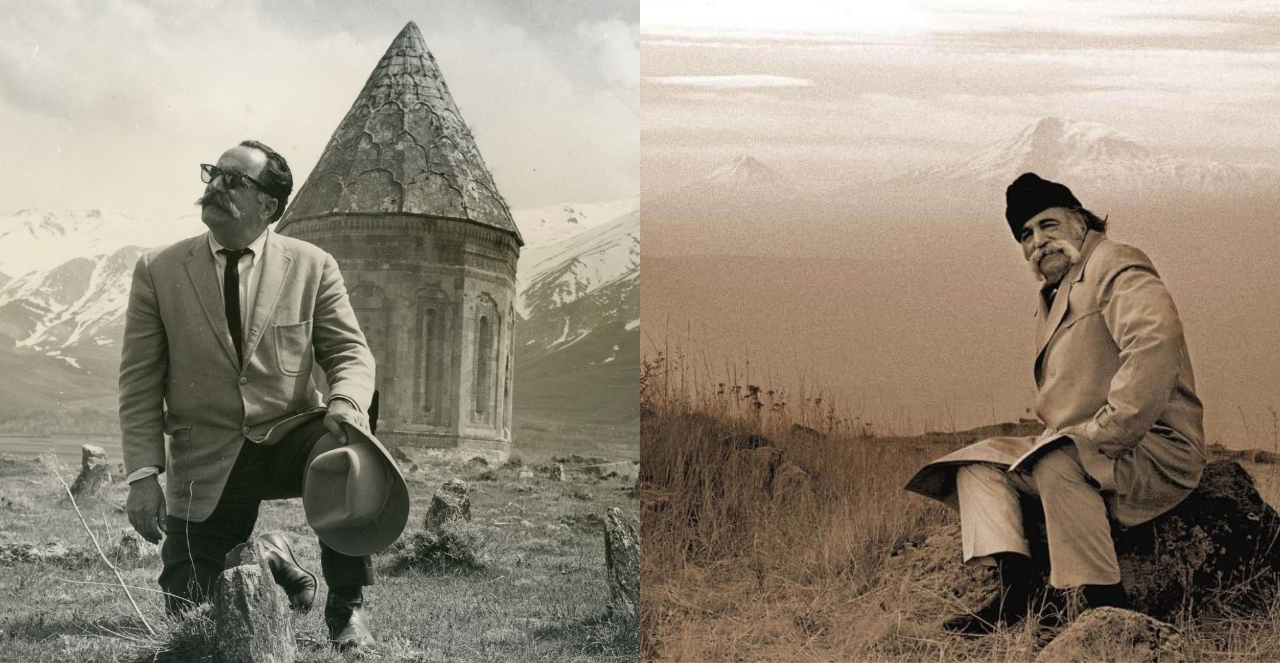

118 years ago today, on August 31, 1908, William Saroyan was born in Fresno, California, to Armenian immigrant parents from Bitlis, in the Ottoman Empire. His father, Armenak Saroyan, was a Presbyterian preacher and writer who had come to America to escape the escalating violence against Armenians in the late 19th and early 20th centuries. His mother, Takoohi Saroyan, was also from Bitlis.
When William was three years old, his father died from a burst appendix at the age of 36. His mother could not support the four children alone. William, his brother Henry, and his sisters Zabel and Cosette were placed in the Fred Finch Orphanage in Oakland, California, where they lived for five years while their mother worked in San Francisco.
He rose to fame during the Great Depression as one of the most widely read authors of the 20th century. He won the Pulitzer Prize for Drama and the Academy Award for Best Story.
From Fresno to the Page
The Saroyan family reunited in Fresno in 1916, where his mother had secured work in a cannery. He left formal education at 15 and self-educated at the Fresno Public Library. At 26, his first book “The Daring Young Man on the Flying Trapeze” (1934) made him a literary sensation. The country was in the throes of the Great Depression, and Saroyan’s unabashedly sentimental style was an antidote to a solemn, often humorless time.
By the time he was 30 years old, Saroyan had published six books and had multiple plays running on Broadway.
The Pulitzer He Refused
His first major play, “My Heart’s in the Highlands,” debuted on Broadway in 1939. One year later, his play “The Time of Your Life,” about a group of lonely drifters in a San Francisco bar, which he had written in only six days, was awarded the Pulitzer Prize.
He became the first writer ever to win the Pulitzer Prize and the New York Drama Critics Circle award for the same work.
Saroyan rejected the Pulitzer, railing against the commercialization of art and arguing that the work was “no more great or good” than anything else he had written. In 1943, his novel “The Human Comedy” was made into an MGM film and won him the Academy Award for Best Story. He accepted the Oscar without objection, having refused the Pulitzer only because he believed monied interests should not sit in judgment of art.
Armenia on the Page
His most successful early collection was “My Name Is Aram” (1940), a book presenting in a poetical light the Armenians of his hometown in the days of his boyhood. It became an international bestseller.
The most enduring Armenian passage Saroyan ever wrote appeared in a short story he composed in New York in August 1935, “The Armenian and the Armenian,” published in his 1936 collection “Inhale and Exhale.” The passage has been quoted at Armenian community gatherings, in classrooms, and in diaspora publications ever since. The full authentic passage, often shortened or misquoted, reads:
“I should like to see any power of the world destroy this race, this small tribe of unimportant people, whose history is ended, whose wars have all been fought and lost, whose structures have crumbled, whose literature is unread, whose music is unheard, whose prayers are no longer uttered.
Go ahead, destroy this race. Let us say that it is again 1915. There is war in the world. Destroy Armenia. See if you can do it. Send them from their homes into the desert. Let them have neither bread nor water. Burn their houses and their churches. See if they will not live again. See if they will not laugh again. See if the race will not live again when two of them meet in a beer parlor, twenty years after, and laugh, and speak in their tongue. Go ahead, see if you can do anything about it. See if you can stop them from mocking the big ideas of the world […] a couple of Armenians talking in the world, go ahead and try to destroy them.”
He wrote it 20 years after the Armenian Genocide.
The Man Behind the Work
From 1958 on, Saroyan lived mostly in Paris for tax purposes, though he continued to maintain a home in Fresno. He married the actress Carol Marcus in 1943, divorced her in 1949, remarried her in 1951, and divorced her again in 1952. They had two children, the writer Aram Saroyan and the actress Lucy Saroyan.
His cousin was the musician Ross Bagdasarian, the creator of Alvin and the Chipmunks. His granddaughter is the writer Strawberry Saroyan.
He published 60 books in his lifetime.
On the tenth anniversary of his death, Saroyan was jointly honored by a commemorative postal stamp issued by both the United States and the Soviet Union, a distinction that captured the dual identity he had carried his entire life.
Half in Fresno, Half in Yerevan
William Saroyan passed away from prostate cancer at the Veterans Hospital in Fresno on May 18, 1981, at the age of 72. Five days before he died, he telephoned a final statement to the Associated Press: “Everybody has got to die, but I have always believed an exception would be made in my case. Now what?”
He asked for half of his ashes to be buried in Fresno and the other half in Yerevan. He is interred at the Ararat Cemetery in Fresno and at the Komitas Pantheon in Yerevan, in two countries and two communities that both claim him entirely.
In 2008, a full-view statue of William Saroyan was erected in Yerevan. In 2018, the City of Fresno officially declared August 31 William Saroyan Day, and his home in Fresno was opened as a museum. The William Saroyan Theatre in Fresno, the Saroyan Prize for Writing at UC Berkeley, and a bust in Yerevan’s Writers’ Walk are among the lasting tributes to his influence.
A Birthday Worth Marking
Born in Fresno to parents who had fled violence in Bitlis, raised in the Fred Finch Orphanage in Oakland, self-educated at the Fresno Public Library, he became one of the defining literary voices of his generation. He refused a Pulitzer, won an Academy Award, wrote 60 books, and asked to be buried in two countries.
His words about the survival of the Armenian people, written 91 years ago in a New York apartment, are carved on monuments from Fresno to Yerevan.


