

Prime Minister Nikol Pashinyan and US Vice President JD Vance signed a joint statement on February 9, announcing the completion of negotiations on the Agreement on Cooperation between the Governments of Armenia and the United States in the Field of Peaceful Use of Nuclear Energy.
Formal cooperation agreements are required between countries that want to trade nuclear power goods and services, and those involving the USA are called 123 Agreements, named after the relevant paragraph of the country’s 1954 Atomic Energy Act, which requires such agreements. Once finalized, the deal will allow US and Armenian companies to “strike deals” on civil nuclear projects.
Vance said that the initial phase would involve up to USD 5 billion in US exports, with an additional USD 4 billion in long-term support through fuel and maintenance contracts.
“This is a classic win-win for both Armenia and the United States of America,” Vance said. “This means stronger energy security for my own country and for Armenia. It will also create a lot of new jobs back home in the United States. It means small modular reactors, American technologies will be coming to this country. Again, this is one of the few countries where we feel confident enough to invest at this level, to send this kind of technology and this is happening because of the Prime Minister’s leadership.”
Technology and Costs
Vance’s announcement highlighted small modular reactor (SMR) technology, advanced nuclear reactors that have a power capacity of up to 300 MW(e) per unit, which is about one-third of the generating capacity of traditional nuclear power reactors. SMRs are under construction or in the licensing stage in Argentina, Canada, China, Russia, South Korea and the United States of America.
The US Department of Energy describes them as next-generation nuclear technology, expected to receive full licensing in the late 2020s or early 2030s.
Following the announcements on February 9, there was some initial confusion in Armenian media over whether the $9 billion mentioned by Vance represented an investment in Armenia. In his speech, Vance said there would be “$5 billion in US exports, plus an additional $4 billion in support through fuel and maintenance contracts”, but the live Armenian translation reportedly changed “exports” to “investment”, which led to misunderstandings about the nature of the funding.
Economist Haykaz Fanyan clarified the economic aspect of the deal, noting that based on the US Vice President’s statement, the United States plans to export $5 billion worth of reactors to Armenia (presumably including construction and expert consultancy) and provide an additional $4 billion in fuel and operational support over the coming years, representing an export of goods and services from the US and an import for Armenia.
He further explained that $5 billion of the $9 billion total should be considered an investment in Armenia, the accumulation of primary capital within the country, regardless of whether financing comes from the US or Armenia itself.
Fanyan emphasized that this financing does not automatically imply public debt, as the project will likely use public-private partnership models, with the government’s debt component expected to be significantly lower than $5 billion.
Armenia’s Nuclear Plant
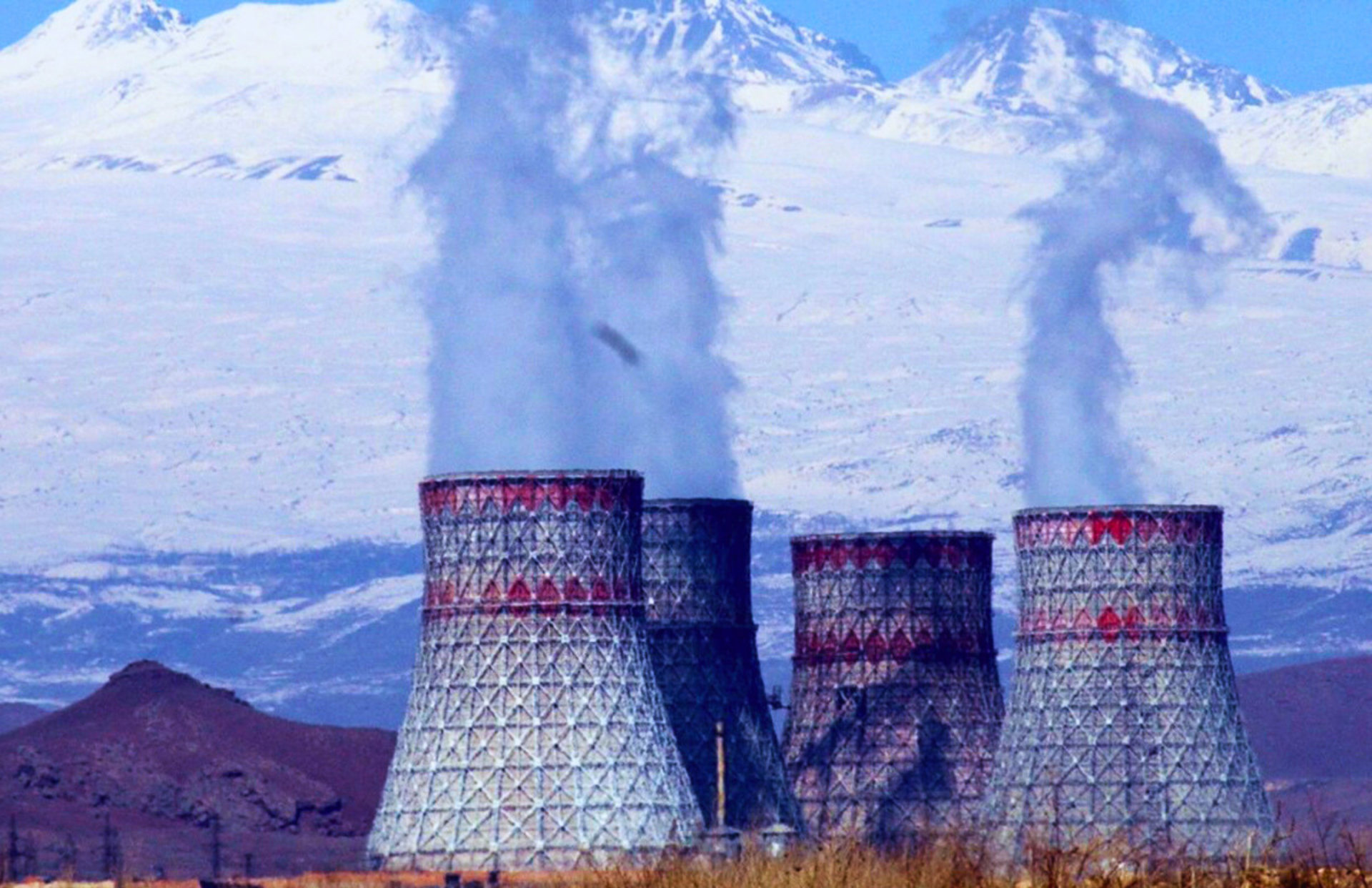
Armenia currently operates a single 376 MWe VVER reactor at the Armenia Nuclear Power Plant, which began operations in 1980. Two units were initially installed, but Unit 1 was decommissioned in 1988 due to seismic safety concerns. Unit 2 was restarted in 1995, and Rosatom is now collaborating with Armenian authorities to extend its operational life to 2036.
For years, Armenia has explored building new nuclear capacity. In January 2022, Rosatom signed an agreement with the Armenian Nuclear Power Plant management to study the construction of new Russian-designed units on the Metsamor site. By January 2024, Armenian officials stated plans to build a new nuclear plant within 8–10 years, considering technology options from Russia, the US, and South Korea.
Armenia’s Minister of Territorial Administration and Infrastructure, David Khudatyan, said on 6 February that the government is reviewing modular reactor models from Russia, the US, France, China, and South Korea. “I believe the selection of the modeexistingl will be made in 2026 or 2027,” he said.
Russian Reaction and Geopolitical Tensions
Moscow reacted quickly to Vance’s announcement. Russian Deputy Foreign Minister Mikhail Galuzin suggested that Armenia has no real alternative to Russian nuclear technology, referencing the untested nature of American SMRs.
“Rosatom is ready to begin implementing the project in the shortest possible time, naturally taking into account the wishes of our Armenian friends,” Galuzin said. He argued that there are no real alternatives in terms of “reliable, already proven technologies, attractive financial parameters, construction, operation, and specialist training.”
Earlier in February, Rosatom CEO Alexey Likhachev met with Armenian Parliamentary Speaker Alen Simonyan to discuss extending the life of the nuclear unit and the construction of new units, offering “comprehensive cooperation” on plants of various capacities, including non-nuclear projects.
Russia also emphasized the sovereignty of Armenia and Azerbaijan in choosing international partners. Kremlin spokesperson Dmitry Peskov told TASS that both countries are “sovereign states, and they have the sovereign right to build relationships with different states,” referring to Vance’s visit and announcements of large-scale cooperative projects.
Before any US–Armenia deal can proceed, the 123 Agreement must undergo domestic approval procedures in both countries. Analysts note that Armenia must now weigh technical readiness, costs, and geopolitical considerations before deciding whether to adopt American SMRs, Russian reactors, or another solution for its future nuclear infrastructure.


