

On January 14, one day after Armenian Foreign Minister Ararat Mirzoyan met with U.S. Secretary of State Marco Rubio in Washington, Armenia and the United States released a joint statement announcing the TRIPP Implementation Framework. According to the document, the US would hold a 74% stake in the company, with the remaining 26% going to Armenia.
It is the first public document to outline how the route connecting Azerbaijan to its Nakhchivan exclave through Armenia would function.
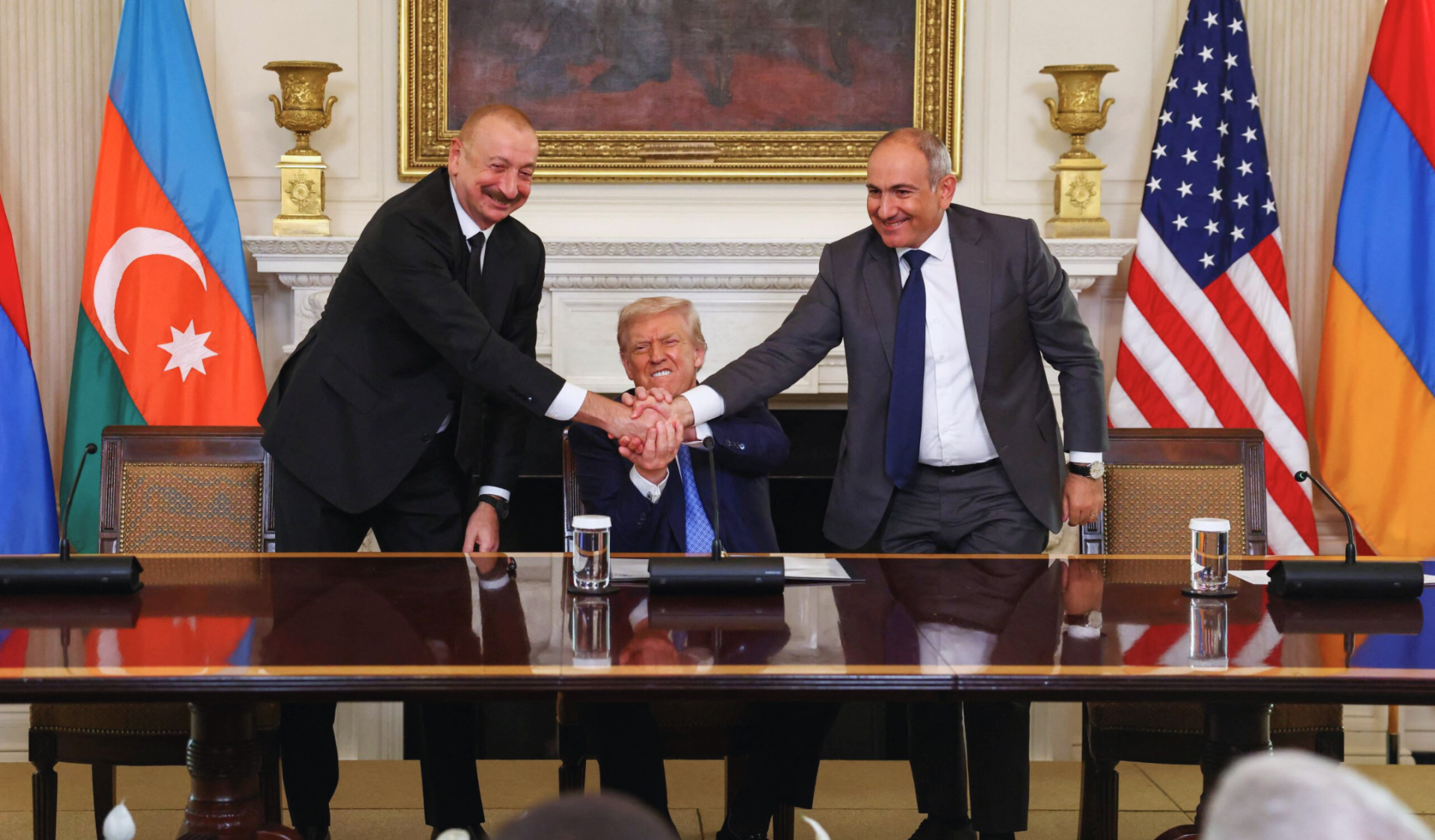
The two countries defined the scope of their rights and obligations under TRIPP five months after the August 8 joint declaration signed by the leaders of Armenia, Azerbaijan, and the United States.
TRIPP Development Company and Ownership Structure
According to the document, the TRIPP Development Company would be granted exclusive development rights for an initial term of 49 years. During this period, the United States would hold a 74 percent controlling stake, while Armenia would retain 26 percent.
Armenia is expected to extend the company’s mandate for an additional 50 years, during which Armenia’s share would increase to 49 percent. Any changes to the company’s ownership, structure, or shareholders would require the prior consent of both the Armenian and U.S. governments.
Speaking at a press briefing on Wednesday, Foreign Minister Ararat Mirzoyan described the share distribution as “very fair,” noting that the United States would make large-scale financial investments, while Armenia’s main contribution would be granting development (land-use) rights.
“There will be issues where, regardless of the size of the shareholding, nothing can happen without the consent of the Republic of Armenia,” Mirzoyan said.
He also stated that the involvement of Turkey or Russia in the project had not been discussed. However, Mirzoyan did not rule out future cooperation with Moscow in related areas.
“In TRIPP itself, no, but other activities, connections, and cooperation related to TRIPP can also be established for the Russian Federation,” he said, according to state-run news agency Armenpress.
Sovereignty and the Concept of ‘Front Office–Back Office’
The framework stresses that Armenia retains full legislative, regulatory, and judicial authority over all TRIPP areas within its sovereign territory. Armenia would also maintain control over national security and law enforcement, as well as authority over border control, customs, taxes, and other mandatory fees.
These powers would be exercised through a “front office – back office” operating model.
Under this system, front office operations, intended to facilitate transit from Azerbaijan into Armenia, would be handled by private operators contracted by the TRIPP Development Company. Their responsibilities would include document collection, fee collection, payment processing, and administrative support.
However, the document explicitly states that front office operators “facilitate; they do not decide.”
All decisions related to security screening, inspections, immigration control, permits, authorisations, and enforcement would remain exclusively with Armenian state authorities, who would maintain a permanent physical presence at all border and customs facilities.
“This system does not outsource any sovereign functions,” Mirzoyan said, stressing that Armenian officials would be present at all relevant sites and that all areas would remain accessible to Armenian authorities.
The arrangement appears to be a compromise addressing Azerbaijani President Ilham Aliyev’s earlier demand that Azerbaijani citizens should not “see the face” of Armenian border guards.
At the start of today’s government session, the Prime Minister announced that Armenia is prepared to provide unimpeded transit to Azerbaijan through Syunik via TRIPP.
“I am prepared, and we will proceed decisively with this, including ensuring unimpeded communication between mainland Azerbaijan and the Nakhchivan Autonomous Republic, according to the principles we have discussed repeatedly. Our position is that here too, we must move beyond the logic of conflict and come to a normal, peace-oriented atmosphere and approach,” the Prime Minister said.
Security, Data, and Infrastructure
According to the TRIPP Implementation Framework, Armenia will be responsible for ensuring security across the entire route. While private operational security personnel may be employed, this would be subject to Armenian licensing, and Armenian authorities would retain primacy in all emergency and enforcement situations.
On data protection, the document states that all government data systems will remain under Armenian sovereign control, and that any data sharing with foreign authorities would require appropriate legal frameworks.
The planned infrastructure in Syunik includes railways, highways, roads, bridges, tunnels, electricity transmission systems, oil pipelines, gas pipelines, and digital infrastructure, though no firm construction timeline has yet been announced.
Mirzoyan said construction could begin by late summer or early autumn.
Turkey and Azerbaijan Express Positions on TRIPP Implementation Framework
“We believe that the Zangezur Corridor will be implemented in line with Azerbaijan’s expectations. This corridor, which will connect mainland Azerbaijan with Nakhchivan, is of great importance both for the Middle Corridor and for Turkey’s access to the Turkic world,” Turkish Foreign Minister Hakan Fidan said at a press conference in Istanbul on Thursday.
Touching upon the peace process between Azerbaijan and Armenia, Fidan noted that Turkey expects the signing and implementation of the peace treaty initiated by the two countries.
“Yesterday in Washington, certain agreements were reached with Armenia regarding the launch of the Trump Route for International Peace and Prosperity (TRIPP). We held a two-hour discussion with Azerbaijan’s Foreign Minister Jeyhun Bayramov on this document and its provisions. I also briefed Turkey’s head of state on the framework agreement,” Fidan said.
Fidan also emphasized that Armenia must fulfill its obligations for the peace agreement to be fully implemented, adding that Turkey supports the constructive approach demonstrated by Armenian Prime Minister Nikol Pashinyan.
He added that the discussions with Azerbaijan included the TRIPP framework document, and that President Erdo?an was fully briefed. Fidan stressed that both Azerbaijan and Turkey, as well as Armenia, have the necessary political will to advance the peace process and regional connectivity.


