The European Union and Armenia have elevated their partnership to a strategic level with the adoption of a new Strategic Agenda for the EU–Armenia Partnership, accompanied by €15 million in new funding for peace, resilience, and security and a €500 million investment in Armenia’s energy infrastructure through the Caucasus Transmission Network project.
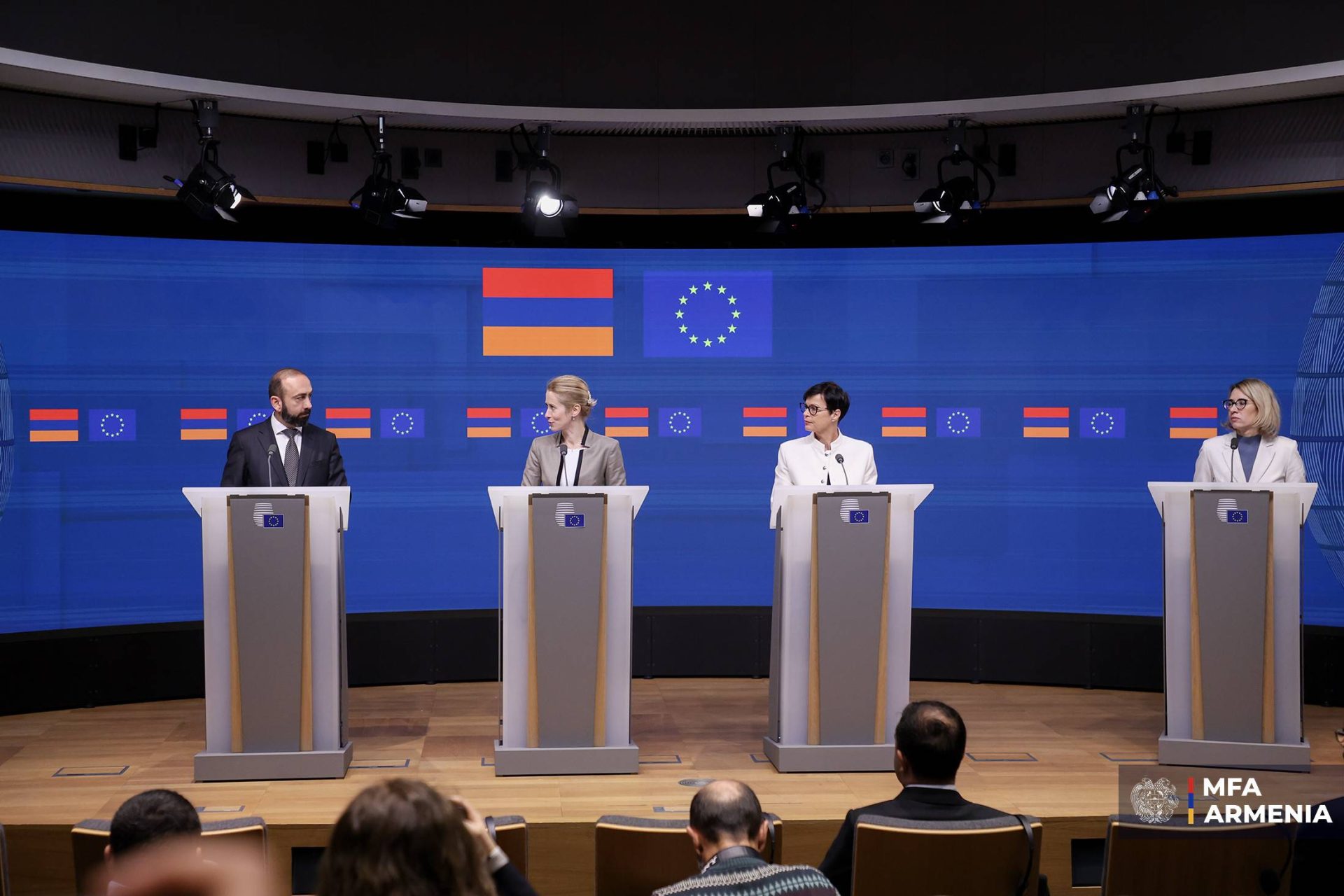
The announcements were made in Brussels during the sixth EU–Armenia Partnership Council, where Armenia’s Foreign Minister Ararat Mirzoyan, EU High Representative Kaja Kallas, and EU Commissioner for Enlargement Marta Kos endorsed the new Strategic Agenda. The document replaces the 2017 Partnership Priorities, builds on the Comprehensive and Enhanced Partnership Agreement (CEPA), and marks a significant expansion of political, economic, and sectoral cooperation as Armenia seeks to deepen ties with the EU and advance its European aspirations.
The €15 million package will support de-mining training and equipment, border management, regional confidence-building measures, and efforts to counter foreign interference and disinformation ahead of Armenia’s 2026 parliamentary elections. Kallas said the money is intended to strengthen Armenia’s defenses against hybrid threats, noting that the EU has observed disinformation campaigns from “Russia and its proxies.”
According to the EU Delegation to Armenia, the Strategic Agenda lays out a wide-ranging framework covering democracy and rule of law, justice reform, human rights, socio-economic development, digital transformation, energy security, trade diversification, and enhanced cooperation on security and defense. It introduces short-term priorities over three to four years and medium-term priorities over seven years that are designed to deliver concrete benefits for citizens and bolster Armenia’s resilience in a complex regional environment. The agenda reiterates the EU’s commitment to Armenia’s reform program, including technical and financial assistance under the Resilience and Growth Plan.
Connectivity is presented as a central pillar of the new framework. The agenda highlights plans to strengthen transport, digital, and energy links between Armenia, the region, and the EU. Strategic investments under the Global Gateway and support for initiatives such as Armenia’s proposed “Crossroads of Peace” are intended to boost regional interconnections, reinforce economic resilience, and expand opportunities for trade and mobility. Mobility remains high on the agenda, with continued progress in the visa liberalization dialogue and targeted support for the integration of displaced Artsakh Armenians. The document also strengthens cooperation in crisis management, cyber resilience, and countering hybrid threats, and it reaffirms the EU’s full support for efforts toward lasting peace in the South Caucasus.
As part of this broader connectivity and energy pillar, the European Union will invest €500 million to reinforce Armenia’s energy security, strengthen infrastructure, diversify supply routes, and help reduce the country’s dependence on Russian energy through the Caucasus Transmission Network project, a major initiative signed in Tashkent and announced in Brussels by Commissioner Kos.
Marta Kos highlighted the €500 million Caucasus Transmission Network project, also referred to in regional discussions as part of the Caucasus Energy System initiative, signed in Tashkent. She described it as a major effort to enhance energy security, improve infrastructure, support diversification, and reduce Armenia’s dependence on external players, including reducing reliance on sole external nations for energy supply.
“There is the whole connectivity agenda. When I was in Tashkent we signed the Caucasus Transmission Network project. It is worth €500 million. So this is a project, we in these big projects, especially in the connectivity, we work together with the international financial institutions and this is now the German bank KfW. So, it is a €500 million investment to connect your power grid with the Georgian one and we are already working on the power grid of Armenia and Turkey. Why? That you get less and less dependent on energy from Russia. And we have experiences. Also we have now special energy plans for Moldova, for Ukraine and also for us. For instance, when the war [in Ukraine] started in 2022, Europe was importing 60% of [natural] gas from Russia, 50% of coal, and I think it was 40% of oil. Now coal is 0, oil is 0, and with the gas we are now slowly down to 0, which is not always easy as you also know,” Commissioner Kos said.
“This is, for instance, one of the projects which is enabling possible through the connectivity agenda.”
Kos noted that EU cooperation with the German development bank KfW is central to the project. She added that she has asked Armenian Minister of Territorial Administration and Infrastructure Davit Khudatyan to present a list of priority programs related to overall interconnectivity. The EU is prepared to assist the ministry with capacity-building. The Caucasus Transmission Network Project, also associated with the broader Caucasus Energy System framework, aims to provide reliable, flexible, and mutually beneficial cross-border energy exchange within the South Caucasus by connecting and synchronizing the Armenian and Georgian power systems.
Mirzoyan welcomed the adoption of the Strategic Agenda, calling it the beginning of “a new and more ambitious phase” in relations and linking it to Armenia’s recent steps toward launching EU accession processes. Kos added that discussions are underway on forming a quadrilateral working group involving Armenia, Azerbaijan, Turkey, and the EU to develop new regional connectivity infrastructure.
The EU Delegation noted that by defining clear priorities and monitoring mechanisms, the Strategic Agenda provides a forward-looking blueprint for EU–Armenia relations and confirms the EU’s readiness to work closely with Armenia, civil society, and international partners to advance shared values and deliver tangible results for citizens.