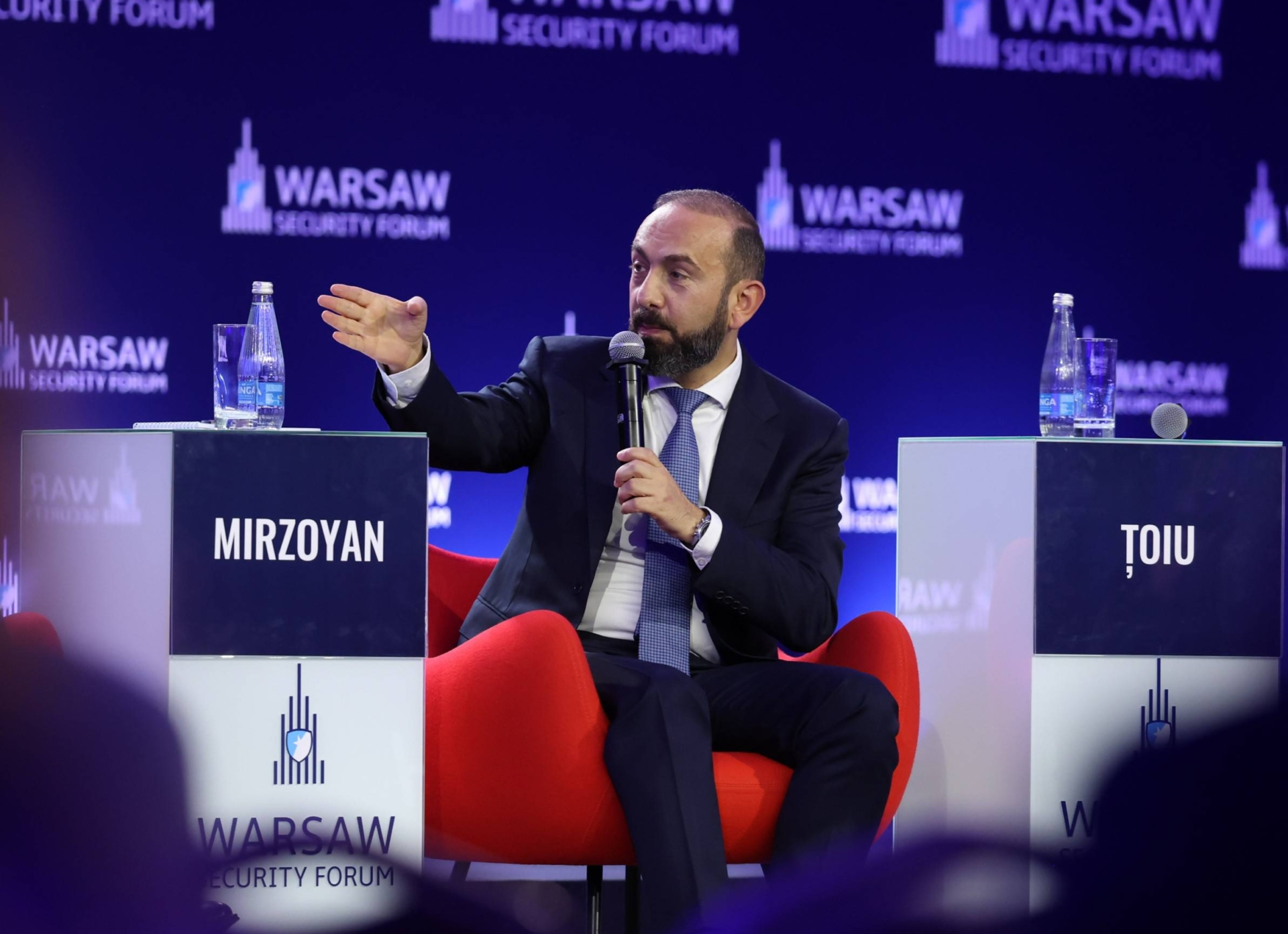

Armenian Foreign Minister Ararat Mirzoyan said normalization with Turkey has “matured considerably” and that the closed Armenia-Turkey border could open at any moment, speaking at the Warsaw Security Forum on Tuesday, October 13.
“The border is still closed, but I think the process has matured considerably,” Mirzoyan said. “We could easily wake up tomorrow morning to a headline in the news feed” announcing the border is open, he said.
Mirzoyan spoke on the panel “Half-Baked or Step-by-Step? Rethinking EU Enlargement,” which opened with remarks by Montenegrin President Jakov Milatovi?. Lithuanian Foreign Minister K?stutis Budrys and Romanian Foreign Minister Oana-Silvia ?oiu also took part, and Steven Everts, Director of the EU Institute for Security Studies, moderated.
Turkey sealed the border in 1993 in support of Azerbaijan’s war on Artsakh (Nagorno-Karabakh) and has kept it closed for 33 years. The 2 countries still have no diplomatic relations, and Ankara has never recognized the Armenian Genocide, in which 1.5 million Armenians were murdered between 1915 and 1923.
In the 44-Day War in 2020, Turkey armed Azerbaijan with combat drones and sent Syrian mercenaries to fight for Baku, which also deployed Israeli-made drones. According to official Armenian data, 3,833 Armenians were martyred in the war, including 3,755 servicemen and 78 civilians.
When Azerbaijan launched its military assault on Artsakh in September 2023, Turkish President Recep Tayyip Erdogan pledged “wholehearted support” for Baku. Days later, he met Azerbaijani dictator Ilham Aliyev in Nakhichevan and praised the victory as 120,000 Armenians were forcibly displaced in the ethnic cleansing of Artsakh.
Ankara has tied the border opening to the signing of the Armenia-Azerbaijan peace agreement. The agreement was initialed in Washington in August 2025 and remains unsigned, with Baku conditioning its signature on a new Armenian constitution. Mirzoyan said Armenia has peace with Azerbaijan, “though several steps still remain.”
Azerbaijan continues to unlawfully hold 19 Armenians hostage in Baku. They include former Artsakh State Minister Ruben Vardanyan, sentenced to 20 years, and former Foreign Minister David Babayan and former Parliament Speaker Davit Ishkhanyan, both sentenced to life by the Baku Military Court on fabricated charges.
At the White House on August 8, 2025, US President Donald Trump offered to ask Aliyev to release the “23 Christians” held in Baku, telling Pashinyan he believed Baku would agree. Azerbaijan handed over 4 of them in January 2026 as Armenia transferred 2 Syrian mercenaries serving life sentences for fighting in the 44-Day War. Aliyev has since said Baku does not plan to release the Armenians convicted by its military court.
In July 2022, the 2 countries’ special envoys agreed to open the border to third-country nationals, and Ankara has yet to implement the deal. Ruben Rubinyan, Armenia’s special envoy for normalization with Turkey, said in August that Armenia was ready to open the crossing to third-country nationals and diplomatic passport holders and was waiting on Ankara to act. Rubinyan, who became Speaker of the National Assembly the following day, said Armenia’s infrastructure had long been ready and that Turkey had begun rehabilitating its section of the Gyumri-Kars railway up to the Armenian border.
On the EU, Mirzoyan said no one knows where Armenia’s path ends: not Armenia, the EU or the member states. He said serious conversation about membership has only just started in Armenia, although parliament passed a law in March 2025 launching the accession process. “At some point in the future we will discuss together whether we should marry or not,” Mirzoyan said.
He cited the visa liberalization dialogue, the EU Monitoring Mission on the Armenia-Azerbaijan border and a second EU mission on hybrid threats, and said Armenia received autonomous trade measures, a Growth and Resilience Plan and European Peace Facility support as a non-candidate country. Mirzoyan said Armenia will keep improving relations with its neighbors regardless of its European aspirations, though he acknowledged that conflicts with neighbors would probably harm a bid for full membership.
He said the United States is heavily involved in unblocking transport links between Armenia and Azerbaijan, which he described as a crucial link between West and East, from Portugal to China.