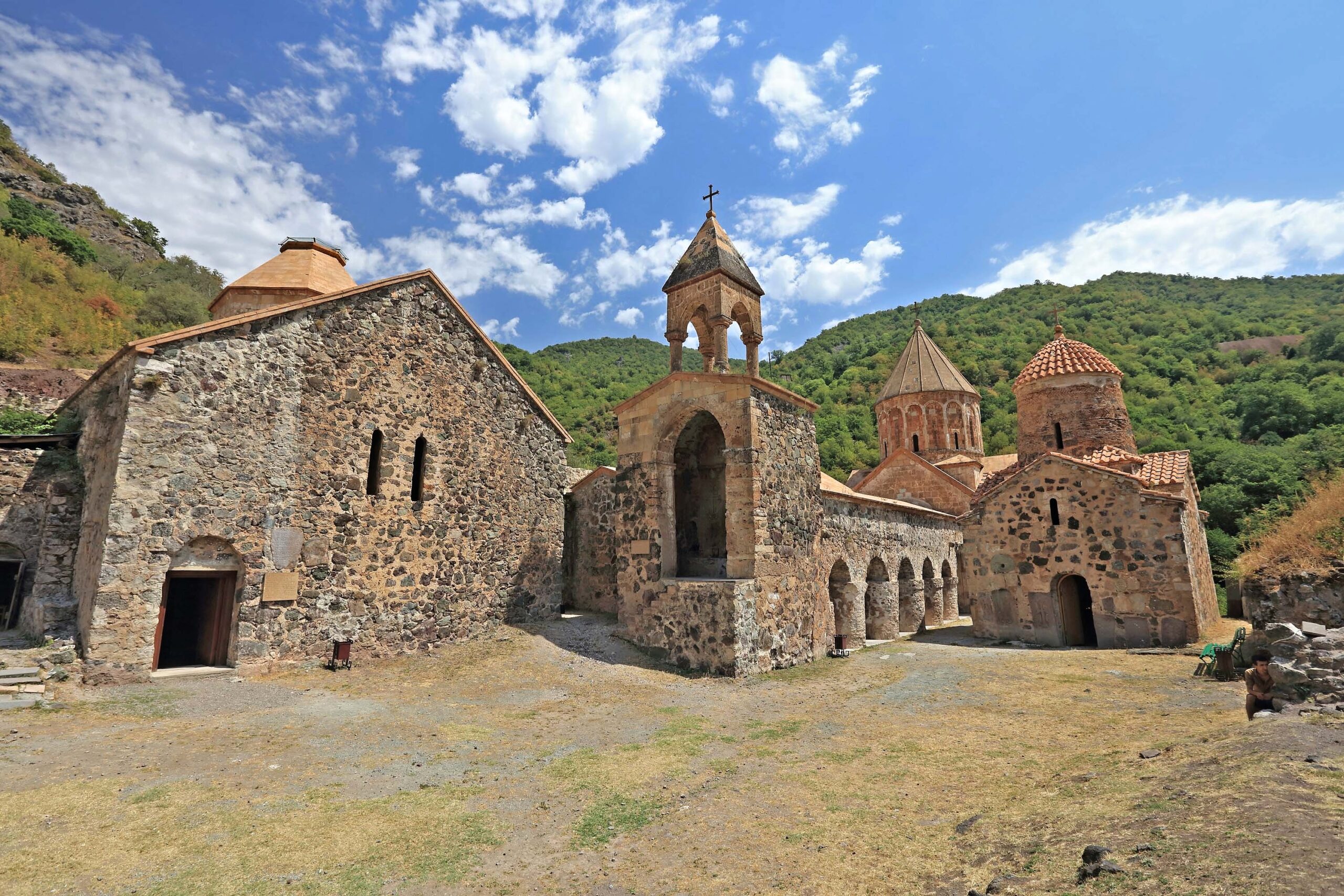

Azerbaijan’s cultural heritage agency accused Armenians on Monday, September 21, 2026, of “looting” Dadivank, the 9th to 13th century Armenian Apostolic monastic complex in occupied Artsakh (Nagorno-Karabakh), as Armenian forces withdrew from the Karvachar (Kalbajar) district under the November 2020 ceasefire that ended the 44-Day War. The accusation lands 9 days after Azerbaijani presidential aide Hikmet Hajiyev personally led approximately 150 representatives of 58 countries’ diplomatic corps and 9 international organizations on a two-day tour of occupied Artsakh, during which he rebranded Dadivank and Gandzasar as “ancient Caucasian Albanian Christian” sites.
Sabina Hajiyeva, who heads Azerbaijan’s State Service for the Protection, Development and Restoration of Cultural Heritage, said crosses, bells, and “other elements belonging to the complex” were taken. “The frescoes were also cut from the walls and stolen, and were later displayed at various exhibitions abroad as ‘works of art of Armenia,'” she said. Hajiyeva named no inventory of missing objects, no photographic record of the walls before and after the handover, and no exhibition at which the frescoes were said to have been shown.
Baku filed the claim with Interpol’s Stolen Works of Art Database on October 9, 2025. Hajiyeva also claimed that Armenian “restoration” work at Dadivank was carried out between 1997 and 2011 at the expense of the Republic of Armenia and the Armenian Apostolic Church, and that Armenian “restoration” of the monastery’s frescoes began in 2014. The two claims contradict each other. Baku accuses Armenians of both looting the frescoes and restoring them.
Armenian specialists have documented the opposite pattern at the site. The Geghard Scientific Analytical Foundation has described Azerbaijan’s approach to Dadivank as a standing propaganda method, arguing that Baku recasts the monastery’s Armenian inscriptions as modern forgeries inserted between 1993 and 2020, and calling the practice “denialism and the invention of non-existent facts.”
Armenia’s Foreign Ministry has not issued a formal statement on Baku’s heritage attacks. Foreign Minister Ararat Mirzoyan told reporters last week that the Pashinyan government was “very satisfied with the position and conduct of the Matenadaran,” which had issued its own institutional response to Hajiyev’s September 12 propaganda tour.
Dadivank stands above the Tartar river gorge in the Kalbajar district of occupied Artsakh. The surviving complex dates mainly from the 9th through 13th centuries. Its main church, St. Katoghike Astvatsatsin, was built in 1214 by Princess Arzu-Khatun, wife of Prince Vakhtang Vakhtangyan of Upper Khachen, in memory of her husband and their two sons, Hasan and Grigor, who fell fighting Turkish invaders. Her Armenian inscription, which covers the entire entrance wall of the cathedral, reads in part: “My first-born Asan martyred for his Christian faith in the war against the Turks, and, three years later, my younger son Grigor also joined Christ.” The monastery is named for St. Dadi, a disciple of Thaddeus the Apostle, who spread Christianity in Armenia in the 1st century AD. Dadivank has served as an active center of the Armenian Apostolic Church for more than a millennium, with an uninterrupted Armenian liturgical tradition.
Azerbaijani officials call the site “Khudavang” and present it as Caucasian Albanian rather than Armenian, a state-manufactured revisionist framing that Azerbaijan has aggressively promoted since 2020 to detach Armenian religious heritage from Armenian identity. Azerbaijan’s Udi community held services at Dadivank in 2021, and in 2024 the Vatican’s official newspaper described the monastery as Albanian heritage, a characterization Armenian scholars rejected as unsupported by the site’s own Armenian epigraphy. On September 12, 2026, Hajiyev told the foreign diplomatic delegation at Gandzasar that “Nagorno-Karabakh has been, is, and will remain the cultural heart of Azerbaijan and the Azerbaijani people,” and accused Armenians of altering both monasteries through what he called “external intervention” under the guise of “restoration.”
The Interpol filing is part of a wider Azerbaijani escalation. On the same day Hajiyeva announced the “looting” claim, she publicly called for “research into Caucasian Albania’s heritage” to be conducted inside the Republic of Armenia itself. On September 21, Baku’s state-organized “Western Azerbaijan Community” announced the creation of a working group to study “Albanian heritage in present-day Armenia,” building toward the territorial claims Azerbaijani President Ilham Aliyev has made on the Republic of Armenia as “Western Azerbaijan.”
The pattern documented on the ground contradicts Baku’s cultural heritage claims. Cornell and Purdue Universities’ Caucasus Heritage Watch, which monitors 518 cultural heritage sites in occupied Artsakh using satellite imagery, has documented the destruction of the 177-year-old St. Hovhannes Mkrtich Church, known locally as Kanach Zham, in occupied Shushi between December 28, 2023 and April 4, 2024. Caucasus Heritage Watch has also documented the destruction of the 18th to 19th century Ghazanchetsots cemetery in Shushi within the same time frame, damage to the archaeological remains of the 1838 Meghretsots Holy Mother of God Church, and the destruction of the Yerevan Gate cemetery. The U.S. Commission on International Religious Freedom placed Azerbaijan on its Special Watch List in its 2025 Annual Report, specifically citing Azerbaijan’s “organized destruction of Armenian religious and cultural heritage in Artsakh.”
The accusation lands 3 years after Azerbaijan’s September 2023 ethnic cleansing forcibly displaced 120,000 Armenians from occupied Artsakh, following a nine-month blockade that former International Criminal Court prosecutor Luis Moreno Ocampo concluded constituted genocide under the Genocide Convention. Nineteen Armenian hostages, including former Artsakh military and political leaders Ruben Vardanyan, David Babayan, and Davit Ishkhanyan, remain unjustly imprisoned in Baku. The International Committee of the Red Cross, the last independent body with access to the Armenian hostages, was expelled from Azerbaijan in September 2025. In December 2021, the International Court of Justice ordered Azerbaijan to prevent and punish acts of vandalism and desecration against Armenian cultural heritage. Azerbaijan has never complied.
Foreign Minister Ararat Mirzoyan and Prime Minister Nikol Pashinyan are in New York for the high-level segment of the 81st session of the UN General Assembly, September 22 to 25. Mirzoyan has said Azerbaijan’s conduct on heritage questions works against the peace process the two governments are negotiating.