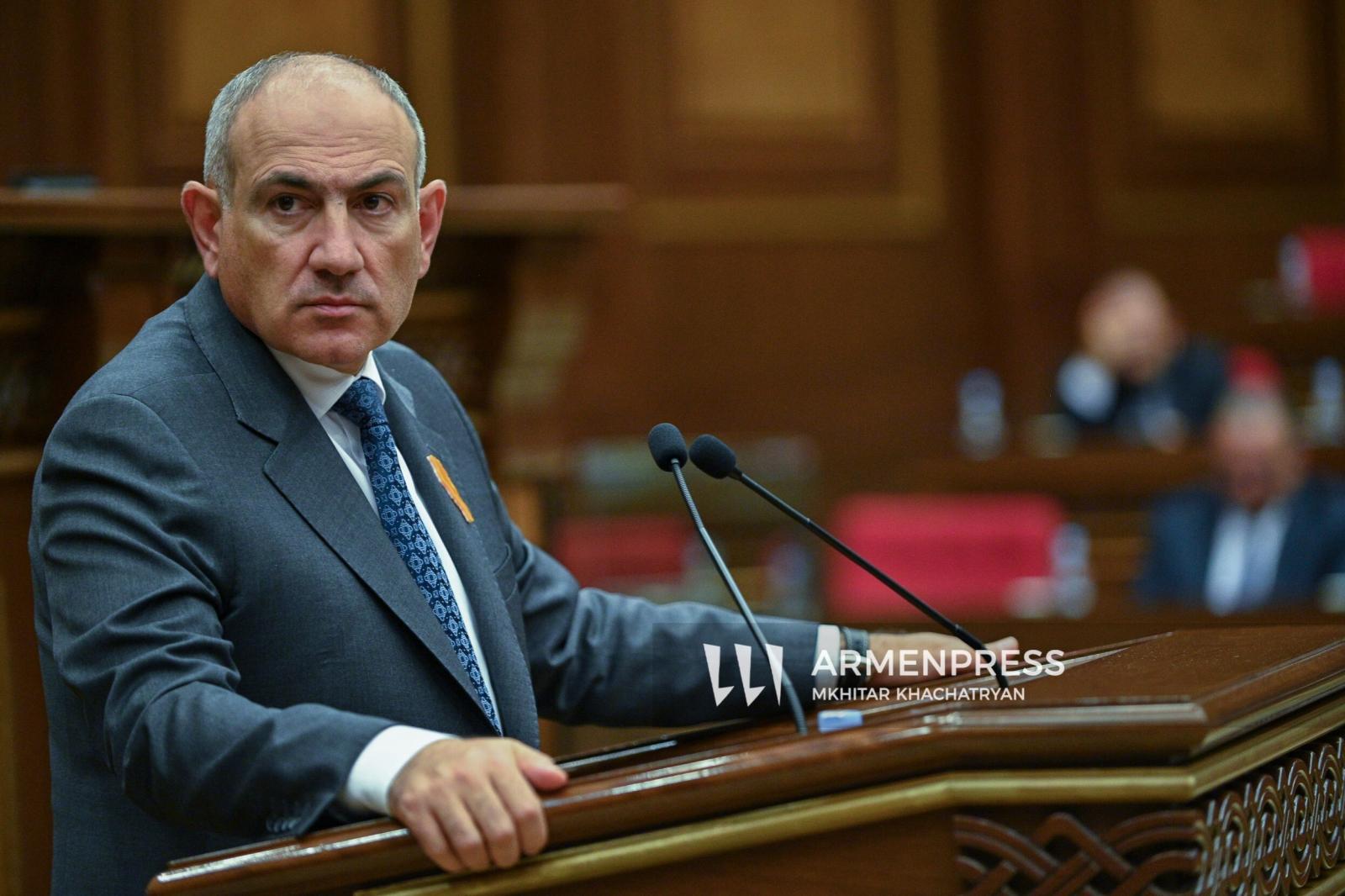

Prime Minister Nikol Pashinyan told the National Assembly on Tuesday, September 16, 2026, that statements made by Azerbaijani presidential aide Hikmet Hajiyev at occupied Gandzasar Monastery are “unacceptable” and “incomprehensible,” and that Armenia had already set out its position through Matenadaran Director Ara Khzmalyan, whose September 14 rebuttal exposed Hajiyev’s manuscript display as a deception.
“If we’re interested in a manuscript’s or monastery’s origins, we should consult the manuscripts and original texts,” Pashinyan told parliament. He added that Baku’s officials could consult with Armenian specialists directly. “Our specialists will be pleased to explain the meaning of every word, phrase, and text,” Pashinyan said.
The Prime Minister was responding to Armenia Alliance MP Anna Grigoryan, who had asked whether Yerevan intended to publicly declare Gandzasar’s Armenian origins in the wake of Hajiyev’s presentation of the 13th-century Armenian monastery to foreign diplomats as an “ancient Caucasian Albanian Christian” site. Pashinyan rejected the premise that Armenia is obliged to prove Gandzasar’s Armenian identity to Azerbaijan. He endorsed Khzmalyan’s factual response as the Armenian government’s position.
Ruling party Civil Contract MP Hasmik Hakobyan spoke separately at a press briefing on Tuesday. “Regarding Gandzasar, the Matenadaran in Yerevan issued a statement. I fully endorse the statement issued by the Matenadaran, which is fact-based,” she said. Hakobyan also stated that Azerbaijani President Ilham Aliyev’s own recent statements about Armenia, including his September 15 claim to Islamic religious organizations in Baku that Armenians had destroyed 65 mosques in territories previously under Armenian control and had converted others into barns, do not support the peace agenda. “It would be good for both Armenia and Azerbaijan to refrain from such rhetoric,” Hakobyan said.
Security Council Secretary Alen Simonyan said the same day that he telephoned Hajiyev directly after the diplomatic tour and raised the concern that such incidents should not obstruct the peace process. “Yes, I spoke with him after that, let’s not tell the details. We are constantly in contact,” Simonyan said, adding that the two men speak roughly every other day.
National Assembly Speaker Ruben Rubinyan had already publicly rejected Hajiyev’s claims on September 14, calling them “unfounded” and stating that they “are neither conducive nor helpful to peace.” Rubinyan had been challenged in parliament on Monday by MP Grigoryan, who asked whether the Speaker intended to publicly affirm that Gandzasar is Armenian.
Ara Khzmalyan, Director of the Mesrop Mashtots Institute of Ancient Manuscripts, known as the Matenadaran, had responded to Hajiyev’s manuscript display on September 14 in an interview with Armenian Public Television’s Lurer news programme. Khzmalyan explained that every manuscript Hajiyev showed foreign diplomats at Gandzasar was a high-quality replica produced for exhibition, not an original. All originals of the Gandzasar manuscript collection are held safely at the Matenadaran in Yerevan. Producing a full manuscript replica is prohibitively expensive, so museums standardly replicate only the two facing pages of a manuscript’s most important opening for display, leaving the remaining pages blank. This is standard international museum practice. Hajiyev presented those blank pages to diplomats and told them the blank pages were evidence of Armenian falsification of history.
“We have no blank pages in our manuscripts or our history, unlike many, many others,” Khzmalyan said in the Lurer interview. He also confirmed that EU Special Representative for the South Caucasus Magdalena Grono, who had participated in Hajiyev’s tour and initially posted on X that “deeply diverging views and narratives persist” regarding the origins of sites she visited, had subsequently visited the Matenadaran in Yerevan on September 14. Following her visit, Grono publicly clarified: “I certainly do not contest past Armenian presence and rich footprint in former conflict-affected areas in Karabakh.” She added that Armenian heritage “should be preserved and cherished, without undue politicization and manipulation.”
Hajiyev, Assistant to President Ilham Aliyev and Head of the Foreign Policy Affairs Department of the Presidential Administration, personally led approximately 150 representatives of 58 countries’ diplomatic corps and 9 international organizations accredited in Baku on a two-day tour of occupied Artsakh on September 11 and 12. The delegation was taken to occupied Stepanakert, which Azerbaijan has rebranded as “Khankendi,” where they were shown Azerbaijan’s newly built “Victory Park,” a memorial celebrating Baku’s 2020 military conquest, erected on the ruins of a destroyed historic Armenian neighborhood in the city that was overwhelmingly Armenian before September 2023. The diplomats were then taken to occupied Shushi, the historic cultural capital of Armenian Karabakh, which Azerbaijan has rebranded as “Shusha,” with video footage showing foreign ambassadors dancing in the ethnically cleansed Armenian city.
On the second day, Hajiyev took the delegation to Gandzasar Monastery in the Aghdara district and Dadivank Monastery, which Azerbaijan has rebranded as “Khudavang,” in the Kalbajar district. At Gandzasar, in addition to displaying the replica manuscripts, Hajiyev told diplomats that “Nagorno-Karabakh has been, is, and will remain the cultural heart of Azerbaijan and the Azerbaijani people,” and accused Armenians of altering the monuments through what he called “external intervention” under the guise of “restoration.”
Gandzasar Monastery was built between 1216 and 1238 by Prince Hasan Jalal Dawla, an Armenian prince of the Hasan-Jalalyan dynasty, which ruled the Armenian principality of Khachen for centuries. The cathedral, dedicated to St. John the Baptist, was consecrated in 1240. Its walls carry a foundation inscription in Classical Armenian, in which Hasan Jalal identifies himself explicitly: “I, Jalal Dola Hasan, a humble servant of God, the son of Vakhtang, and the grandson of Hasan the Great, am the rightful ruler of the vast and glorious province of Artsakh, including the majestic fortress of Hohanaberd.” A second inscription describes him as “the legitimate autocrat of the great and high country of Artsakh.” Hasan Jalal was buried at Gandzasar in 1261 after being tortured to death by the Mongol prefect Arghun for refusing to abandon his Christian faith. The Catholicosate of Aghvank, seated at Gandzasar, functioned as a jurisdiction of the Armenian Apostolic Church answering to Etchmiadzin until 1815.
Dadivank Monastery is a 9th to 13th century Armenian Apostolic monastic complex. The main church, St. Katoghike Astvatsatsin, was built in 1214 by Princess Arzu-Khatun, wife of Prince Vakhtang Vakhtangyan of Upper Khachen, in memory of her husband and their two sons, Hasan and Grigor, who fell fighting Turkish invaders. Her Armenian inscription covers the entire entrance wall of the cathedral. The monastery is named for St. Dadi, a disciple of Thaddeus the Apostle, who spread Christianity in Armenia in the 1st century AD. Dadivank has served as an active center of the Armenian Apostolic Church for more than a millennium.
The “Caucasian Albanian” designation Azerbaijan applies to both sites rests on the name of the Aghvank catholicosate rather than on the monuments themselves. The inscriptions and manuscripts at both sites are Armenian, and the catholicosate itself answered to Etchmiadzin as a jurisdiction of the Armenian Apostolic Church.
Both monasteries have been under Azerbaijani control since the September 2023 ethnic cleansing that emptied Artsakh of its indigenous Armenian population. More than 120,000 Armenians were forcibly displaced from their ancestral homeland. No Armenian clergy remain at either site. In December 2021, the International Court of Justice ordered Azerbaijan to prevent and punish acts of vandalism and desecration against Armenian cultural heritage. UNESCO has sought an independent monitoring mission to Artsakh since 2021 and has not been granted access. Nineteen Armenian hostages, including former Artsakh military and political leaders, remain unjustly imprisoned in Baku.
Follow @ZartonkMedia, your home for all things Armenian. ??