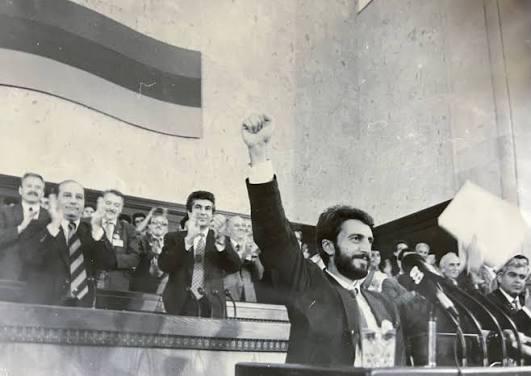

36 years ago today, on August 23, 1990, in Yerevan, Armenia declared its independence from the Soviet Union. The Supreme Council of the Armenian SSR adopted the Declaration of Independence, renaming the country the Republic of Armenia and setting in motion the restoration of Armenian statehood 70 years after the fall of the First Republic.
The Declaration was read aloud from the podium of the Supreme Council by the deputy Aram Manukyan, a member of the Pan-Armenian National Movement newly elected from Vanadzor. He had been chosen for the honor because he shared his name with Aram Manukian, the founder of the First Republic of Armenia in 1918. The symbolism was intentional. To signal that the new Republic was the direct continuation of the one Sovietization had ended, the parliamentarian with the same name as the founder of the First Republic was given the honor of reading aloud the Declaration that would restore Armenian statehood. Two Aram Manukyans, 72 years apart, declared Armenian independence.
“I was entrusted with the proclamation because of my name and surname,” Manukyan later recalled. “The founder of the first independent republic was Aram Manukyan and I was his namesake. Actually, we continued the activity of the First Republic.” Of the referendum vote that would follow in September 1991, he said: “Some of our friends had already been killed in action. And those fighting did not see it. I was reading out for them.”
The Declaration was signed by the Chairman of the Supreme Council Levon Ter-Petrosyan and by the Secretary Ara Sahakian, and adopted point by point in 12 separate votes. It established the country’s own flag, coat of arms, and national anthem. It created a right of return for the Armenian diaspora. It declared the sovereignty of the Republic over its own currency, military, banking system, and internal security. It guaranteed free speech, free press, and a division of powers between the judicial, legislative, and executive branches. In the words of American Supreme Court Chief Justice Warren Burger, the Declaration was the promise. The Constitution of 1995 would become its fulfillment.
The Declaration committed the Republic to supporting international recognition of the Armenian Genocide of 1915 in the Ottoman Empire and Western Armenia. International recognition of the Genocide became a founding commitment of the modern Armenian state.
The Declaration was adopted at the peak of the Karabakh movement. Two years earlier, in February 1988, hundreds of thousands of Armenians had marched in Yerevan demanding the reunification of Nagorno-Karabakh with Armenia. In December 1989, the Supreme Councils of the Armenian SSR and Nagorno-Karabakh had passed a joint decision on reunification. The Declaration of Independence incorporated that decision into the founding of the new Republic.
The Declaration also grounded itself in Armenian statehood history. It named the First Republic of Armenia, founded on May 28, 1918 and lost to Sovietization in December 1920, as its direct historical predecessor. After 70 years of Soviet rule, the Armenian people were restoring the state Sovietization had ended.
The day after the Declaration was adopted, on August 24, 1990, the Supreme Council adopted the law establishing the Armenian tricolor of red, blue, and orange as the national flag. The tricolor had first flown over the First Republic in 1918. It had been outlawed for 70 years. On the second day of Armenia’s return to sovereignty, it flew again.
His Holiness Vazgen I, the 130th Catholicos of All Armenians, formally blessed the Declaration in the Supreme Council chamber on the day of its adoption. The spiritual leader of the Armenian nation stood in the same room as the political leadership that was ending Soviet Armenia. He gave the document the sanction of the Armenian Apostolic Church.
The Declaration did not, on its own, produce full independence. That came 13 months later, on September 21, 1991, when 99% of voters in a national referendum voted to leave the Soviet Union. Full independence was declared on that date, and the Republic of Armenia became a sovereign state on the international stage. Levon Ter-Petrosyan was elected as its first president in October of that year with 83% of the vote.
The Declaration of August 23, 1990 was the moment the Republic of Armenia legally existed for the first time in the modern era. The referendum ratified what the Declaration had already claimed.
The original copy of the Declaration is preserved today at the History Museum of Armenia, in the exhibition hall dedicated to the Third Republic. Article 1 of the 1995 Constitution of the Republic of Armenia, still in force today, references the Declaration of Independence in its preamble. The founding document of the modern Armenian state was written 36 years ago. Its 12 provisions still define the Republic that exists today.