
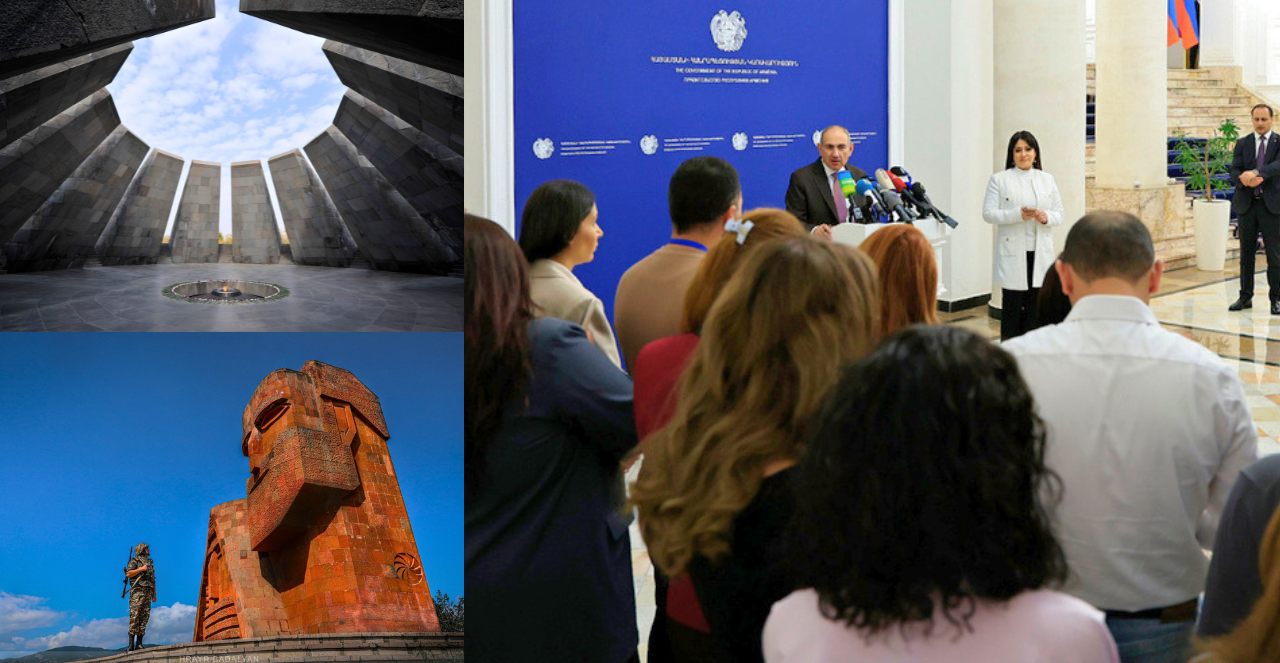

Armenian Prime Minister Nikol Pashinyan said on March 26 that he rejects the agenda of restoring so-called “historical justice” and argued that the demand for international recognition of the Armenian Genocide, along with the broader “return” narrative, has kept Armenians in a refugee mentality, preventing the creation of the Republic of Armenia as a state and pushing the country toward renewed conflict as Armenia approaches parliamentary elections scheduled for June 7.
Speaking at a Cabinet meeting and later to journalists, Pashinyan said Armenia must shift away from historical narratives and focus instead on building a just reality in the present. His remarks come amid ongoing debates in Armenia over the country’s peace strategy, the future of displaced Armenians from Artsakh, and broader questions of statehood, sovereignty, security, and national identity.
“I completely reject the agenda of restoring so-called historical justice,” Pashinyan said. “I believe we should pursue a just reality, not the restoration of historical justice. The more we pursue historical justice, the more we will face new historical injustices.”
Pashinyan said the demand for international recognition of the Armenian Genocide, along with the broader “return” narrative, has kept Armenians trapped in a refugee mentality for generations. He argued that this has worked against the creation of the Republic of Armenia as a state and has encouraged a mindset in which Armenians are taught not to settle, but to wait for a future return.
Pashinyan said Armenians have been living with that expectation for 100 years, describing it as an “imperial” and “anti-Armenian” policy under which people are told not to calm down because they will return, or “we will return,” after the international recognition of the Armenian Genocide, and then return to Van, Mush, Cilicia, and other historic Armenian lands.
According to Pashinyan, this policy pursues two goals: first, to preserve a refugee mentality within the Armenian people, and second, to prevent the creation of the Republic of Armenia as a state.
The prime minister also suggested that rhetoric centered on genocide, ethnic cleansing, and historical return can become part of a cycle that fuels regional hostility rather than solving current national challenges.
“Enough feeding our people with data about genocides. This competition of genocides must be stopped. In our region, everyone accuses everyone of genocide. Talks about genocides create new talks about genocides,” Pashinyan said.
Addressing the September 2023 Azerbaijani ethnic cleansing and military offensive in Artsakh (Nagorno-Karabakh) and the displacement of more than 100,000 Armenians from Artsakh following Azerbaijan’s military takeover, Pashinyan said he considers the use of terms such as “ethnic cleansing” and genocide rhetoric to be harmful if they deepen confrontation without improving the situation of those who were forced to flee.
“I consider that rhetoric harmful,” Pashinyan said. “We may say ‘ethnic cleansing,’ and in response receive mirrored accusations of ethnic cleansing, genocide, and so on. That means entering a path of conflict.”
He emphasized that peace is not only a political concept, but also a socio-psychological one.
“We talk a lot about peace, but I want to emphasize that peace is not only a political concept, but also a socio-psychological one,” Pashinyan said.
He said he wanted to note and condemn all tendencies aimed at keeping Armenians displaced from Artsakh, and the Armenian people as a whole, in the status of wanderers.
According to him, when Armenians speak about return, they are essentially the first to prevent those displaced from Artsakh from calming down and coming to terms with their situation.
“This is very important, because peace is not just an agreement, peace is when a person calms down, understands, and does not keep a suitcase ready. There is nothing more cruel and painful than waiting,” he said.
“Peace is not only an agreement, but a state of mind,” he added.
“In a country where the social psychology of refugees prevails, where we are supposed to go somewhere else, this is not a place where we should stay, such a state cannot be built,” Pashinyan said.
He went on to argue that Armenia has established peace at the political level, but that this alone is not enough.
“We have established peace at the political level, but when we talk about care, it means that we also need peace at the socio-psychological level. Otherwise, we will not find peace and will lose it,” Pashinyan said.
He warned that continuing these narratives leads Armenia into conflict with everyone around it.
“Continuing these narratives leads us into conflict with everyone around us. Then we realize that our resources are insufficient and start seeking guarantees at the expense of our sovereignty, independence, and statehood,” Pashinyan said.
Instead, he said his government’s priority is practical, ensuring that displaced Armenians from Artsakh can live in peace and dignity, with access to housing, employment, security, safety, protection of rights, and freedom, alongside broader efforts to stabilize conditions within Armenia.
“My concern is what should be done so that our people displaced from Karabakh can find peace and have homes, jobs, security, safety, and freedom,” he said.
Pashinyan also argued that dangerous narratives have kept Armenians, including displaced Artsakh Armenians, trapped in a mindset of permanent dispossession, false hope, instability, and prolonged uncertainty.
He called on society to move away from what he described as a refugee or expatriate mentality and instead fully embrace Armenia as its permanent home.
“We have reached home, and Armenia is our home,” Pashinyan said, urging citizens to take ownership of the state rather than view it as a temporary shelter before some eventual return elsewhere.
Pashinyan also rejected the view that Armenia had peace before the 2020 war, saying the country had only a “frozen war.”
“We did not have peace, we had a frozen war,” Pashinyan said. “We postponed the war at the expense of our sovereignty, independence, statehood, welfare, freedom, and development. By 2016, all resources to postpone the war had already been exhausted.”
He further warned that if the return narrative is set in motion, it could lead to devastating regional consequences and renewed instability.
Pashinyan further argued that some forces have sought to preserve Artsakh Armenians in a prolonged refugee-like condition by holding out unrealistic expectations, whether through international recognition campaigns or hopes tied to historic frameworks such as the Treaty of Sèvres.
He also took aim at former Armenian and Artsakh authorities, saying they had kept the people of Artsakh in a hostage-like situation for unclear purposes, while his government is trying to move the country toward a more realistic and sustainable national strategy.
At the same time, Pashinyan confirmed that his Civil Contract party will seek a constitutional majority in parliament, which would allow it to initiate the adoption of a new constitution, including removing references to the 1990 Declaration of Independence from the preamble.
That declaration references a 1989 act on unification between Soviet Armenia and Artsakh, a point long criticized by Azerbaijani President Ilham Aliyev and other Azerbaijani officials as implying territorial claims against Azerbaijan. Azerbaijani officials have repeatedly linked the issue to the broader peace process.
Under Armenian law, such a constitutional change would require a national referendum. Pashinyan said his government would continue to advocate for constitutional reform regardless of potential setbacks.
“We will go and persuade our people, explain to them,” he said. “I am convinced that whatever we discuss with our people honestly and fairly, they will understand.”
In one of his remarks, Pashinyan referenced Armenia’s recognition of its territorial integrity, saying that in Prague in October 2022 he made a decisive choice to affirm that principle as necessary for the country’s long-term statehood and survival.
He said that what ultimately gave him the confidence to speak openly on these sensitive issues was his recent interaction with citizens across Armenia.
“I consider it my duty to share this with our people,” Pashinyan said, adding that even for a prime minister, it takes courage to speak so directly on such matters.
Pashinyan said he believes Armenians will support this course because it offers a serious opportunity to better understand and defend the country’s true national interests.
The constitutional debate is unfolding alongside continued tensions between the government and opposition forces. Opposition groups have criticized the government’s approach following military setbacks in Artsakh and subsequent border developments, arguing that concessions made in the peace process could have long-term consequences for Armenia’s security.
Pashinyan has rejected those claims, warning that attempts to revise the current framework of agreements with Azerbaijan could lead to renewed conflict with serious consequences for Armenia.
Earlier this week, National Assembly Speaker Alen Simonyan echoed similar themes, questioning the use of the name Artsakh and explicitly stating that “Karabakh is Azerbaijan’s.”
Speaking to journalists, Simonyan argued that Armenia’s recognition of territorial integrity through the Prague process was essential to safeguarding statehood. He suggested that using the name Artsakh reflects territorial claims, drawing a parallel with the use of Azerbaijani names for locations within Armenia.
“Why do you say ‘Artsakh’?” Simonyan said. “Karabakh is Azerbaijan’s, why use another name?”
Simonyan also defended the government’s constitutional reform agenda, including discussions around removing references to the Declaration of Independence, arguing that the new situation requires new solutions.
His remarks came amid heightened domestic tensions following a recent public incident involving Pashinyan and a displaced woman from Artsakh in the Yerevan metro. The exchange, which centered on differing perceptions of Armenia’s territorial map and the loss of Artsakh, further fueled debate over identity, displacement, and the government’s peace strategy.
As the election campaign approaches, the government is increasingly framing its strategy around securing stability and institutional development within Armenia, while critics question whether this approach adequately addresses issues of justice, security, and national identity.


