
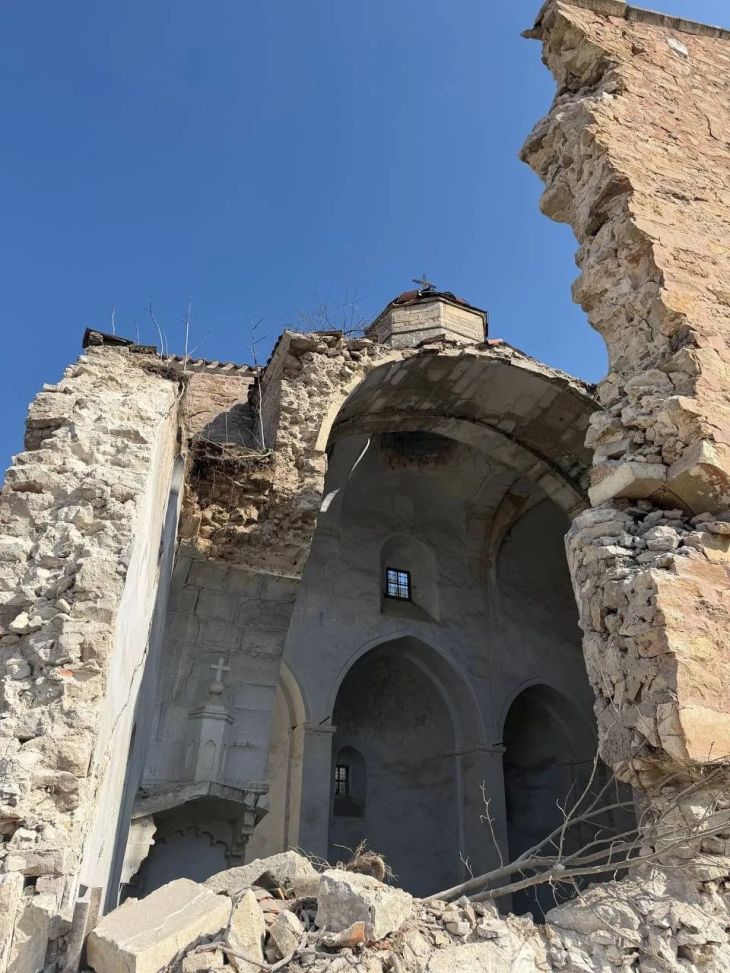

A second collapse in just months has struck the 15th-century Armenian Church of the Archangels Michael and Gabriel in Feodosia, Crimea, after part of the historic structure gave way in mid-March following the earlier partial and then total collapse of its bell tower this winter. The repeated damage has triggered a criminal investigation, prompted prosecutors to fault local authorities for failing to protect the cultural heritage site, and pushed officials to move toward a full restoration of one of the region’s oldest Armenian religious monuments.
Following the incidents, Russia’s Investigative Committee opened a criminal case to determine the circumstances surrounding the damage. The case has drawn the attention of Investigative Committee head Alexander Bastrykin after concerned residents filed complaints over the site’s condition. On March 11, prosecutors concluded that local authorities had failed to take timely measures to preserve the cultural heritage monument, in violation of legal requirements.
The 15th-century Armenian church, built in 1408 and located in Feodosia’s historic district on Armenian Street, is a federal cultural heritage site. The church has been inactive for years and remains closed to visitors, with access restricted by locked gates. Built in the style of medieval Armenian architecture with Romanesque elements, it features carved limestone masonry, finely hewn stone arches and corners, as well as preserved fragments of murals and original tiled flooring. The last major restoration works were carried out between 1967 and 1970.
A section of the church collapsed in mid-March, according to RIA Novosti Crimea and local reports, when part of the building’s corner gave way. Earlier this winter, the church’s hexagonal stone bell tower partially collapsed on January 12 and later fully collapsed in February.
Authorities say the site had been transferred several years ago to the Armenian Apostolic Church under a free-use agreement, placing responsibility for its preservation on the Church. According to Feodosia’s deputy head of administration, Yulia Filatova, the Armenian Apostolic Church and the local Armenian community had commissioned a preventive stabilization project prior to the collapses. Due to the recent damage, however, that plan is now being revised to focus on full restoration instead.
Criticism has emerged in recent months, with some accusing local authorities of neglecting the centuries-old monument and delaying restoration efforts. In response, officials say urgent measures have been discussed, including dispatching specialists to assess the structure and prepare a technical report. Experts from the regional Ministry of Culture’s heritage protection department are expected to evaluate the site and provide recommendations.
The preparation of a restoration project is expected to take approximately three months, followed by a state review. While authorities say the process is being expedited, no exact start date for the restoration has yet been set. “Once financing is allocated, a licensed contractor will be selected, and only then will we have a clearer timeline,” Filatova said.
The cost of restoration remains unknown and will be determined after the project undergoes expert evaluation. Officials say the city budget alone cannot cover the expenses, describing the work as costly, and are therefore relying on support from regional and federal authorities. Feodosia has already submitted a request for such assistance following the initial collapse of the bell tower.


