
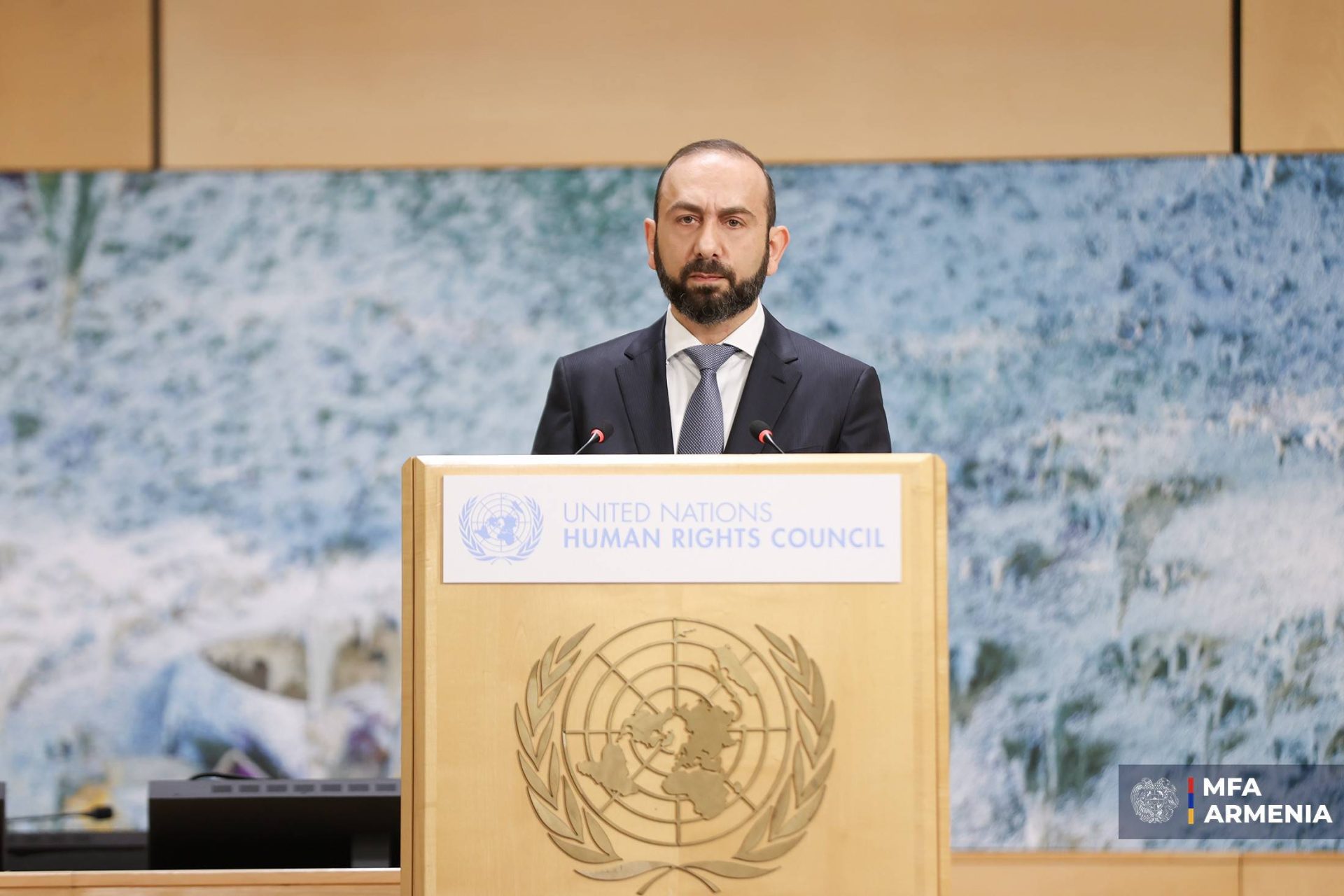

Armenian Foreign Minister Ararat Mirzoyan told the UN Human Rights Council in Geneva on Monday that urgent humanitarian consequences of the conflict remain unresolved, including 19 Armenians detained in Baku and the need to clarify the fate of missing persons and cases of enforced disappearances, while reaffirming that Armenia has chosen the “difficult path of reconciliation” with Azerbaijan.
Speaking at the high-level segment in Geneva, Mirzoyan acknowledged the ongoing humanitarian consequences of the conflict between Armenia and Azerbaijan, including the continued imprisonment of 19 Armenian detainees in Baku and unresolved cases of missing persons and enforced disappearances.
“Though the painful humanitarian consequences of the conflict are still to be resolved and the wounds of the distant and recent past linger on, we have chosen the difficult path of reconciliation,” Mirzoyan said. “This is indeed a difficult endeavor with 19 Armenian detainees still being held in Baku, and need for clarification of the fates of missing persons and cases of enforced disappearances, and amid dissemination of distorted historical narratives.”
In Geneva, Mirzoyan focused primarily on what he described as progress toward long-term peace following agreements reached at the Washington Peace Summit last August, hosted by U.S. President Donald Trump. He said the process has opened new prospects for regional trade, connectivity, and people-to-people engagement.
“Nevertheless, Armenia remains firmly committed to pursuing this path to its future-oriented conclusion with the understanding that further institutionalization of peace will foster a more conducive environment for addressing the consequences of the conflict,” Mirzoyan stated.
He emphasized that Armenia has chosen the “difficult path of reconciliation,” seeking not only intergovernmental agreements but also broader societal dialogue and trust-building. At the same time, he cautioned that reconciliation efforts are complicated by lingering grievances and what he described as distorted historical narratives.
Despite referencing the detainees, Mirzoyan did not explicitly condemn the lengthy prison sentences handed down earlier this month to eight former leaders of Artsakh (Nagorno-Karabakh) who were captured by Azerbaijani forces in 2023.
Five were sentenced to life imprisonment, while three received 20-year prison terms following trials widely criticized by Armenian lawyers and human rights advocates as politically motivated. Amnesty International last week described the convictions as “a travesty.”
The Armenian government has not formally commented on the sentences, prompting criticism from opposition figures who accuse Prime Minister Nikol Pashinyan’s administration of failing to defend the detainees publicly. In January 2025, Pashinyan argued that overt condemnation could negatively affect the defendants’ situation. Critics have countered that the government is avoiding confrontation with Azerbaijani President Ilham Aliyev in pursuit of its broader peace agenda.
Earlier this month, Aliyev rejected calls for clemency, comparing the imprisoned former Karabakh officials to Nazi leaders prosecuted after World War II and describing their trials as “absolutely transparent.”
The remarks underscored the delicate balance facing Armenia’s leadership as it advances diplomatic normalization efforts with Azerbaijan while humanitarian and accountability concerns remain unresolved.


