
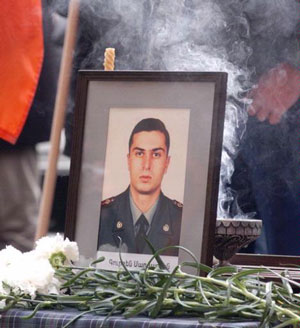

22 years ago today, on February 19, 2004, Armenian officer Gurgen Margaryan was killed in Budapest during a training program organized within NATO’s Partnership for Peace framework.
Margaryan and Azerbaijani officer Ramil Safarov were attending English-language courses alongside other officers. In the early hours of February 19, Safarov entered Margaryan’s locked dormitory room and attacked him with an axe while he was asleep. He then attempted to enter the room of another Armenian officer, Hayk Makuchyan, but was unable to do so because the door was locked.
Safarov was arrested at the scene. During both his interrogation and court trial, he stated that he killed Margaryan because he was Armenian.
On April 13, 2006, a Budapest court sentenced Safarov to life imprisonment, with the possibility of parole after 30 years. The ruling was later upheld on appeal.
In 2008, during a visit to Yerevan, Hungary’s then-foreign minister, Kinga Göncz, addressed the possibility of Safarov’s transfer to Azerbaijan. She stated that while such an option existed, Hungary had no obligation to carry it out.
Göncz described the murder as a shock and a horror for Hungarian society and said all issues related to Safarov would be considered very seriously. “There is a possibility of returning Safarov, but Hungary has no such obligation. The most important question is whether Safarov will serve a life sentence in Azerbaijan or not,” she said.
On August 31, 2012, Safarov was extradited from Hungary to Azerbaijan. Prior to the transfer, Azerbaijan’s Justice Ministry had assured Hungarian authorities that he would continue serving his sentence there. However, only hours after arriving in Baku on a special flight operated by Azerbaijan Airlines, Azerbaijani President Ilham Aliyev signed a decree granting him a full pardon. The order took effect immediately. Safarov was released, promoted in rank, and publicly honored.
On the same day, Armenia severed diplomatic relations with Hungary. Diplomatic ties between Yerevan and Budapest were restored in December 2022.
The case was later examined by the European Court of Human Rights, which ruled in 2020 that Azerbaijan had violated the European Convention on Human Rights in its handling of Safarov’s release, while not establishing a direct link between the Azerbaijani state and the murder itself.
At the end of last year, Azerbaijani media reports, cited by Khroniki Kavkaza, indicated that Safarov had been promoted to the rank of colonel in Azerbaijan.


