
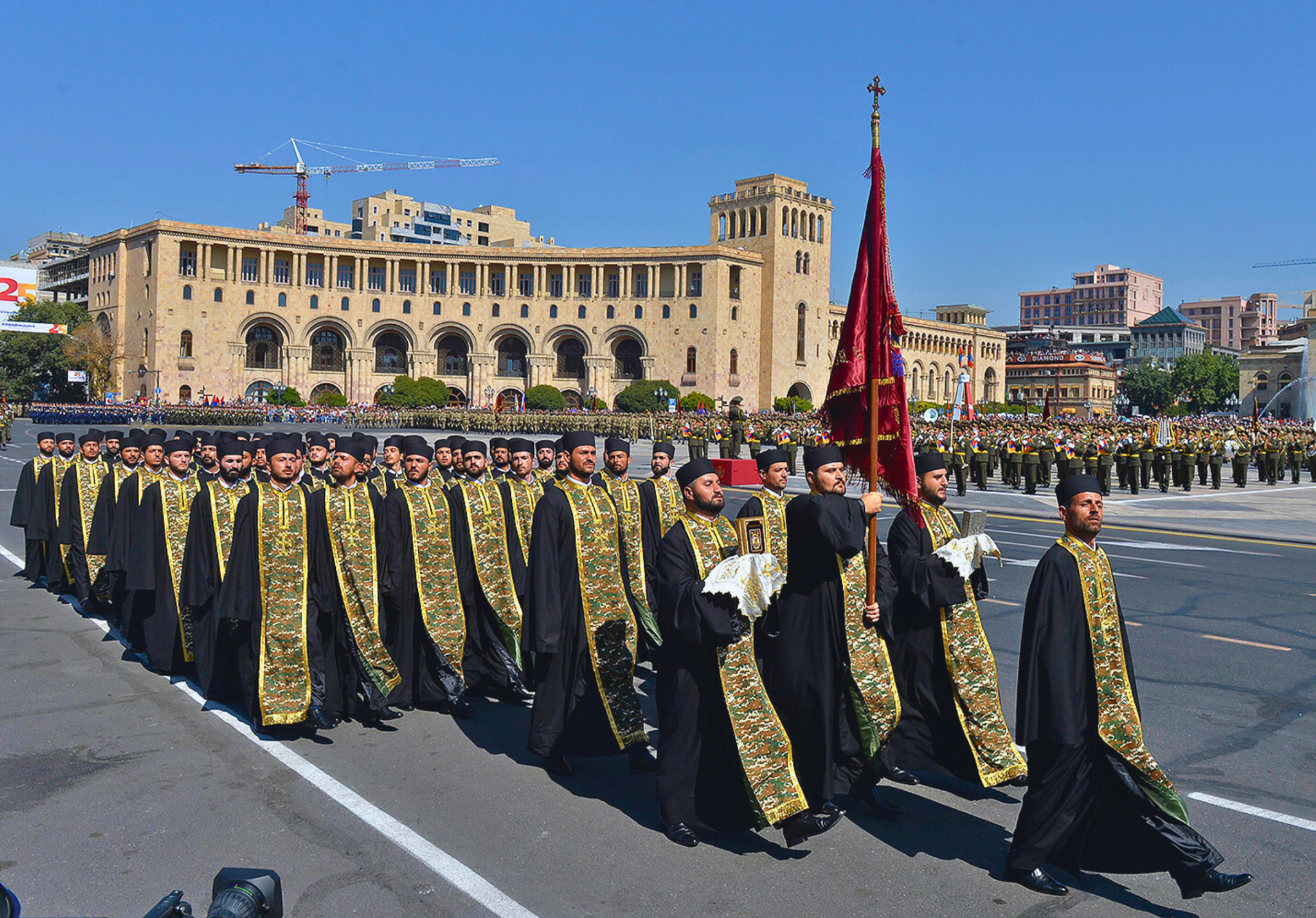

Armenia’s Defense Minister Suren Papikyan has ordered the termination of the Armenian Apostolic Church’s chaplaincy service within the Armed Forces, ending the activities of the head of the spiritual service and all clergy appointed within the Ministry of Defense system effective February 1, 2026, according to an order he published on January 30.
The order shifts responsibility for spiritual service to the General Staff’s Moral and Psychological Support Department under the direct subordination of unit commanders, outlines how clergy serving as conscripts will be reassigned under standard compulsory service procedures, and has triggered sharp condemnation from clergy and opposition figures, who say the move targets those resisting Prime Minister Nikol Pashinyan’s church “renewal” roadmap aimed at removing Catholicos Karekin II.
The order also addresses the status of clergy currently serving compulsory military service.
It instructs that conscripted enlisted personnel who are clergy of the Armenian Apostolic Holy Church must have their military service organized in accordance with the procedures established by law for compulsory enlisted servicemen.
After completing the required training program, and upon the recommendation of their unit commander, with approval from the General Staff’s Moral and Psychological Support Department, such individuals may be appointed to the military positions of senior chaplain or chaplain.
Until the new system takes effect, existing senior and junior military chaplains will continue to carry out their duties under the overall coordination of the General Staff’s Moral and Psychological Support Department and the direct supervision of their unit commanders.
Within three days of the order’s entry into force, proposals must be submitted to establish positions for senior and junior chaplains holding the military ranks of major and captain. One of the key requirements for these positions will be having received theological education from the Armenian Apostolic Church.
The decision has sparked strong criticism from clergy and opposition figures.
Deacon Samvel Grigoryan described the move as a serious setback, stating: “Dissolving the Armed Forces’ spiritual chaplaincy and closing church doors to soldiers, the wounded, and medical staff is not merely an administrative step. It is an unprecedented regression in our modern history, undermining the spiritual security of our army and our people.”
Opposition MP Gegham Manukyan also sharply criticized the decision during a Facebook broadcast, arguing that Defense Minister Suren Papikyan had effectively overturned a policy initiated during the tenure of the late Defense Minister Vazgen Sargsyan.
“Just imagine, by Papikyan’s order, Vazgen Sargsyan’s initiative has been canceled. From February 1, there will be no spiritual service or leadership in the army. The chaplaincy institution will cease to exist. Everyone, including chaplains, must become regular military personnel,” Manukyan said.
He emphasized that the chaplaincy institution was established through the joint initiative of the late Catholicos Karekin I and Vazgen Sargsyan, and that chaplains had served alongside Armenian soldiers even during periods of active combat.
According to Manukyan, the decision signals that Armenia’s current leadership no longer sees the need for spiritual service within the Armed Forces. “The Kanaker Church, the army’s church, will no longer see soldiers who once regularly attended Sunday liturgies. The Holy Cross of Ashot Yerkat, which symbolized the spiritual backbone of our military, will no longer be connected to the army,” he said.
He described the move as an attack on the Armenian Apostolic Church. “This is a cowardly, malicious, sectarian, and hostile campaign. They saw that despite pressure, not a single chaplain betrayed the Catholicos, just as none betrayed the homeland during war. Realizing they could not break them, they chose to dismantle the entire system,” Manukyan said.
Further details surrounding the decision emerged from the clergy.
About a week before the order was announced, a meeting reportedly took place at the Ministry of Defense to which military chaplain-deacons were invited, while priests were excluded. This was reported to Shoghakat Television by Priest Psak Mkrtchyan.
According to Father Psak, the meeting was attended by Defense Minister Suren Papikyan and the Chief of the General Staff. “The deacons were directly approached in an attempt to determine their stance on the so-called ‘reform program’ and to extract as much support for it as possible,” he said.
The reform program refers to the so-called “roadmap for renewal” of the Armenian Apostolic Church proposed by Nikol Pashinyan in early January, which aims to remove Catholicos Karekin II.
The Spiritual Leadership of the Armed Forces of the Republic of Armenia was originally established on November 13, 1997, through the joint initiative of the late Catholicos Karekin I and then-Defense Minister Vazgen Sargsyan.
Father Psak said the deacons were directly asked if they supported the initiative and refused. He added that senior military officials then visited units to reassess their positions. “In some cases, there was psychological pressure. They were not even allowed to contact the spiritual leader. At times, false information was spread, claiming he had agreed, when in reality this was not the case,” he said.


