
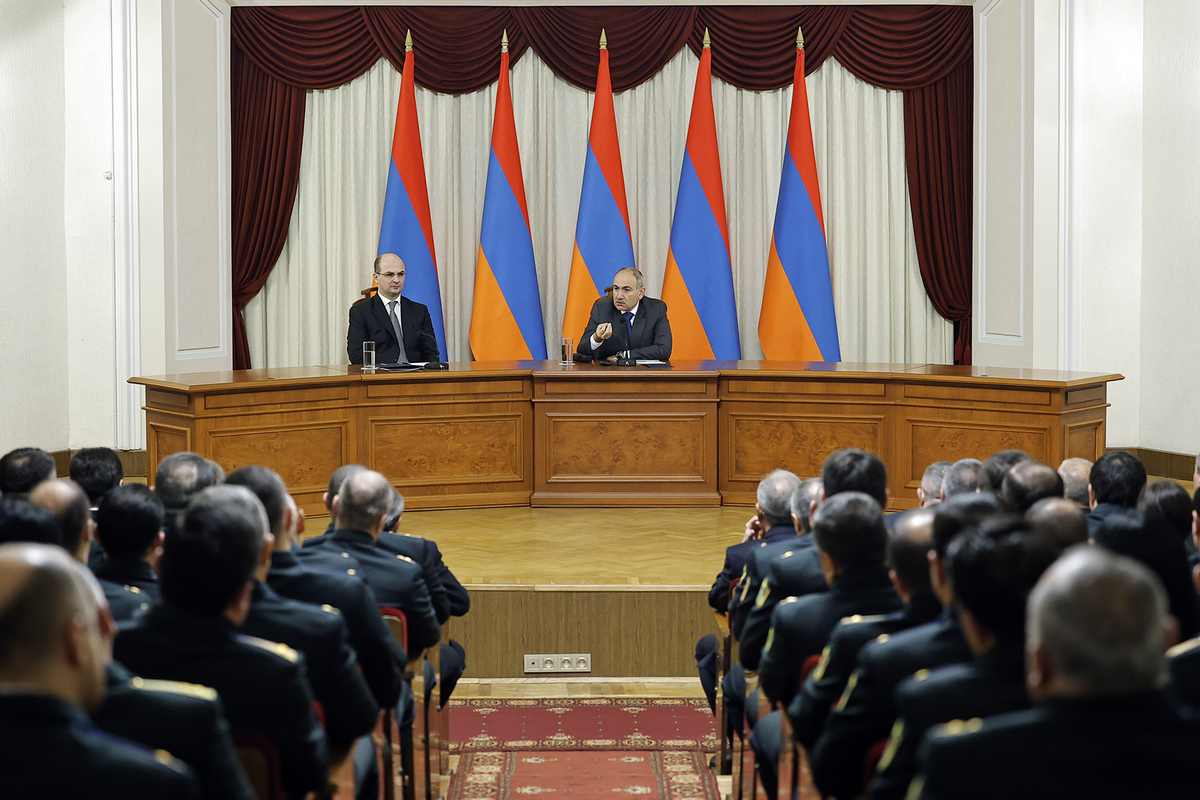

Armenian Prime Minister Nikol Pashinyan held a press conference on Thursday during which he addressed a range of issues, including Armenia’s economic transformation under the peace agenda, ongoing discussions with Azerbaijan on potential trade, and the government’s confrontation with the Armenian Apostolic Church.
On Thursday, Pashinyan linked regional peace to economic reform while also responding to criticism surrounding tensions between the authorities and the Church.
Armenia and Azerbaijan Exchange Preliminary Trade Lists
During the press conference, Pashinyan announced that Armenia and Azerbaijan have exchanged preliminary lists of goods that could be of mutual interest for trade. He emphasized that the process remains exploratory and does not yet involve binding agreements.
“The exchange of lists reflects a process in which both sides are assessing which products they may be interested in buying and selling,” he said. “When there are concrete developments, the public will be informed.”
According to the prime minister, these discussions are part of Armenia’s broader effort to reassess its economic positioning in the region under conditions of peace, including improved access to markets and logistics routes.
Fuel Imports and Market Assessment
On the issue of fuel, Pashinyan said that during a meeting between the deputy prime ministers of Armenia and Azerbaijan, the Azerbaijani side expressed readiness to sell petroleum products to Armenia. Following this proposal, the Armenian Cabinet of Ministers conducted an assessment of the domestic fuel market and informed business operators that importing Azerbaijani fuel was a possible option.
Pashinyan stressed that Armenian companies are neither required to purchase fuel from Azerbaijan nor restricted from doing so.
“The market and the opportunity are open to everyone,” he said. “Any company that wishes can take advantage of it.”
Two Armenian companies have already established contacts with Azerbaijani counterparts regarding fuel imports, marking the first practical steps toward economic engagement.
The prime minister acknowledged that the first batch of Azerbaijani fuel faced resistance, with some gasoline station chains refusing to sell it. He described this as effectively amounting to a boycott and said it confirmed earlier government concerns that economic cooperation, particularly in sensitive sectors such as fuel, could become politicized.
The first batch of petroleum products was imported into Armenia from Azerbaijan on December 19: a train carrying 1,218 tons of A-95 gasoline arrived at the Ayrum railway station via Georgia.
The second batch of fuel is expected to arrive soon, with several thousand tons being shipped from Azerbaijan, Minister of Economy Gevorg Papoyan announced today.
Economy Reshaped by the Peace Agenda
Pashinyan also noted during the Cabinet meeting on Thursday that Armenia is, for the first time, consciously shaping its economic policy based on the assumption of stable regional peace. According to him, the peace agenda is not only a diplomatic objective but also a transformative economic factor that affects markets, competitiveness, and institutional reforms.
“The peace agenda radically changes the structure of the economy, the competitive environment, access to logistics and export markets, creating completely new opportunities for development,” he added, linking the country’s broader economic strategy to both domestic reforms and ongoing regional normalization efforts.
He stressed that Armenia’s economic and institutional transformation doctrine is increasingly conditioned by the evolving regional and foreign policy environment. In his words, peace and its institutionalization are among the government’s top priorities and must inevitably find expression in economic policy.
“In conditions of peace, the economy must also be transformed and repositioned. This is happening today, right before our eyes,” Pashinyan added.
The prime minister also highlighted Armenia’s fiscal achievements, noting that the revenues of the 2025 state budget were implemented at 100.2 percent, slightly overachieving the planned targets. He explained that the state budget should be understood as a statement of intentions rather than a literal sum of money waiting to be spent.
Pashinyan: Catholicos To Leave Just Like Third President Serzh Sargsyan
During the press conference, Pashinyan addressed the growing confrontation with the Armenian Apostolic Church, saying that the Catholicos of All Armenians Karekin II may eventually have to leave his position, drawing parallels to the political exit of former President Serzh Sargsyan.
Armenia’s Prime Minister Serzh Sargsyan stepped down in April 2018 after ten days of unprecedented street protests led by Pashinyan.
Speaking at the press briefing, Pashinyan stated, “Serzh Sargsyan also had no intention of leaving, but he had to leave. And the same applies to Ktrich Nersisyan (Catholicos of All Armenians Karekin II), who will have to leave.”
Addressing questions about Karekin II’s reported reluctance, the Prime Minister added, “You say that Ktrich Nersisyan has no intention of leaving. We are going to make it so that he changes his intention. No one has any intention of leaving.”
Pashinyan emphasized that any transition would be carried out “without shocks and in a manner imbued with Christian tolerance and love.”
In the same briefing, the Prime Minister spoke about a new initiative for church reform, saying that a declaration signed by ten bishops is open to others, including the Catholicos, who may wish to join. He explained, “The declaration outlines a new framework for the Armenian Apostolic Church, which should include not only rules for clerical ethics but also mechanisms to ensure these rules are followed. The Armenian people have been distanced from the Church because of the leadership’s practices that isolate the Church from the people.”
Pashinyan assured that the government’s goal is to restore unity between the Church and the public. Commenting on the recent Christmas procession, he said it was attended by a large crowd, including officials, citizens, mothers of fallen soldiers, and visitors from abroad. He emphasized that officials were only a small minority among participants, responding to criticism about their presence. “If officials and their colleagues had boycotted, people would have said Armenia is facing a governance crisis,” he noted.
The Prime Minister also addressed his own role in the reform discussions, stating that he acts both as a citizen and as the Prime Minister. “If I had written the statement on the creation of the so-called coordination council for the ‘reforms’ of the Armenian Apostolic Church not as the Prime Minister of Armenia, but as a citizen, I would have been asked today: ‘Why did you organize the meeting at the residence of the Prime Minister of Armenia, and not at your house in Ijevan?’” he said.
“I am now appearing before you as the Prime Minister. Am I not a citizen? I am a citizen of the Republic of Armenia and a follower of the Armenian Apostolic Holy Church,” Pashinyan added. He assured that he sits among the bishops “As a sinner, like any follower of the Armenian Apostolic Church.”
Observers note that Pashinyan’s recent statements represent one of the most direct government interventions in church affairs in recent years, raising questions about the potential implications for the Church’s autonomy and for relations between the state and religious institutions in Armenia.
In December, around 30 civil society organizations and individuals issued a joint statement expressing deep concern over what they described as escalating violations of Armenia’s Constitution, the rule of law, and fundamental rights, including the autonomy of the Armenian Apostolic Church. The signatories accused state authorities of unlawfully interfering in church governance, pressuring clergy through law-enforcement bodies, selectively using criminal justice tools, and using hate speech against religious figures.
Warning that such actions could deepen social polarization, they stressed that any reform within the Church must take place internally, in line with constitutional guarantees and Armenia’s international legal obligations.


