
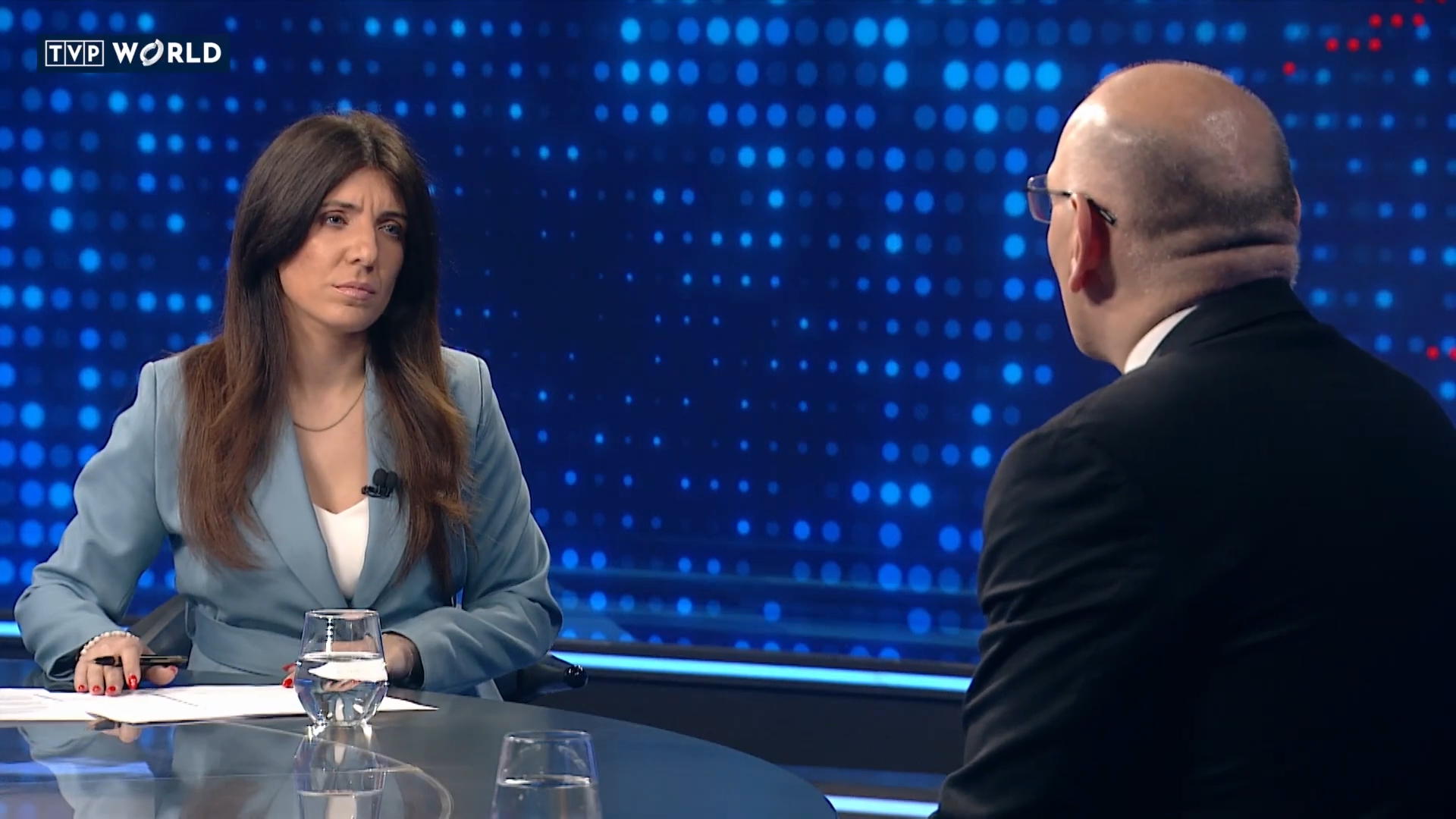

On December 12, Elchin Amirbayov, the Representative of the President of Azerbaijan on Special Assignments, appeared live on TVP World’s World Talks in Warsaw, where he categorically denied that Azerbaijan holds any Armenian prisoners of war, dismissed reporting by Armenian media outlets and Amnesty International, accused detained Armenians of sabotage, and defended their ongoing trials in Baku. His statements, delivered during a discussion on Armenia-Azerbaijan relations and regional diplomacy, were repeatedly challenged on air and stand in direct contrast to Armenian reporting and international human rights documentation. The exchange concluded with Amirbayov exiting the set early while the broadcast was still live, as the program moved into its closing remarks.
The interview was conducted by Diana Skaya, a Polish-Armenian journalist and news anchor for TVP World based in Warsaw, Poland’s first English-language news channel, which covers global developments from a Polish and Central European perspective. Skaya was born in Yerevan and previously worked as a correspondent for Horizon Weekly in Montreal.
Claims Of A ‘Historic Year’ In Armenia-Azerbaijan Relations
Addressing Armenia-Azerbaijan relations, Amirbayov repeatedly framed recent developments as a historic turning point, claiming that “2025 will go into history as a historic year in the relations between Armenia and Azerbaijan,” following what he described as three decades of conflict. He pointed to the August 8 summit in Washington and the initialing of a draft peace agreement as evidence of what he called “lasting and irreversible peace,” describing it as “just the beginning of a long relationship.”
Later in the interview, Amirbayov acknowledged that the agreement has not been signed, stating that it was only initialed and that its formalization depends on Armenia bringing its constitutional framework “into compliance with the letter and spirit” of the draft agreement. Armenian officials have consistently stated that no final peace agreement has been concluded and that several core issues remain unresolved.
When asked to identify what he described as the root cause of the conflict, Amirbayov asserted that “the main reason of this conflict has been taken over, taken out,” attributing it to what he characterized as “the territorial claim from the Armenian side to Azerbaijan.” This framing is rejected by Armenian analysts and civil society actors, who point instead to the security, rights, and protection of the Armenian population of Artsakh, particularly in the context of repeated military escalations, blockades, and the eventual mass displacement of its population.
Amirbayov further claimed that Azerbaijan had “restored its territorial integrity and sovereignty,” and said that after “two and a half years of discussions,” the sides agreed in 2025 to the text of a draft peace agreement, reaffirmed in Washington in the presence of the leaders of Armenia, Azerbaijan, and the United States. While the Armenian government has pursued diplomatic engagement through international platforms, Armenian legal experts and human rights groups continue to stress that normalization cannot be separated from humanitarian law obligations, accountability, and the unresolved issue of Armenians detained in Azerbaijan.
Connectivity Projects And Armenia’s Position
Promoting regional connectivity projects, Amirbayov described initiatives such as the so-called Zangezur Corridor and the TRIPP route as central to the peace process. He claimed the project would “link the main part of Azerbaijan with Nakhchivan,” “link Armenia and Azerbaijan,” and serve as “one of the alternative routes linking Asia to Europe,” arguing that economic interdependence would act as “one of the best insurance policies for peace.”
Armenia has consistently rejected any extraterritorial corridor through its sovereign territory, emphasizing that any regional transport routes must operate under Armenian jurisdiction and in accordance with international law. Armenian officials have stated that economic cooperation cannot come at the expense of sovereignty or be used to sidestep unresolved humanitarian and security issues.
Tourism, Free Movement, And Unanswered Safety Concerns
Skaya also asked Amirbayov whether a future peace process would allow for tourism and free movement between the two countries, specifically whether Azerbaijanis would be able to enter Armenia and whether Armenians would be able to travel freely to Azerbaijan. Amirbayov did not provide a direct answer, instead responding that the situation is “a work in progress” and describing relations as “uncharted territory,” noting that Azerbaijan and Armenia “have never lived in the conditions of peace” since independence. He framed reconciliation as a long-term process involving governments, civil society, and so-called Track 2 diplomacy, adding that peace “is not automatically brought by signatures” and must be felt “in their daily lives” by both Armenians and Azerbaijanis.
While Amirbayov spoke broadly about trust-building and suggested that borders and tourism could one day become a reality, he did not address existing concerns regarding the safety of Armenians in Azerbaijan. Armenian civil society groups and human rights organizations have long documented hostility, discrimination, and past incidents involving Armenians in Azerbaijan, raising questions about whether free movement could realistically occur without concrete guarantees for security and rights. These concerns remain unaddressed amid ongoing detentions, unresolved displacement, and the absence of mechanisms ensuring the safety of Armenians traveling to or residing in Azerbaijan.
Denial Of Armenian Prisoners Of War And Justification Of Detentions
The interview’s most contentious moment came when host Diana Skaya directly asked Amirbayov whether Azerbaijan still holds Armenian prisoners of war in Baku. Amirbayov responded categorically, stating, “No, we don’t have any prisoners of war, because all prisoners of war, they were returned to Armenia right after the end of the second Karabakh war.”
Skaya immediately challenged the claim, citing Armenian media and reports by Amnesty International indicating that Armenians remain detained in Baku and are currently facing trials. Under international humanitarian law, including the Geneva Conventions, prisoner-of-war status is determined by the circumstances of capture and participation in hostilities, not by unilateral reclassification by the detaining state.
Amirbayov rejected that characterization, insisting, “These people are not prisoners of war,” and argued that the definition was being misapplied. He claimed the detainees entered Artsakh illegally after the war ended, stating they “tried to enter illegally the territory of Azerbaijan after the end of the second Karabakh war” and were “engaged in sabotage activities.” Armenian human rights organizations and independent observers dispute this account, noting that many detainees are former Artsakh officials, servicemen, or civilians who were captured or prevented from leaving Artsakh amid Azerbaijan’s military actions.
When pressed on whether he was referring to Artsakh or Baku, Amirbayov stated that the detainees entered “the internationally recognized territory of Azerbaijan, which is Karabakh,” where they were apprehended. Asked to specify the alleged sabotage, he claimed, “They were bringing in landmines, they were trying to attack the Azerbaijani positions,” without presenting evidence during the interview.
Amirbayov further defended the ongoing trials in Azerbaijan, stating, “These are people who are now tried in justice and I think that we should respect the judiciary,” and claiming that “some of them have committed wars of crime” and “violated the Azerbaijani laws.” Armenian legal experts and international observers have repeatedly raised concerns about these proceedings, describing them as politically motivated and pointing to due process and fair trial violations documented by human rights organizations.
Earlier in the interview, Amirbayov addressed reconciliation, arguing that peace must be “based on the mutual recognition and respect of each other’s territorial integrity, sovereignty and inviolability of borders,” and claiming that both sides would need to abandon “any territorial claims to each other.” Armenian civil society groups and rights advocates have countered that reconciliation cannot be meaningful while Armenians remain detained, displaced populations remain unable to return, and allegations of ethnic cleansing and war crimes remain unaddressed.
When Skaya noted that Amirbayov’s position reflects the Azerbaijani narrative and not the Armenian one, he responded, “I’m here to speak about Azerbaijani narratives.”
Abrupt Exit During Live Broadcast
Moments later, the interview concluded with Amirbayov exiting the set early while the broadcast was still live, as Skaya delivered her closing remarks following their exchange of thanks.
Poland Visit, Energy, And Regional Context
Earlier in the program, Amirbayov discussed Poland-Azerbaijan relations, describing Poland as “one of the key partners of Azerbaijan in the European Union and NATO.” He stated that Azerbaijan’s relationship with the European Union is “multi-dimensional,” with energy as “one of the pillars,” alongside transport routes and regional connectivity linking “East and West and North and South.”


